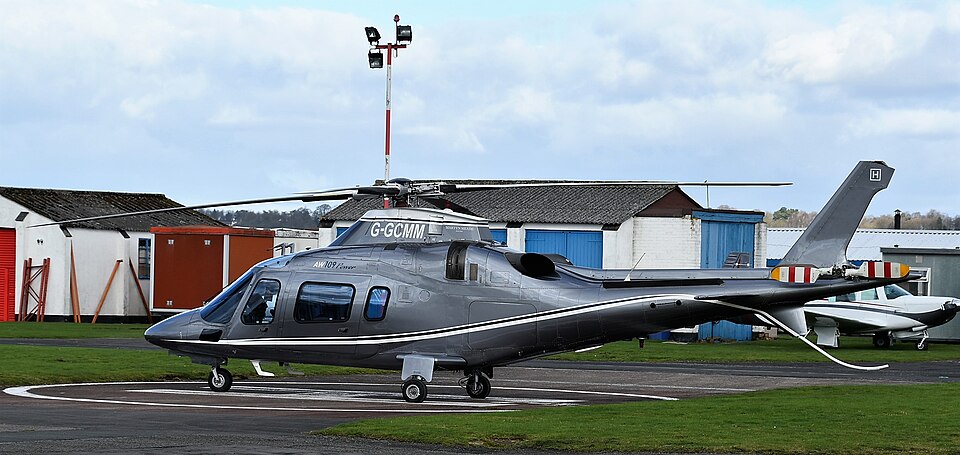
History of the Flight
The pilot of Agusta A109E G-GCMM planned to transport a passenger from an office near Stoke-on-Trent to Gloucester and then to an industrial depot in Corsham, Wiltshire. After departing Gloucester at about 1025 hrs, the passenger called the depot from a car giving 30 minutes notice. Upon arrival, the normal landing position at the depot was occupied by two articulated lorries. The pilot orbited the site to find another landing area. The passenger pointed out the depot manager, who appeared to be indicating to land at the depot entrance, and asked if the pilot could do so. The pilot conducted an airborne inspection, judged the site "tight" but large enough, and set up an approach into wind.
The Accident
As the helicopter descended into a high hover, it encountered turbulence from a warehouse, causing difficulty in controlling heading and height. Once established in a hover 5 ft above the landing area, the pilot began to lower. He felt a slight shudder at the rear, with no perceptible rotor rpm change, followed by tail rotor vibration through the rudder pedals. The landing was completed without apparent incident, but subsequently the helicopter's tail rotor blades, gearbox, and pitch change mechanism were found damaged after striking a hedge (branches 3-4 cm diameter) and a concrete post. No injuries were reported.
Video Evidence
A video recorded by an occupant of an adjacent building from about 35 m showed the moment the tail rotor struck the concrete post. Another person was observed approximately 15-20 m from the helicopter.
Pilot's Comments
The pilot noted that a private airfield about 1 nm south of the depot was available, but the passenger had previously insisted on landing at the depot. The pilot had considered landing in adjacent fields but could not determine ownership or access.
Depot Manager's Comments
The depot manager stated he learned of the passenger's arrival only about 10 minutes before the accident, having believed the passenger would arrive by road. He made hand signals hoping to indicate the pilot should not land but go to the airfield. He added that with 30 minutes notice he could have moved the lorries or arranged pickup from the airfield.
Passenger's Comments
The passenger remarked that confusion arose because he made the ETA call from a car in Gloucester. In hindsight, the helicopter should have landed at the airfield 1 nm away or at its base in Malmesbury, 9 nm north.
Discussion
The landing site was described as "tight" and possibly unsuitable for the prevailing wind conditions. In less turbulent conditions, the helicopter might have landed safely. The area was surrounded by buildings occupied by businesses unconnected with the passenger, whose staff may not have been familiar with helicopter operations.
Damage
Tail rotor blades, gearbox, and pitch change mechanism were replaced.