Summary
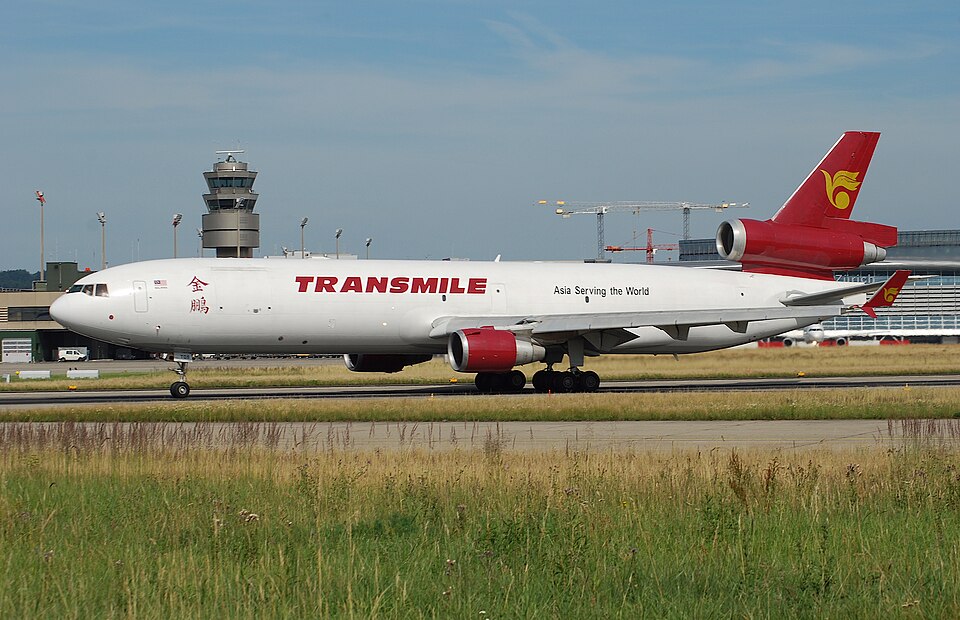
On January 10, 2007, at approximately 11:45 Japan Standard Time, a McDonnell Douglas MD-11F cargo aircraft, registration 9M-TGS, operated by Transmile Air Services as Flight 8376, experienced a serious incident while en route from Anchorage International Airport, United States, to Hong Kong International Airport, China. The aircraft was cruising at Flight Level 380 over the sea 30 kilometers southwest of Cape Ashizuri, Kochi Prefecture, Japan, when the second-in-command (SIC) pilot suddenly lost consciousness. The pilot in command (PIC) and cruise captain took over control, diverted to Kansai International Airport, and landed at 12:19 JST without further incident. All five persons on board—three operating crewmembers and two company staff—were uninjured.
Flight History
The flight departed Anchorage at 03:07 JST. The crew consisted of a PIC, an SIC (who was also qualified as PIC), a cruise captain, and two company staff. Prior to the event, the crew had exchanged positions. At the time of the incident, the cruise captain was acting as pilot flying (PF) in the left seat, and the SIC was pilot-not-flying (PNF) in the right seat. The PIC was resting in the crew rest compartment.
Around 11:45, the SIC suddenly emitted a loud noise and appeared to stiffen. His legs extended irregularly onto the rudder pedals, causing the aircraft to yaw. The cruise captain instructed a company staff member to fetch the PIC and immediately declared a medical emergency to Fukuoka Area Control Center, requesting a diversion to Nagoya. Shortly after, the crew changed the destination to Kansai International Airport, which was nearer.
Crew Actions
The cruise captain, aided by company staff, moved the SIC's seat back and removed his legs from the rudder pedals. The PIC then returned to the cockpit and took the left seat, while the cruise captain and staff carried the SIC to the rest compartment, laid him flat, and provided oxygen after clearing his mouth of vomit. The PIC handled the approach and landing normally; the aircraft was radar vectored and landed on Runway 24 at Kansai at 12:19 JST. The crew did not set the transponder to emergency code but communicated their need for medical assistance upon landing.
Communications
ATC communications showed that at 11:45:22 the aircraft declared a medical emergency requesting Nagoya, then at 11:49:09 requested Kansai. At 11:52:36 they requested a doctor after landing. The aircraft was cleared for an ILS approach to Runway 24. The crew declined a shorter approach to Runway 06 due to a tailwind. After landing, they requested and received medical assistance.
Aftermath
No injuries were reported. The incident was classified as a serious incident under Japanese regulations due to flight crew incapacitation by illness. The investigation focused on the sequence of events and crew actions. The report did not specify a probable cause.