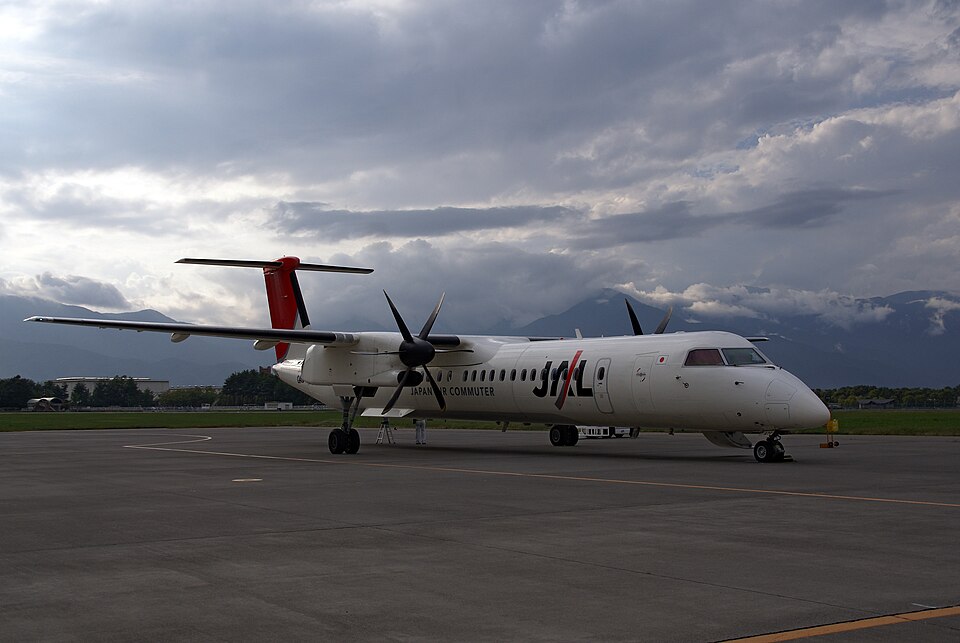
Incident Overview
On March 25, 2009, at approximately 09:34 Japan Standard Time, a Bombardier DHC-8-402 aircraft, registered JA847C, operated by Japan Air Commuter Co., Ltd. as scheduled Flight 3760, experienced an engine failure shortly after takeoff from Tanegashima Airport. The aircraft was climbing through about 3,800 feet when a loud bang was heard, and instrument indications confirmed a failure of the No. 1 engine. The crew shut down the engine and declared an emergency, eventually landing at Kagoshima Airport at 10:26. There were 42 persons on board—two pilots, two cabin attendants, and 38 passengers—and no injuries were reported.
Flight History
The flight departed Tanegashima Airport's Runway 31 at 09:33 under instrument flight rules, bound for Kagoshima Airport at a planned cruising altitude of 12,000 feet. At 09:34:14, the crew contacted Fukuoka Area Control Center, reporting passage through 3,700 feet. Seconds later, a loud bang occurred, accompanied by illumination of the master caution light and the No. 1 engine oil pressure warning light. The No. 1 engine's low-pressure compressor/turbine speed (NL) dropped sharply to approximately 47%, and the crew shut down the engine at 09:34:26, reducing fuel flow to zero. The aircraft leveled off at 8,000 feet and requested an emergency landing at Kagoshima Airport. During the approach, the crew reported that the No. 1 engine propeller could not be feathered, leading to a request for fire engines as a precaution. The aircraft landed on Runway 34 at 10:26 without further incident.
Investigation Findings
The Japan Transport Safety Board (JTSB) conducted an investigation, with participation from Canada (state of design and manufacture) and the United Kingdom (state of design and manufacture of the propellers). Examination of the No. 1 engine reduction gear box revealed that the 1st stage input gearshaft and the flange coupling shaft were each fractured at three locations. The helical input gearshaft was found fractured, and an impurity inclusion was identified in the material of this fractured shaft. Teardown examinations of the feathering pump and motor were also conducted. The investigation provided factual information to the Civil Aviation Bureau, including the fractures and the impurity inclusion, but did not explicitly state a probable cause for the serious incident.