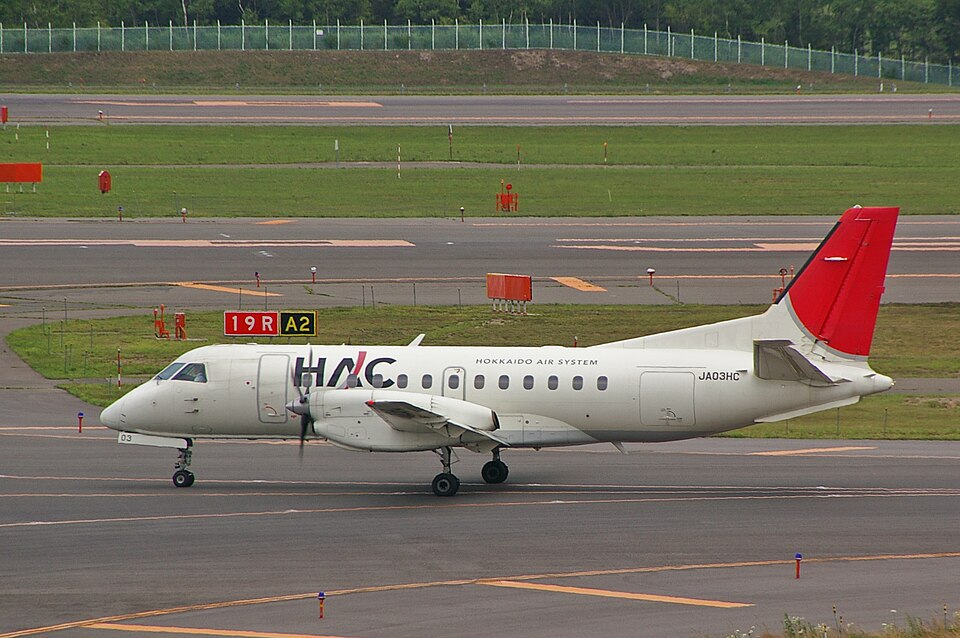
Incident Overview
On June 4, 2011, at approximately 11:38 JST, a SAAB 340B aircraft, registered JA03HC and operated by Hokkaido Air System Co., Ltd., was involved in a serious incident during approach to Runway 31 at Okushiri Airport. The aircraft had departed from Hakodate Airport as scheduled Flight 2891. After executing a go-around, the aircraft initially climbed but then reversed to descend. The flight crew became aware of the situation and performed an emergency operation to avoid collision with terrain. The aircraft subsequently returned to Hakodate Airport after holding over Okushiri. There were 13 persons on board: the Pilot-in-Command (PIC), the First Officer (FO), a cabin attendant, and 10 passengers. No injuries were reported, and the aircraft sustained no damage.
Flight History
According to records from the Digital Flight Data Recorder (DFDR), Terrain Awareness and Warning System (TAWS), and air traffic control communications, the aircraft contacted Okushiri Remote at 11:27:14 while cruising. The approach to Runway 31 was initiated, but a go-around was executed. The aircraft began to climb but soon transitioned to a descent. The descent continued until the flight crew initiated an emergency pull-up. The aircraft then performed holds and returned to Hakodate.
Probable Causes
The Japan Transport Safety Board (JTSB) determined that the descent and proximity to terrain were highly probably caused by the following factors:
1. The PIC followed Flight Director (FD) command bar instructions that indicated descent because the altitude setting was not changed to the initial go-around altitude, and subsequently the PIC made the aircraft descend even lower than the FD command bar instructions. 2. The PIC and FO did not notice the aircraft's descent, leading to delayed recovery maneuvers.
These findings resulted from the PIC's inability to perform fundamental instrument flight, inappropriate use of the Autopilot/Flight Director System without confirming flight instruments and modes, and the FO's transient lack of close instrument monitoring due to other tasks. Additionally, the FO's engagement of the autopilot and change of vertical mode to climb using the Autopilot/Flight Director System likely delayed ground-proximity avoidance maneuvers. The company's failure to create standard procedures for mode change confirmation and callouts, as per the Aircraft Operating Manual, and inadequate training were probable contributing factors. The PIC and FO excessively relied on the autoflight system.
Recommendations
Based on the investigation, the JTSB recommended that Hokkaido Air System Co., Ltd. take the following actions:
1. Ensure flight crew comply with Airplane Operating Manual specifics for confirming and calling out mode changes when using the Autopilot/Flight Director system, and consider revising the Flight Training Guide accordingly. 2. Increase training opportunities, including simulator sessions, to improve raw data instrument skills, clarify problems from excessive autoflight reliance, and inform crew of specific countermeasures.