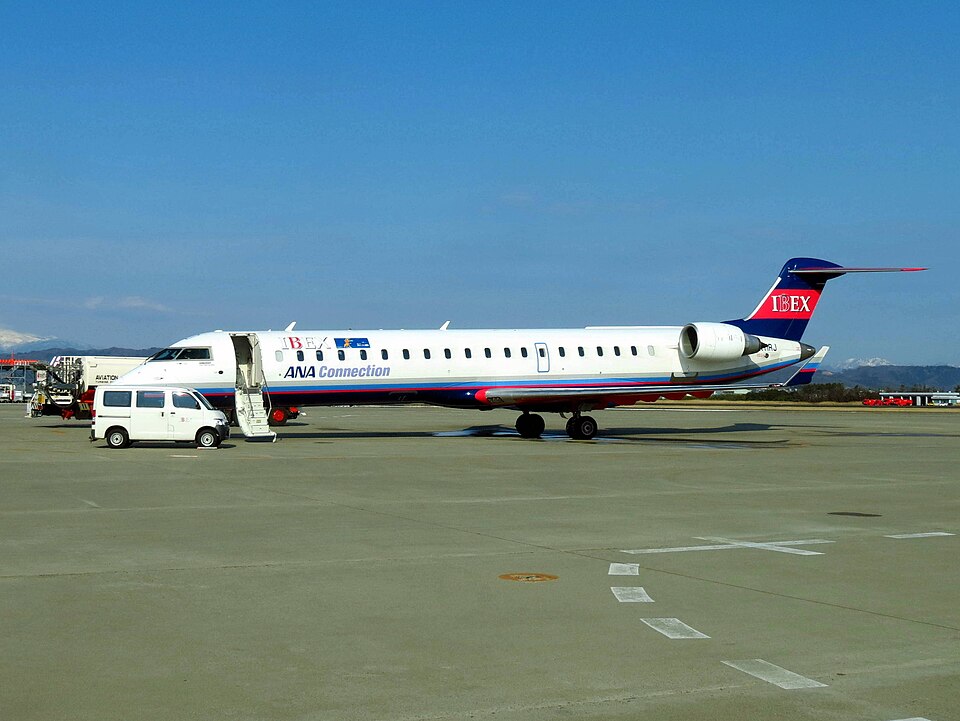
Incident Overview
On October 30, 2019, at 16:31 Japan Standard Time, a Bombardier CL-600-2C10, registered JA11RJ, operated by IBEX Airlines Co., Ltd., departed from Sendai Airport as scheduled flight 16. The aircraft was en route to Fukuoka Airport with 73 people on board, including the pilot in command (PIC), three other crew members, and 69 passengers. The serious incident occurred at approximately 18:02 over Ohnan-cho, Ohchi-gun, Shimane Prefecture, at flight level 260 (FL260).
Sequence of Events
At around 17:47, while cruising at FL340 about 50 km east of Miho Airport, the PIC observed a flash near the left window. Subsequently, the Engine Indicating and Crew Alerting System (EICAS) displayed a “L WINDOW HEAT” caution message. Following the checklist, the PIC switched the left windshield heat switch from “LOW” to “OFF/RESET” and then back to “LOW,” which cleared the message.
At approximately 17:53, the PIC again saw a flash near the left window, and EICAS displayed a “L WSHLD HEAT” caution. Again, the PIC performed the same switch action, and the message disappeared. At that time, the cabin altitude was about 5,700 ft.
Around 17:56, while still at FL340 and approximately 50 km southwest of Miho Airport, the PIC noticed what appeared to be cracks in the left windshield. He began following the checklist for windshield damage. As he manually decreased cabin pressure per the checklist, the cabin altitude began to rise.
At 17:58, EICAS displayed a “CABIN ALT” caution, which quickly escalated to a warning. The PIC initiated an emergency descent at about 17:59, aiming for 10,000 ft at a descent rate of roughly 3,000 ft/min to avoid increasing airspeed, mindful of the windshield crack. According to the PIC, the cabin altitude was approximately 12,400 ft at that time.
At around 18:02, during the emergency descent at FL260, EICAS displayed “PASS OXY ON” caution, and the cabin oxygen masks deployed automatically. The PIC and first officer (FO) reported the cabin altitude was about 14,000 ft with a differential pressure of 5.2 psid. The aircraft reached about 10,000 ft over Iwami Airport at 18:10, and the cabin altitude also stabilized at 10,000 ft. After communicating with Fukuoka Approach, the PIC declared an emergency at 18:21. The aircraft landed at Fukuoka Airport at 18:38.
Injuries and Damage
No injuries to persons were reported. Examination of the aircraft revealed arcing on the upper part of the left windshield. No cracks were found in the glass layers. The left windshield's heater element resistance substantially exceeded the reference value. All other windows and systems functioned normally.
Investigation Findings
The Japan Transport Safety Board (JTSB) investigated the incident. The left windshield and left side window were removed and tested; only the left windshield heater element showed abnormal resistance. The heater controllers and anti-ice control panel were tested and found normal. The moisture seal on the left windshield had been repaired on October 7, 2019, due to degradation. No probable cause was stated in the report.