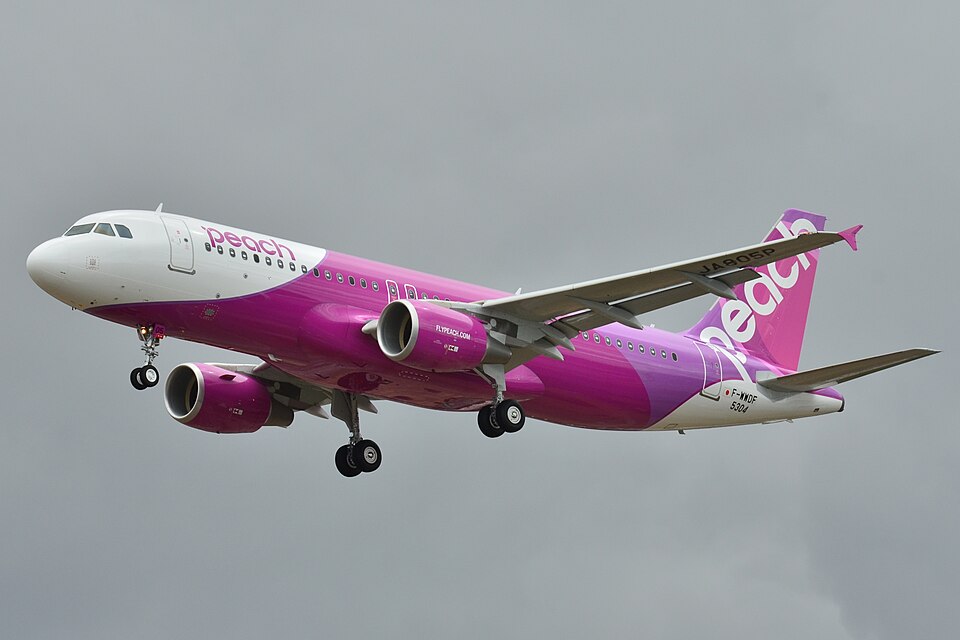
Nose Gear Failure Disables Airbus A320 at Fukuoka Airport

Casualties unknown • Fukuoka Airport, JP

A Peach Aviation Airbus A320-214 was unable to continue taxiing after its nose landing gear malfunctioned due to a disconnected torque link pin during landing.

What happened

On March 24, 2018, an Airbus A320-214, registered JA805P, operated by Peach Aviation Ltd., experienced a serious incident upon landing at Fukuoka Airport. The aircraft, operating as a scheduled flight, touched down normally on Runway 16. However, as the aircraft decelerated during the landing roll, the flight crew noticed increasing vibrations. At approximately 40 knots, the vibrations became significant enough that the pilot in command took control of the aircraft.

The aircraft was unable to maintain its direction and eventually came to a halt on the runway, positioned roughly 15 degrees left of the centerline. The nose wheel had turned approximately 90 degrees clockwise, rendering the aircraft unable to continue taxiing. There were no injuries to the crew.

The investigation

The Japan Transport Safety Board (JTSB) investigation focused on the mechanical failure of the nose landing gear. Investigators recovered the apex pin, which connects the upper and lower torque links, from the runway. Examination of the pin revealed that the threads were heavily damaged, flattened, and showed signs of corrosion. Notably, the nut, lock plate, and several washers were not recovered from the site.

Technical analysis by the aircraft manufacturer and landing gear supplier revealed that the cadmium plating on the pin threads had been significantly degraded. This degradation was likely caused by repeated removal and installation of the pin during maintenance, as well as the absence of a shur-lok washer, which allowed vibrations from the shock absorber to transfer rotational movement to the nut. Furthermore, investigators found no trace of grease on the pin threads, suggesting insufficient lubrication during previous maintenance intervals.

Findings

  • The aircraft became disabled because the nose wheel steering was lost when the upper and lower torque links separated.
  • The separation occurred because the apex pin disconnected after the mechanical strength of its threads failed.
  • The failure of the pin threads was driven by corrosion that developed due to compromised cadmium plating.
  • The corrosion process was likely accelerated by insufficient lubrication of the threads during a previous heavy maintenance check and the lack of a shur-lok washer, which allowed for increased friction and water infiltration.

Safety action

Following the investigation, the aircraft manufacturer updated the Aircraft Maintenance Manual to clarify cleaning and inspection procedures for the pin, specifically regarding corrosion detection. The manual now mandates that threads and splines be thoroughly cleaned, dried, and completely filled with grease. Additionally, a Service Bulletin was issued to A320 operators recommending fleet-wide inspections of the pin threads.

Probable cause

The aircraft's nose wheel steering failed because the apex pin disconnected during the landing roll. This disconnection was caused by the deterioration of the pin's thread strength due to corrosion, which was accelerated by inadequate lubrication and the absence of a shur-lok washer during maintenance.

Frequently asked questions

What happened in the 2018-03-24 Airbus A320-214 accident near Fukuoka Airport, JP?

A Peach Aviation Airbus A320-214 was unable to continue taxiing after its nose landing gear malfunctioned due to a disconnected torque link pin during landing.

What aircraft was involved and where did it happen?

The accident on 2018-03-24 involved a Airbus A320-214, registration JA805P, operated by Peach Aviation Ltd., at Fukuoka Airport, JP.

What was the probable cause of the accident?

The aircraft's nose wheel steering failed because the apex pin disconnected during the landing roll. This disconnection was caused by the deterioration of the pin's thread strength due to corrosion, which was accelerated by inadequate lubrication and the absence of a shur-lok washer during maintenance.

Investigation report by the Japan Transport Safety Board (JTSB). Original record: https://jtsb.mlit.go.jp/eng-air_report/JA805P.pdf. This page is a structured re-presentation; facts and quotes are in the Japan Transport Safety Board (JTSB) - Ministry of Land, Infrastructure, Transport and Tourism.

Loading the flight search…