Summary
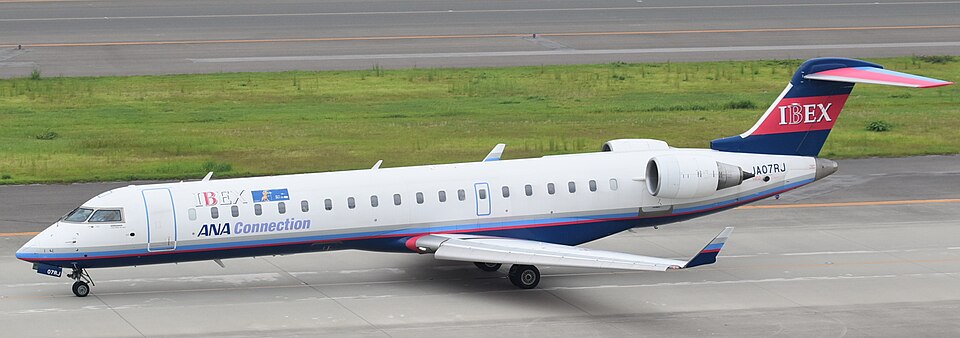
On Monday, April 18, 2022, a Bombardier CL-600-2C10, registration JA07RJ, operated by IBEX Airlines Co., Ltd., as scheduled flight 18, took off from Sendai Airport at 18:51 Japan Standard Time (JST). While cruising at flight level 360 (FL 360) over Oda City, Shimane Prefecture, en route to Fukuoka Airport, the flight crew experienced temporary unreliable airspeed indications on both the Pilot in Charge (PIC) and First Officer (FO) primary flight displays (PFDs). The PIC declared a state of emergency, continued the flight, and landed at Fukuoka Airport at 20:39. The Japan Transport Safety Board (JTSB) investigated the serious incident. There were 38 persons on board, including the PIC, three other crewmembers, and 34 passengers. No injuries to persons or damage to the aircraft were reported.
Flight History
According to statements from the PIC and FO and flight data recorder (FDR) records, the aircraft took off from Sendai Airport at 18:51 and flew on autopilot at FL 360. When the aircraft began a descent to FL 240 about 60 km southwest of Izumo Airport, the Engine Indication and Crew Alerting System (EICAS) displayed messages “STALL FAIL” (inoperative stall warning) and “RUD LIMIT FAULT” (loss of redundancy of rudder authority limiting device). The PIC took over control and initiated procedures for the “STALL FAIL” message. During these actions, the PIC noticed that the indicated airspeed (IAS) on both PFDs slowly decreased from 258 kt despite no change in speed setting. Judging the IAS indications as unreliable, the PIC disengaged the autopilot and flight director. Using the integrated standby instrument (ISI), which appeared to display normal IAS, the PIC continued the descent and declared an emergency to air traffic control. The IAS indications on both PFDs further decreased to a lowest limit of 40 kt, then recovered to normal values one to two minutes later. After the IAS indications stabilized around FL 240, the PIC resumed autopilot use and landed at Fukuoka Airport.
Aircraft and Crew Information
The aircraft was a Bombardier CL-600-2C10 (serial number 10327), manufactured on May 17, 2011, with a certificate of airworthiness valid until June 11, 2022. Total flight time was 25,411 hours 45 minutes over 23,922 cycles. The PIC, aged 53, held an Airline Transport Pilot Certificate with type rating for Canadair CL-65 and had 14,810 hours 30 minutes total flight time, including 13,685 hours 56 minutes on type. The FO, aged 36, held a Commercial Pilot Certificate with type rating for Canadair CL-65 and had 2,983 hours total flight time, including 2,649 hours 33 minutes on type. Both pilots held valid Class 1 Aviation Medical Certificates.
Meteorological Conditions
At the time of the incident, weather at Sendai Airport (19:00 JST) included light rain, wind from 200° at 10 kt, visibility 10 km or more, and cloud layers at 1,200 ft, 5,000 ft, and 7,000 ft. At Izumo Airport and Iwami Airport (20:00 JST), conditions were CAVOK. Radar composite charts showed the maximum echo top altitude in the vicinity of the incident site was 8 to 10 km. A domestic significant weather analysis chart indicated jet streams at FL 350 and FL 390 near the incident site. Hourly analysis charts showed winds at FL 360 from the west at about 100 kt, and FL 360 was near the tropopause.
Air Data System
The aircraft was equipped with two air data computers (ADCs). ADC1 received pitot pressure from the left pitot/static probe, ADC2 from the right pitot/static probe, and both ADCs received static pressure from the left and right probes. Normally, IAS computed by ADC1 displayed on the left PFD, and IAS from ADC2 on the right PFD. The ISI computed IAS using pressure from a standby pitot probe on the left and standby static ports on both sides.