Synopsis
A decision to continue rather than abort the landing at the midfield markings on a wet and short-cut grass runway led to a runway excursion. The accident occurred in daylight under visual meteorological conditions.
Flight History
During a private VFR flight from Skive (EKSV) to Endelave (EKEL), the pilot noted from documentation that a low approach over a road adjacent to the threshold of runway 29 should be avoided. Having flown to EKEL only once before, the pilot performed an extra circuit to inspect the runway and assess wind conditions, observing wind from the south/southwest at about 5–10 knots. The pilot established the aircraft on final approach to runway 29 with flaps set to 40°. Approaching the runway, during the flare and while passing trees south of and parallel to the runway, the pilot perceived an unintentional sink and increased engine power. The aircraft touched down just beyond the midfield markings. Upon braking, the pilot found the wheel brakes ineffective, and the aircraft slid along the runway. Judging it too late to abort, the pilot attempted to turn left toward an adjacent field. The aircraft exited the runway end, collided with willow trees, and came to a full stop. The engine stopped during the sequence. After stopping, the pilot shut off fuel, retracted flaps, and cut electrical systems.
Personnel
The pilot, a 71-year-old female, held a valid Private Pilot Licence (PPL(A)) with Single Engine Piston (SEP land) privileges valid until 30 April 2025, and a valid Light Aircraft Pilot Licence (LAPL) medical certificate valid until 20 June 2025. She had 571:55 total flight hours, of which 507:40 were on type, including 4:38 hours in the previous 90 days. She had prior grass runway experience at EKEL and other fields.
Aircraft
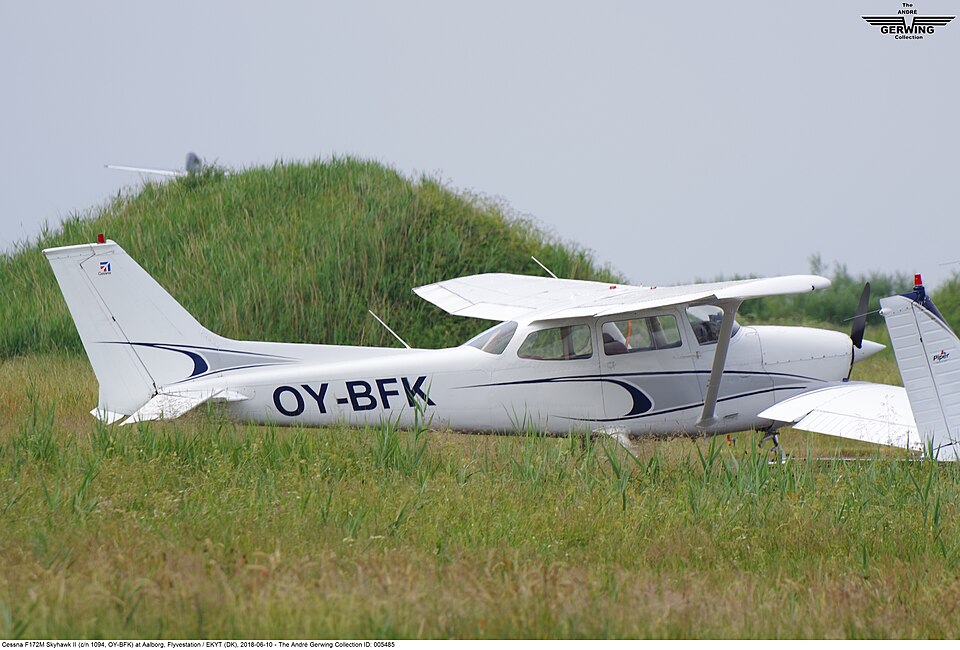
The aircraft was a Reims Aviation F 172 M, registration OY-BFK, serial number 1094, with a valid airworthiness review certificate expiring 4 March 2025. It was powered by a Lycoming O-320-E2D engine. Maximum takeoff and landing mass was 1043 kg. The pilot reported no technical problems during the flight. A theoretical mass and balance calculation based on pilot information and flight manual data was prepared by the investigation.
Meteorological Information
The pilot observed wind from the south/southwest at 5–10 knots at the time of landing. No other meteorological data were explicitly reported in the source.
Aerodrome Information
Endelave aerodrome (EKEL) has a grass runway. Runway 29 was wet and short-cut. The accident occurred at the runway end where willow trees were present.
Investigation Findings
The investigation determined that the aircraft touched down beyond the midfield markings on a wet, short-cut grass runway. The pilot's decision to continue the landing rather than abort at that point led to the runway excursion. The aircraft collided with willow trees, resulting in substantial structural damage. No injuries to the pilot or two passengers occurred. There was also damage to the trees.