History of Flight
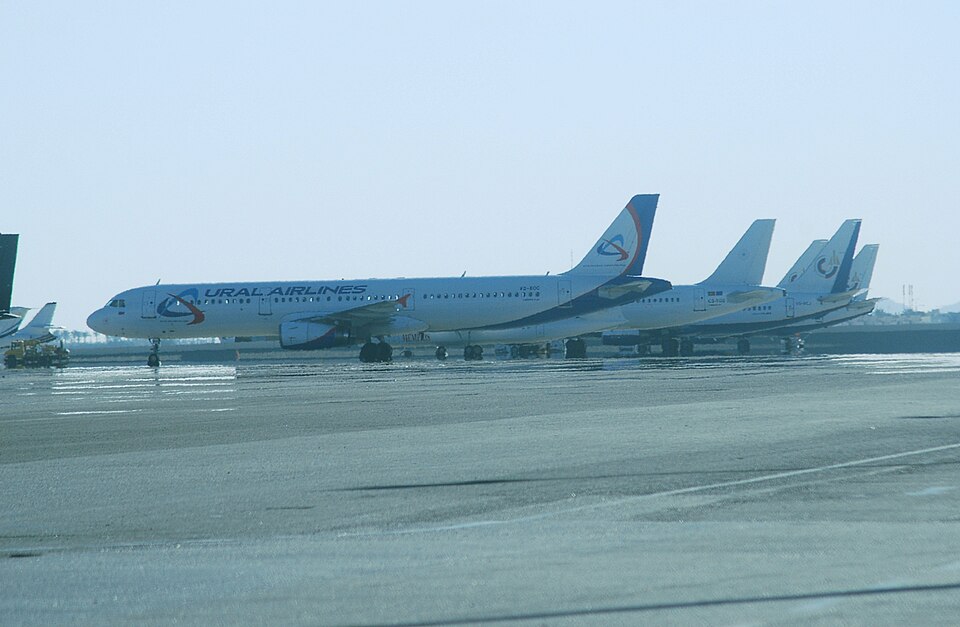
On 16 February 2014, an Airbus A321-231, registration VQ-BOC, operated by Ural Airlines, arrived at Dubai International Airport from Novgorod, Russia, as flight U6-803. The aircraft was parked at its gate with the passenger loading bridge (PLB) connected to the left forward door (L1). Eight cabin crew members were on board.
A catering vehicle was scheduled to service the aft right door (R4). The vehicle stopped several meters away from the aircraft, awaiting a marshaller's signal to move forward. After receiving the signal, the driver pressed the brake pedal and shifted into drive. When he released the brake, the vehicle suddenly accelerated forward and struck the aircraft.
The driver reported that he pressed the brake pedal three times but the brakes did not respond.
The impact forced the aircraft to rotate approximately 30 degrees to the right, moving about four meters from the parking bay centerline. A gap opened between the PLB and the L1 door. A cabin crew member standing near the L1 door fell through the gap onto the ramp, a drop of about three meters, sustaining serious head and limb injuries.
Injuries
One cabin crew member was seriously injured. No other persons were injured. The flight crew and other cabin crew were uninjured.
Damage
The aircraft sustained damage to the lower fuselage on the right side. The catering vehicle was damaged on its left upper forward corner.
Personnel Information
The injured cabin crew member was assigned to Zone 1 of the cabin and was performing a routine check of the cabin crew panel about one meter from the L1 door at the time of the accident.
The vehicle driver, a 43-year-old male employed by Emirates Flight Catering since July 2010, had worked five consecutive 12-hour shifts before the accident, with one hour break per shift. The accident occurred on his sixth and last shift before a rest day. He had rested at home for about six and a half hours before reporting for the evening-morning duty starting at 14:00. During his shift, he completed several missions, taking a 39-minute break around 18:00. The accident occurred on his fourth mission of the day, less than two hours before his shift was scheduled to end.
Causes
The investigation determined that the causes of the impact were that the vehicle driver was not aware that the vehicle was approaching the aircraft at excessive speed, and his situational awareness was most likely degraded by tiredness and/or distraction.
Safety Recommendations
Two safety recommendations were issued: one to Emirates Flight Catering to review rest policies for airside operators and introduce balanced break periods, and one to Dubai Airports to improve ramp safety emergency response plans, particularly rapid response and medical transport for injured persons.