Occurrence
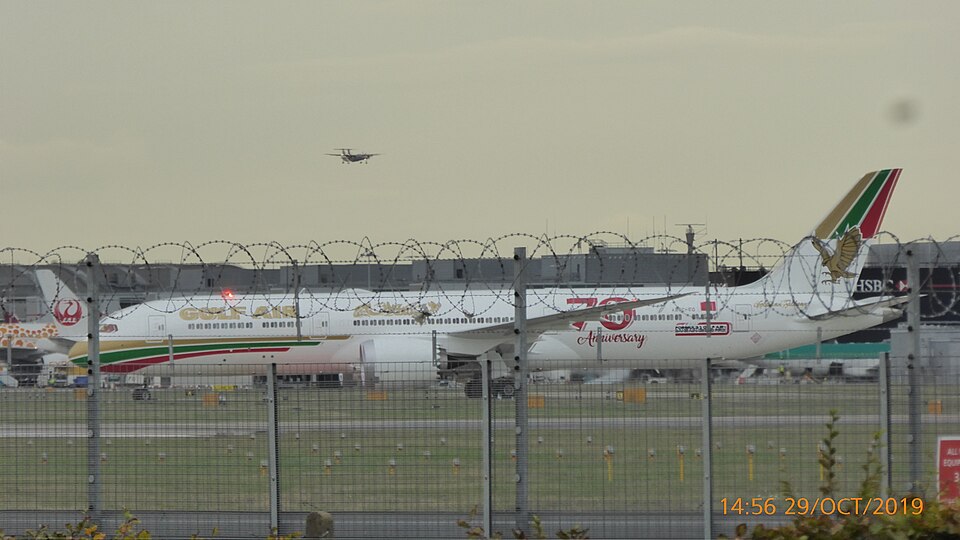
On 10 March 2023, a Boeing 787-9 aircraft, registration A9C-FG, operated by Gulf Air as flight GF504 from Bahrain International Airport to Dubai International Airport, experienced a serious incident. The aircraft carried 183 passengers, 2 flight crew, and 8 cabin crew.
History of the Flight
The aircraft took off from runway 30R at 1728:58 UTC. After climbing to flight level 250 for 26 minutes, descent began at 1754:00. At that time, the flight crew experienced a failure of all three tuning control panels (left, center, right), followed by an EICAS message indicating loss of transponder, weather radar, and traffic collision avoidance system (TCAS). The crew could not change radio frequencies. They initiated the quick reference handbook for non-normal checklists and communicated with Dubai Approach on standby frequency 119.3. At 1756:23, clearance was received for the VUTEB waypoint and descent to 13,000 feet. The aircraft entered a holding pattern at VUTEB while the crew troubleshooted. Dubai Approach controlled the descent on frequency 119.3 because the transponder was inoperative; the controller could not see the aircraft on radar. At 1822:15, the crew declared a radio communication emergency and descended for approach. The aircraft landed safely on runway 12L at 1835:33 and vacated the runway at 1836:15. The fire commander cancelled the full emergency at 1842:00.
Personnel Information
The Commander held an ATPL issued by Bahrain, valid until 7 August 2025, and a Class 1 medical certificate valid until 20 March 2023, with a requirement to wear prescription glasses for near vision. The Copilot also held an ATPL valid until 1 October 2027 and a Class 1 medical certificate valid until 14 August 2023, with no vision impairment. Both crewmembers had completed the operator’s required training.
Aircraft Information
The Boeing 787-9, serial number 39986, was manufactured in 2019 and delivered to Gulf Air on 16 August 2019. It had accumulated 12,152:36 hours and 2,558 cycles. The left engine had 2,319 cycles since new, with 135 cycles since installation on the incident aircraft. The right engine had 2,317 cycles since new, with 510 cycles since installation. The last heavy inspection (C1 check) was on 30 October 2022, and the last A1 check on 26 January 2023. No deferred defects were noted prior to the incident, and no maintenance fault messages were reported afterward. Maintenance personnel reset the TCP and conducted a ground test with no EICAS messages, and the aircraft was returned to service.
Tuning Control Panel Failure
The TCPs are used to tune and control VHF/HF communication, SATCOM, SELCAL, and other systems. A malfunction can affect TCAS, transponder, and weather radar operation. The crew attempted to troubleshoot using the company iPad but could not find reset procedures. Both crewmembers did not discuss the flight crew operations bulletin relevant to TCP inoperative procedure.
Meteorological Information
Weather conditions at the time were not a contributory factor.
Conclusion
The investigation determined that the incident involved a communication failure due to a tuning control panel malfunction. No probable cause was stated.