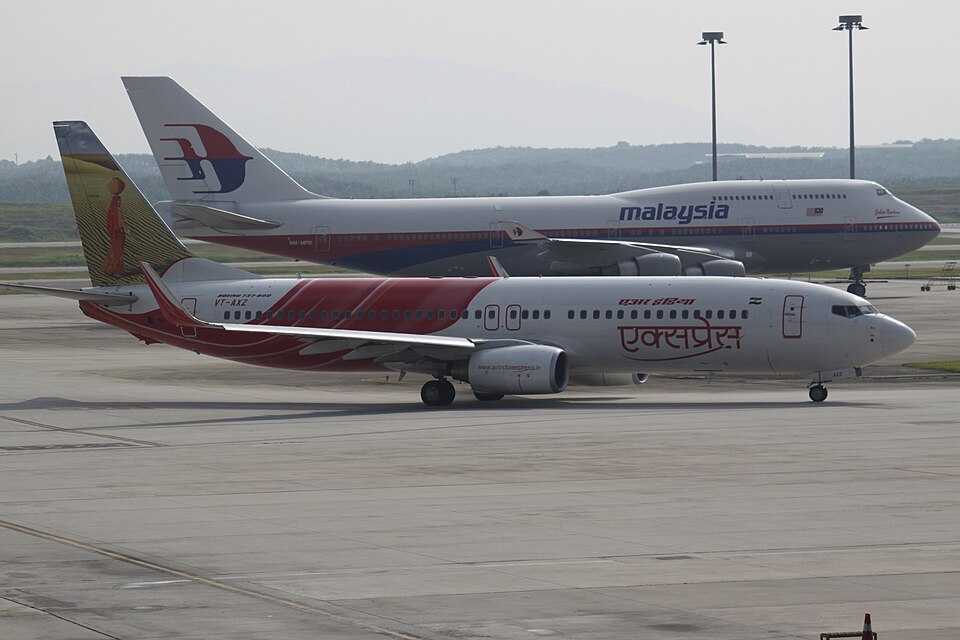
On April 21, 2025, a Boeing B737-800 (registration VT-AXZ) was involved in an aviation accident near Ras Al Khaimah International Airport, AE. This summary draws on records from the UAE Air Accident Investigation Sector (GCAA AAIS).
On 22 April 2025, an Air India Express Boeing 737-800 (VT-AXZ) experienced a tail strike during landing at Ras Al Khaimah International Airport, UAE, causing minor fuselage damage.
Incident Overview and Investigation Authority On 22 April 2025, an Air India Express Boeing 737-800, registration VT-AXZ, was involved in a serious incident at Ras Al Khaimah International Airport (OMRK) in the United Arab Emirates. The occurrence was classified as a serious incident following an initial on-site investigation. The Air Accident Investigation Sector (AAIS) of the UAE conducted the investigation in accordance with Civil Aviation Law No. 20 of 1991 and Annex 13 to the Chicago Convention. The AAIS notified the Aircraft Accident Investigation Bureau (AAIB) of India, the State of Registry and Operator, and the National Transportation Safety Board (NTSB) of the United States, the State of Manufacture and Design. ## Flight History and Approach The aircraft departed Calicut International Airport (VOCL) at 1027 UTC for scheduled passenger flight IX331 to Ras Al Khaimah. There were 174 people on board, including 170 passengers, 2 flight crewmembers, and 2 cabin crewmembers. The Commander served as pilot monitoring, while the Copilot was pilot flying. After climbing to flight level 360, the aircraft began its descent at 1319 UTC and proceeded with an RNAV 1 standard arrival for runway 34. At 1345:13 UTC, the Commander contacted OMRK Approach Surveillance, and the controller provided the QNH setting of 1011 millibars and cleared the aircraft for an ILS Zulu approach to runway 34 at 1345:42 UTC. ## Landing and Damage Assessment At 1349:25 UTC, the aircraft was 9.6 nautical miles from the runway threshold when the Commander contacted Tower. The aircraft touched down on both main landing gears at 1353:06 UTC, bounced once, and experienced a tail strike on the subsequent touchdown. The aircraft then continued its landing roll and vacated the runway via taxiway Sierra to parking stand number 2. Initial inspection revealed paint scratches and a 1.5-inch skin crack on the bottom fuselage panel. Detailed damage assessment indicated the tail strike occurred at station 887 between stringers 27L and 27R. The rub mark measured 6 inches in length and 2 inches in width, with a pinhole puncture and a 1.25-inch crack line identified between two rivets. No internal damage was found. The tail strike also left paint marks on the runway surface in the touchdown zone of Runway 34, with no foreign object debris found. ## Aircraft and Personnel Information The aircraft, manufacturer serial number 36336, was first flown on 9 January 2009 and delivered to the operator on 3 February 2009. At the time of the incident, it had accumulated 57,322 flight hours and 18,519 cycles. The aircraft was fitted with two CFM56-7B turbofan engines and a tail skid assembly designed to absorb impact energy. The Commander held a valid air transport pilot license (ATPL-A) and Class 1 medical certificate issued by the Directorate General of Civil Aviation (DGCA) of India. The Copilot held a valid commercial pilot license (CPL-A) and Class 1 medical certificate issued by the DGCA of India. Both crewmembers were type-rated for the Boeing 737. Hard landing inspections in accordance with B737-800 AMM Task 05-51-01 were completed with no findings.