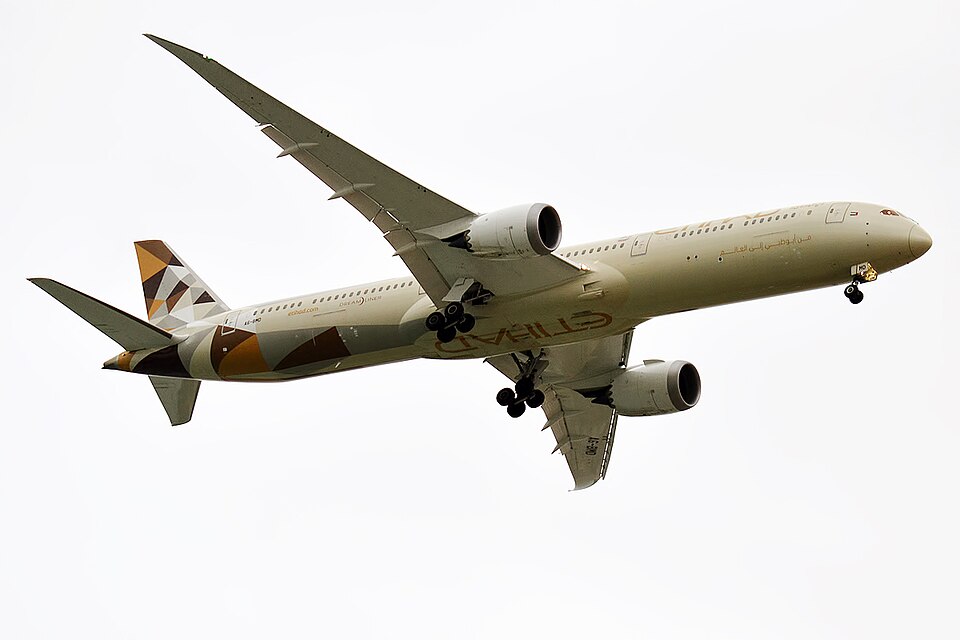
History of the Flight
On 6 June 2020, Etihad Airways flight EY9878, a Boeing B787-10 with registration A6-BMD, was operated as a cargo flight from Beijing Capital International Airport, China, to Abu Dhabi International Airport, United Arab Emirates. The flight crew consisted of a Commander and two Copilots; three persons were on board.
During the approach to runway 31L at Abu Dhabi International Airport, the aircraft was conducting an RNP AR approach (RNAV (RNP) Y). When the aircraft was on final approach at approximately 1.3 nautical miles from the runway threshold and at a radio altitude of about 210 feet, the flight crew initiated a go-around. The go-around was decided by the Commander after observing four red lights on the precision approach path indicator (PAPI), and was executed by the Copilot acting as pilot flying.
Cause and Contributing Factors
The Air Accident Investigation Sector (AAIS) determined that the cause of the aircraft flying below the vertical profile during approach was the incorrect local pressure (QNH) altimeter setting.
Contributing factors identified by the AAIS include:
- The operating flight crew omitted to preset the local Abu Dhabi QNH value after receiving automatic terminal information service (ATIS) information.
- Prior to and at transition level, the flight crew were fixated on high-energy management for the descent, resulting in an incorrect barometric setting change from standard pressure (1013 hPa) to the local QNH.
- The Approach Controller did not provide local QNH information with the initial descent clearance or when issuing clearance for the RNAV Y runway 31L approach.
- The vertical situation display (VSD) and its cues were not used by the flight crew for vertical profile assessment during the approach.
- Air traffic control did not instruct the flight crew to check the QNH setting and aircraft level when the minimum safe altitude warning activated on its radar screen.
- At higher altitudes, forward visibility was less than reported due to haze layers commonly associated with temperature inversions in the Middle Eastern region.
Safety Recommendations
The AAIS issued six safety recommendations: four to the aircraft operator (Etihad Airways), one to the GAL Air Navigation Services provider (GAL ANS), and one to the General Civil Aviation Authority (GCAA). These recommendations focused on reinforcing QNH barometric presetting, enhancing monitoring by additional flight crew, amending baro-VNAV approach procedures with more detailed VSD information, reviewing the effectiveness of safety actions taken after the incident, including supplementary instructions in the Air Traffic Services Operating Manual, and implementing 25-hour cockpit voice recorder (CVR) recording capability.