History of the Flight
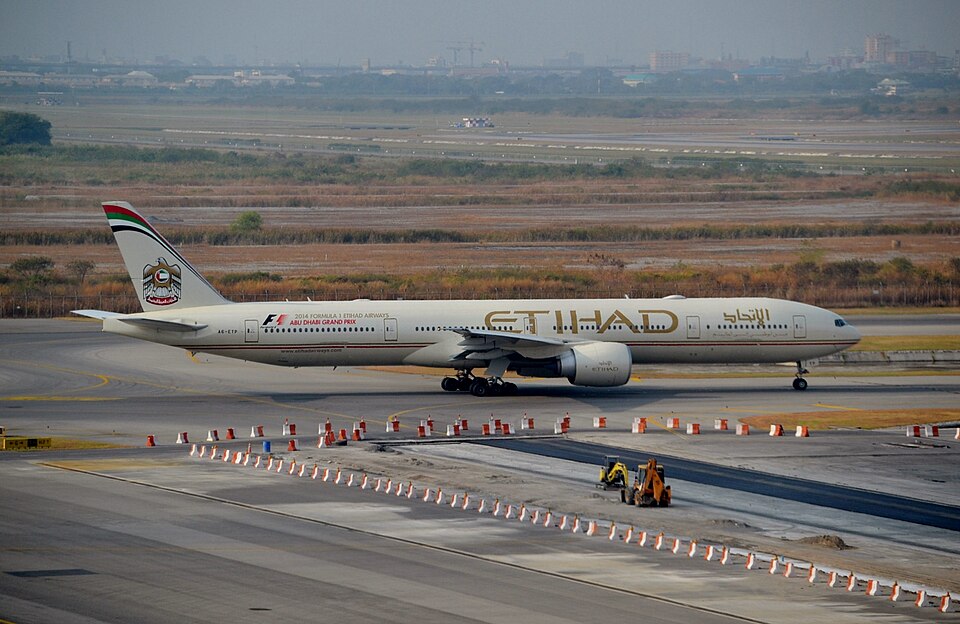
On 18 May 2023, at 1054 UTC, an Etihad Airways Boeing 777-300ER, registration A6-ETP, departed Sydney Kingsford Smith Airport (YSSY) as scheduled passenger flight EY455, bound for Abu Dhabi International Airport (OMAA). The aircraft carried 366 people: 348 passengers, 4 flight crew, and 14 cabin crew. The commander served as pilot monitoring and the copilot as pilot flying.
The aircraft landed on runway 13R at 0139 on 19 May 2023. After vacating the runway via taxiway Echo 10, it proceeded on taxiway Echo and exited via Echo 13, continuing on taxiway Foxtrot. During taxi, the flight crew shut down the right engine for single-engine taxi per procedure. Shortly after, they noticed flames from the left main landing gear via the ground maneuver camera system (GMCS) display. The flames self-extinguished, but smoke continued emanating from the same area.
The flight crew stopped the aircraft on taxiway Foxtrot between Echo 6 and Echo 9, declared a MAYDAY due to suspected landing gear fire, and requested airport rescue and firefighting services. They also made an alert call via the passenger address system. At 0145, air traffic control declared the ground incident and notified fire services.
Emergency Response
Fire trucks arrived at 0146 and observed smoke and hydraulic oil leakage from the left main gear. The fire commander requested the left engine shutdown. At 0147, ground operations inspected taxiways and found small metal fragments on taxiway Echo 13. At 0158, runway 13R inspection revealed broken metal and carbon fiber pieces on the centerline abeam taxiway Echo 10. At 0204, the south runway was deemed unsafe for operations; the north runway was prepared for use. Firefighters remained vigilant.
At 0207, an operator's maintenance engineer arrived and used convection fan cooling on the left main gear brakes. After confirming wheel rotation, the engineer, in consultation with the operator's engineering department, decided to tow the aircraft to the nearest parking stand. Towing began at 0300, with a fire truck escort, and the aircraft reached stand 301 at 0305. All passengers and crew disembarked uneventfully. The airport emergency status was concluded at 0323 after inspections of the runway and taxiways.
Damage to Aircraft
At the parking stand, a high-energy brake damage inspection per AMM 05-51-14 found brake assembly number 2 damaged, with hydraulic fluid leakage from one piston. The brake assembly was replaced per AMM 32-45-07. Further inspection revealed overheating damage on the axle sleeve, which was replaced per AMM 32-11-28. Main landing gear wheels 1 and 2 were also replaced. An operational test on the new brake assembly showed no leakage and normal indications.
Personnel and Aircraft Information
Two sets of flight crew (Crew A and B) were assigned for long-range operations. All held valid ATPL-A licenses and Class 1 medical certificates, type-rated for the Boeing 777.
The aircraft (Boeing 777-3FXER, serial number 41669) was manufactured in May 2013 and delivered on 25 June 2013. At the time of the incident, it had 46,745 flight hours and 6,567 cycles. The last A-check was on 4 May 2023 at 46,256.9 hours and 6,501 cycles. The transit check was on 18 May 2023 prior to departure from YSSY. Maximum takeoff weight was 351,534 kg and maximum landing weight 251,290 kg. The brake assembly (part number 2-1693, manufactured by Collins) had accumulated 1,188 cycles since installation and 9,250 cycles since new; there were 78 cycles since the last tire change. The aircraft's technical logbook had no recorded defects or deferred items before the incident. No post-flight EICAS fault messages were displayed. Manufacturer fleet team digest and service bulletins did not indicate known issues or similar occurrences.
Meteorological and Aerodrome Information
At 0200 UTC on 19 May, weather at OMAA was: wind 260° at 3 knots, visibility 10 km or more, temperature 29°C, dewpoint 19°C, QNH 1008, no significant clouds. Sunrise was at 0538 local (0138 UTC). Weather did not contribute to the incident.
Abu Dhabi International Airport coordinates are 24°25'59"N 54°39'04"E, designated at the midpoint of runway 13R/31L.