History of the Incident
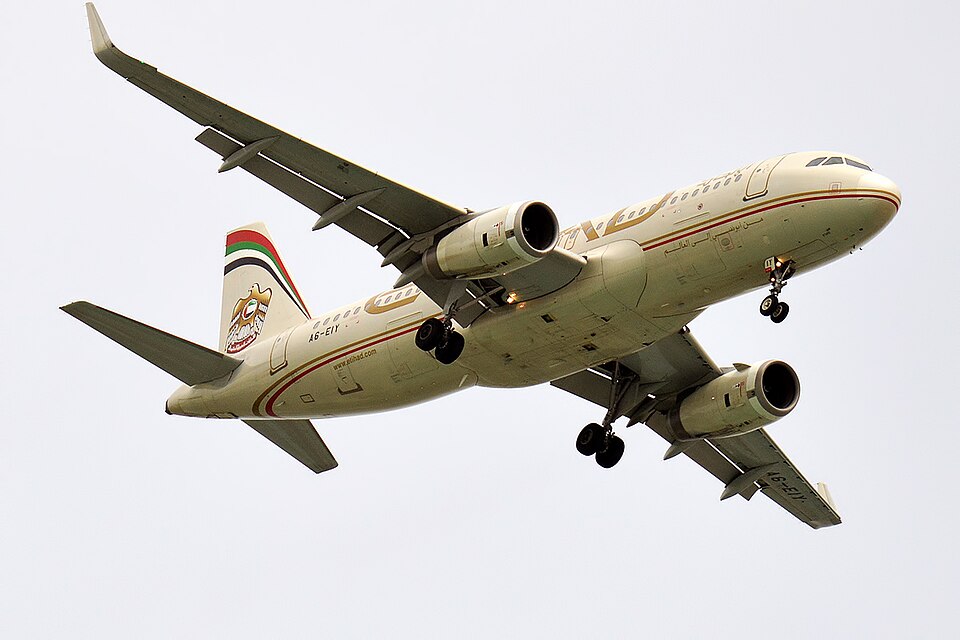
On 25 November 2015, an Etihad Airways Airbus A320-232, registration A6-EIY, operated flight ETD 222 from Karachi, Pakistan, to Abu Dhabi International Airport, UAE. The aircraft arrived at approximately 0645 LT and parked on stand 406 with 92 persons onboard, including seven crew and 85 passengers. After chocking and engine shutdown, ground equipment was positioned for disembarkation and cargo unloading.
During passenger disembarkation, a Medical Hi Loader (MHL) was being positioned to the aircraft's right-hand R1 door to assist a sick passenger. The MHL struck the aircraft in the area of the R1 door, causing significant damage to the fuselage. At the time, passengers were disembarking from the left-hand L1 door using external steps. Approximately 50 passengers and all seven crew were still onboard, with about 10 passengers descending the stairs when the impact occurred.
CCTV recordings showed the MHL impacted the aircraft violently, resulting in significant lateral movement. The impact was felt by crew and passengers onboard. Some passengers on the stairs lost their balance, but none sustained injury. Disembarkation was temporarily halted and resumed after the aircraft was deemed safe.
Damage to Aircraft
The collision caused one significant skin puncture and several dents below the R1 door. The damage exceeded Structural Repair Manual limits, requiring the aircraft to be towed to a hangar for repair. The MHL was withdrawn from service.
Personnel and Operational Factors
The MHL operator had joined Etihad Airport Services in July 2013 as a bus driver. He had completed MHL training and was checked out in July 2015, but his apron permit had not been endorsed with the MHL rating. On the day of the incident, his rostered duty was from 0600 to 1600 LT, his fourth consecutive morning shift. He reported for duty at 0530 LT and was initially assigned to operate a passenger bus before being reassigned to the MHL around 0630 LT by a line trainer. The operator stated he informed the trainer he could not operate the MHL alone and required supervision. The trainer advised him to call if needed and then left to oversee another operator.
The MHL operator positioned the MHL to stand 406 at approximately 0655 LT. He requested a Passenger Service Agent (PSA) staff member to marshal the MHL. As the MHL approached the aircraft, the operator stopped about 1.5 meters away, then continued slow movement. When close to the aircraft, he mistakenly depressed the accelerator pedal instead of the brake, causing sudden acceleration and impact. The marshaller shouted and gave a stop signal but received no response and moved away to avoid injury.
The marshaller, employed by a contractor, stated he had not received any airside safety or marshalling training. The senior manager training confirmed PSA personnel were not supposed to perform marshalling, as they were not trained for those tasks.
Additional Information
Pedal differences between the Cobus 3000 bus and the MHL 17-07 were noted: the distance between brake and accelerator pedals on the bus was much smaller than on the MHL. This difference contributed to the operator depressing the accelerator instead of the brake.
Drug and alcohol tests conducted on the MHL operator after the incident were negative. The operator reported feeling physically fit and not tired or fatigued prior to the incident.