Incident Overview
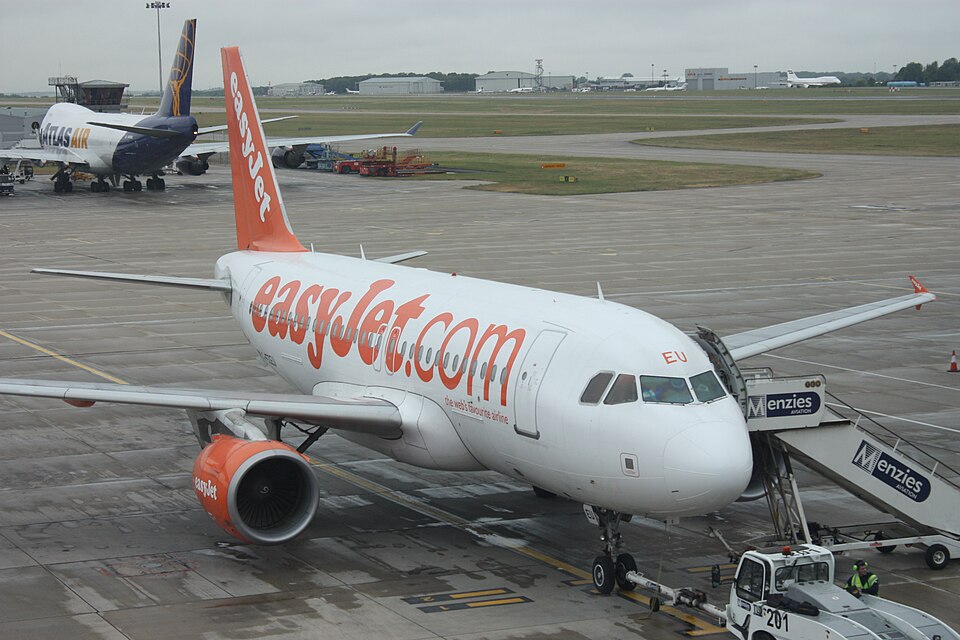
On 24 November 2005 at 0835 hours UTC, an Airbus A319-111, registration G-EZEU, operated by an airline on a scheduled passenger flight to Alicante, collided with a parked Airbus A320 on the adjacent stand at Nottingham East Midlands Airport. The aircraft had 6 crew and 110 passengers on board; no injuries were reported among occupants or ground personnel. The collision caused damage to the left wing tip and winglet of G-EZEU and the left wing tip of the A320, including a separated section of winglet embedded in the A320's leading edge. Neither aircraft sustained internal structural damage.
Flight Crew and Ground Crew
The commander, aged 45, held an Airline Transport Pilot's Licence and had 10,670 total flying hours, with 756 on type. He was normally based in Berlin and was temporarily operating from Nottingham East Midlands. On the day before the incident, he had commanded the same flight from a different stand. The co-pilot had joined the airline four months earlier and was based at the airport; this was his fifth or sixth departure from Stand 50. The ground crewman serving as wingman had one year of experience and had been trained that Stand 50 was not a push-back stand.
Sequence of Events
The commander initially requested a pushback, as per published procedures indicating Stand 50 was a push-back stand. Air traffic control (ATC) advised that the operator's aircraft normally self-manoeuvred from that stand, and no tug was present. The commander confirmed this local practice with the co-pilot and ground crew, then elected to start engines and taxi forward. After engine start, the ground crewman positioned himself by the A320's left wing tip to provide guidance. He gave a thumbs-up signal, but after the aircraft moved forward a few meters, he realized G-EZEU was not turning right as expected and gave a stop sign. The commander, possibly obscured by window reflection, did not see the signal, and the wing tips made contact. The aircraft stopped shortly after impact, having traveled about 38 meters at a maximum ground speed of 6 knots.
Post-Incident Actions
The commander applied parking brake, visually checked for leaks, and the co-pilot notified ATC. The crew declined fire service assistance initially but requested an engineer. After inspection confirming safety, the aircraft taxied to another stand under fire service escort. Passengers disembarked via coaches.
Investigation Findings
The operator's charts and the UK AIP listed Stand 50 as a push-back stand, with no forward taxi markings. However, a local practice had developed where the operator's Boeing 737-300 aircraft self-manoeuvred from that stand, a practice extended to the A319 in September 2005. The A319's wider wingspan (34.09 m) reduced clearance compared to the B737-300 (28.89 m). The cockpit voice recorder and flight data recorder indicated the aircraft used differential thrust to initiate a right turn, but the turn rate was low (about 2.8° per second) and brakes were applied only after impact. No rudder or brake pedal movement was recorded during the turn.
Procedural Context
Aerodrome licensing standards (CAP 168) require minimum clearance of 20% of wingspan, reducible to 4.5 m for nose-in push-back stands with an approved guidance system. The investigation noted that the commander, as per JAR OPS, bore responsibility for aircraft safety from the start of taxi. The operator's manual required commanders to ensure clearance and provide wing tip watch if necessary.