Incident Overview
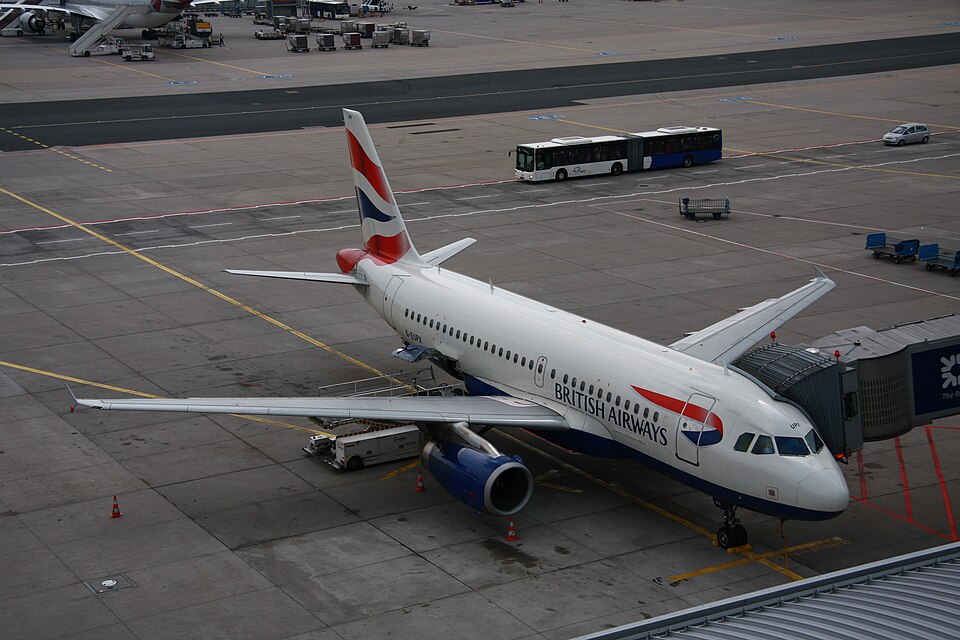
On 25 April 2012, an Airbus A319-131 (registration G-EUPX) operated by a commercial airline experienced a serious incident during the landing roll on Runway 09L at London Heathrow Airport. The aircraft, on a scheduled flight from Berlin Tegel Airport, Germany, carried 5 crew and 112 passengers, none of whom were injured. The tyres sustained scuff damage.
Flight and Landing Sequence
The commander, serving as pilot flying, had disconnected the autopilot at approximately 420 ft above airfield level and received landing clearance from air traffic control. The runway surface was damp, and the wind was reported from 170° at 21 knots. During touchdown, the commander removed drift using left rudder, flared, and touched down positively but not firmly. The co-pilot selected thrust reversers and made standard rollout calls. With idle reverse thrust, the aircraft decelerated on the runway centreline.
Believing it would be better to vacate the runway at the second rapid exit turnoff, the commander relaxed and disengaged the Autobrake using the brake pedals at about 100 knots. He momentarily glanced inside, possibly to check spoiler deployment, then looked up to find the aircraft diverging to the right toward the runway edge. To correct, he initially applied both brake pedals simultaneously, followed by full left brake and left rudder. The co-pilot also applied left brake. The aircraft returned to the centreline, then taxied off the runway and stopped on the taxiway. After checking systems, the aircraft taxied to stand without further incident.
Brake System Examination
The braking system comprises hydraulically powered multi-disk brake units on each main wheel, operated by two independent systems. Differential braking is possible via foot-operated pedals integral to the rudder. The Autobrake function, when selected (LO, MED, or MAX), automatically applies brakes to achieve a chosen deceleration once conditions are met. Disengagement occurs when a pilot applies sufficient deflection to at least one brake pedal (50.3% on a single pedal or 11.03% on both). The antiskid system deactivates below 20 knots. All braking and steering are controlled through a Brake and Steering Control Unit (BSCU).
Examination of the tyres revealed lateral scratch marks consistent with the deviation, most prevalent on the outer edge of the outboard tyre of the left main gear. An extensive test of the brake system identified no faults. As a precaution, the operator replaced all wheel and tyre assemblies, brake units, and the BSCU. The aircraft returned to service with no further incidents reported.
Recorded Data and Autobrake Disengagement
Flight data recording showed touchdown at a normal acceleration of 1.4 g, computed airspeed of 126 knots, and groundspeed of 128 knots. Ten seconds after touchdown, the cockpit voice recorder captured a crew announcement of 'DECEL', indicating felt deceleration. The Autobrake did not apply pressure at this point due to sufficient aerodynamic braking and reverse thrust. Shortly after, the flight data recorder detected deflection of both brake pedals, with significantly greater pressure on the right, disengaging the Autobrake. This caused increased brake pressure on the right main gear brakes, limited by the antiskid system. Four and a half seconds after the right pedal was depressed, the left brake pedal and left rudder were applied, reducing the yaw rate and returning the aircraft to the centreline.
Operator's Comments and Guidance
During a simulator assessment under the same conditions, the commander demonstrated a tendency to inadvertently apply more pressure on the right brake pedal when disengaging the Autobrake. He underwent subsequent simulator training and returned to line flying. The aircraft manufacturer noted that no specific guidance exists on when to disengage the Autobrake, as it depends on circumstances. The operator's procedures recommend disengagement before speed drops to 20 knots to avoid brake jerks at low speed. The operator planned to highlight the incident in a crew newsletter, drawing attention to the potential difficulty of disengaging the Autobrake at high speed in crosswind conditions.
Conclusion
The aircraft veered to the right during the landing roll following the asymmetric application of the brake pedals when the Autobrake was disengaged. No faults were found with the aircraft braking system.