Incident Description
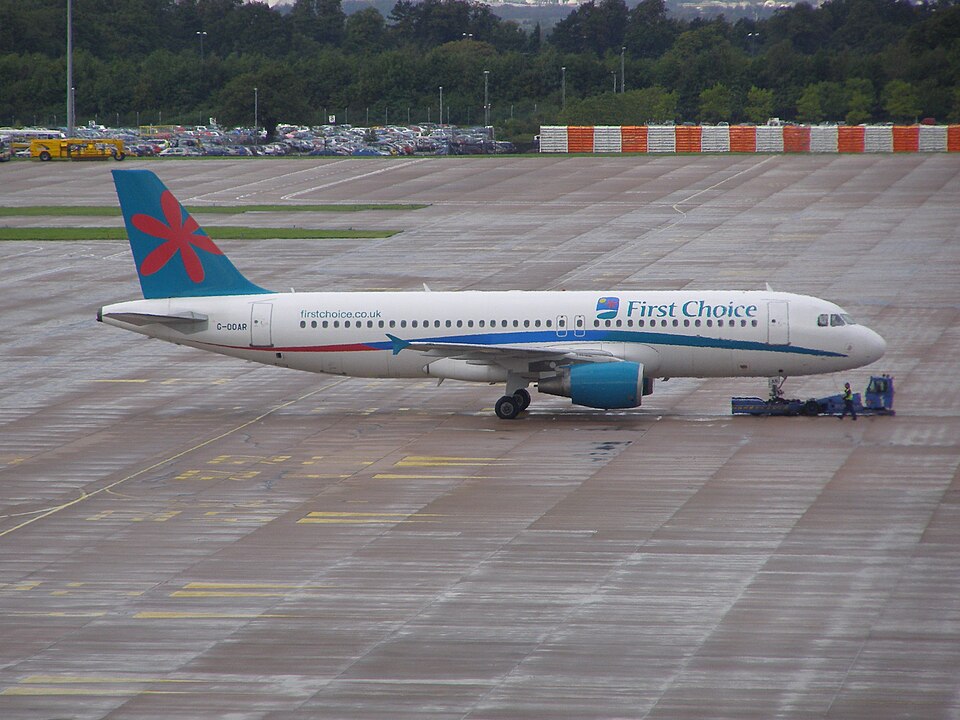
On 2 March 2001 at 0130 UTC, an Airbus A320-214, registration G-OOAR, was descending 18 nautical miles south of Dublin Airport, Ireland, after a charter flight from Lanzarote. The aircraft was in clean configuration with Autopilot No 2 and Autothrust engaged; the first officer was handling. Weather at the airport was calm with visibility greater than 10 km, few clouds at 4,000 feet, temperature -5°C, and QNH 1003 hPa. The crew reported excellent visibility of Dublin city lights, but some cloud was present near the aircraft at 4,000 feet over the Wicklow mountains.
Air Traffic Control had cleared the aircraft to descend to 4,000 feet on QNH with no speed restrictions. As the aircraft descended through 4,200 feet, the Enhanced Ground Proximity Warning System (EGPWS) Mode 2 alert activated, producing a 'Terrain, Terrain - Whoop, Whoop - Pull Up, Pull Up' audio and visual warning. Both flight deck crew responded by executing a standard EGPWS avoidance maneuver: full aft sidestick and TOGA thrust.
The aircraft pitched up sharply. A cabin crew member working in the aft galley lost balance, fell, and sustained a fractured collarbone. The senior cabin crew member advised keeping the injured crew member on the floor for landing. The flight crew performed a gentle touchdown with minimal braking. Airport authorities alerted an ambulance, which met the aircraft after arrival on stand.
Similar Occurrence
On 8 April 2001, another Airbus A320 of the same operator, G-OOAD, experienced a similar EGPWS event approximately 10 nautical miles southwest of Killiney, heading 040°M at 320 knots indicated airspeed as requested by ATC. A 'Terrain, Terrain' warning sounded for about two seconds, ceased, then recurred after five seconds with a 'Pull Up' warning. The commander reported the warning ceased with recovery action. The DFDR data from this event had been overwritten before notification to the AAIB.
Local Topography and ATC Procedures
In the area of these events, terrain rises rapidly to elevations of 2,385 and 2,352 feet amsl, with higher peaks up to 2,686 and 2,788 feet amsl further west. The local sector safety altitude is 4,100 feet. Within 12 nm of the airport, no terrain exceeds 2,000 feet amsl.
ATC is responsible for terrain separation when giving radar vectors to aircraft operating under IFR. Descent clearances must provide at least the minimum prescribed separation of 1,000 feet. For arrivals at Dublin, a published speed restriction of 250 knots IAS applies below FL100. ATC may remove speed restrictions for sequencing, transferring responsibility for speed choice to the commander.
EGPWS System Operation
The relevant EGPWS mode for these circumstances is Mode 2A (Excessive Terrain Closure Rate), active when the aircraft is not in landing configuration and not on the glideslope. The activation envelope depends on airspeed and descent rate measured by the radio altimeter (active below 2,450 feet above ground). For G-OOAR, DFDR data showed the aircraft at about 298 knots IAS, descending from 4,200 feet amsl at a barometric rate of about 1,500 ft/min. However, due to rapidly rising terrain, the radio altimeter measured 2,200 feet above ground with a closure rate of about 9,000 ft/min, triggering the alert. At no time did the aircraft descend below 1,700 feet above local terrain, so the minimum separation was not lost.
The EGPWS includes an envelope modulation database to reduce sensitivity at certain airports, but not all aircraft in the operator's fleet were equipped. The operator issued a Company Briefing Sheet requiring crews to observe the standard speed restriction in the vicinity of this terrain. The AAIB noted a need to warn all pilots of possible spurious GPWS activations in this area.
Recommendations
The AAIB made two safety recommendations:
- 2002-34: The Irish Aviation Authority should place a warning in the Irish AIP Dublin Approach Procedures highlighting the probability of GPWS terrain alerts for aircraft exceeding the standard speed restriction while at or below 5,000 feet near the high terrain south of Dublin.
- 2002-35: The Irish Aviation Authority should ensure Dublin Approach procedures avoid aircraft descending south of Dublin at combinations of airspeed and altitude where GPWS Mode 2 may be subject to nuisance activation.
The Irish Aviation Authority indicated it would issue a Notice to Staff advising controllers not to request airspeeds above 250 knots at or below Transition Level south of Dublin in the problematic area.