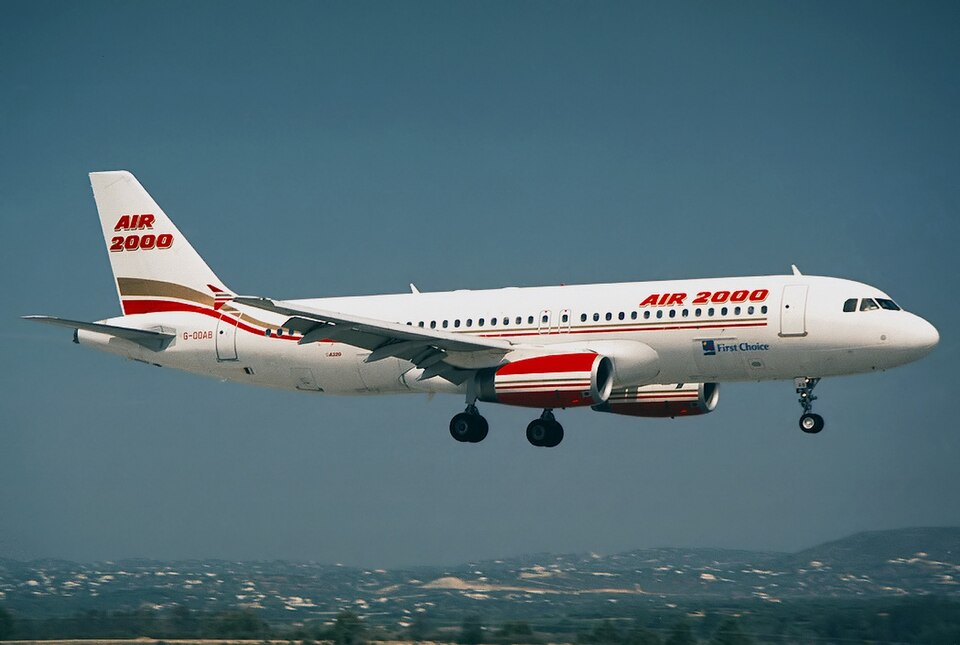
History of Flight
The commander, originally on standby, was called to operate a flight to Heraklion when the scheduled first officer was unwell. The airline had a policy allowing captains to operate as non-handling pilot in the co-pilot's seat after six months on the line. On this flight, the captain scheduled to command both legs offered to share the flying by exchanging seats for the return leg. The standby captain chose the outbound sector and became the commander.
The aircraft was loaded to 73.1 tonnes for a CONFIG 3 takeoff from Runway 27 with weather wind 210°/9 kt, visibility 30 km, scattered clouds at 300 ft and broken at 500 ft, QNH 1006 mb. Takeoff speeds V1 127 kt and VR/V2 139 kt were set for TOGA takeoff. The captain acting as co-pilot called speeds. After rotation, the commander felt a bump. Initially both pilots thought it was turbulence, but the senior cabin crew reported the tail had struck the runway. The captain suggested returning to Bristol; the commander agreed. The APU was started, and after an ILS approach, the commander executed a gentle landing. Full reverse thrust and wheel braking were used. The crew cancelled the flight, and passengers were transported by another aircraft.
Aircraft Examination
Examination confirmed scrape damage to the lower rear fuselage, with drain masts showing evidence of runway contact. Detailed inspection revealed slight deformation around the lowermost stringer near the rear pressure bulkhead. Runway 27 at Bristol had a scrape mark about 20 feet either side of a centreline light located 692 m from the far end of the 2,011 m runway; the light had fresh damage to its painted upper surface.
Flight Data Analysis
The flight data recorder (FDR) and cockpit voice recorder (CVR) were serviceable. FDR data indicated the commander initiated rotation at correct speed but applied significantly more rearwards sidestick than other pilots in a sample of seven flights. He also applied a large lateral sidestick deflection before and during rotation, sufficient to deploy left-wing roll spoilers. Spoiler deployment during rotation decreases wing lift and increases nose-up pitch rate. The combined effect was a sustained pitch rotation rate exceeding twice the recommended 3°/sec.
The aircraft manufacturer analyzed the FDR data and stated that the lateral sidestick input alone was sufficient to cause a tailscrape with a normal pitch input. The manufacturer also discounted any significant effect of windshear.
Sidestick Training Considerations
In Airbus fly-by-wire aircraft, there is no mechanical linkage between sidesticks, making it difficult for trainees to learn correct technique by following through. The required rearwards sidestick movement varies with conditions, so a standard technique is not feasible. The difficulty of achieving the recommended 3°/sec rotation rate is illustrated by test pilots commonly achieving 4°/sec. Airline pilots have no ready means to assess their pitch rate, making subjective judgment crucial.
The AAIB was aware of inconsistent advice on sidestick handling during crosswind takeoffs in some A320 training organizations. The sidestick order indicator on the Primary Flying Display shows when sidestick application approaches the limit for spoiler deployment.
Safety Actions
After two previous tailscrape investigations in Airbus A340 aircraft, advice on rotation technique was amended in the A340 Flight Crew Operating Manual (FCOM) in May 1995, with comparable changes later incorporated into the A320 FCOM. The operator's Standard Operating Procedures (SOPs) dated 1 April 1998 emphasized a rotation rate of 3°/sec but did not mention centralizing lateral sidestick input. The Airbus FCOM SOPs advised centering the stick during rotation to achieve zero roll rate demand. The commander stated he had never been taught this technique.
Upon discovering the discrepancy, the operator issued a notice to pilots with the revised Airbus advice. Both pilots recognized that starting the APU after a suspected tailscrape and returning immediately were unwise. Given the operator's swift reaction and the FCOM advice, the AAIB made no safety recommendations.