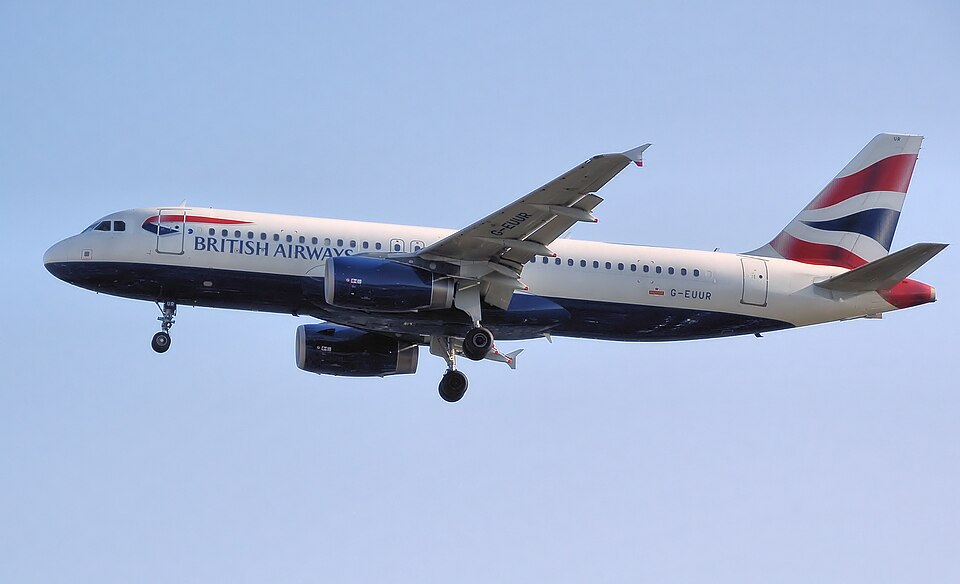
Synopsis
During a daytime instrument meteorological conditions (IMC) approach to Runway 23 at Glasgow Airport, an Airbus A320-232, registration G-EUUR, was given and accepted a 'terrain unsafe' clearance. The flight crew subsequently climbed the aircraft upon receiving a GPWS warning. The minimum terrain clearance during the event was 959 feet.
History of the Flight
The aircraft was operating a scheduled passenger service from London Heathrow to Glasgow as 'Shuttle 6C' (SHT6C). The flight departed at 0724 hrs with the commander as handling pilot. The flight was uneventful until the approach at Glasgow began around 0811 hrs, with the aircraft level at flight level 050 (FL050). In accordance with standard procedures, the commander handed control to the first officer before top of descent, who was to conduct the approach. The first officer became pilot flying (PF) for the remainder of the events.
The air traffic control officer (ATCO) was on his first shift after leave. At 0800 hrs, he was single-staffed on radar with light traffic. He gave G-EUUR a heading from the LANAK reporting point and a descent to 3,000 ft. After the aircraft passed a base leg heading of 325°, the controller considered a closing heading due to a strong westerly wind of about 40 kts. He wrote the closing heading, 275°, on the ATC strip but did not transmit it.
Believing he had given the closing heading, the controller cleared the aircraft to descend to 2,000 ft. The crew acknowledged and initiated a descent while still heading 325°, tracking more than 90° from the ILS centreline due to wind. The PF selected open descent (idle thrust), initially concerned about excess energy if given a short route. The descent rate reached 1,500 fpm.
The ATCO saw the aircraft on radar at about 10 miles from the airfield, descending on base leg, and thought it was slowly turning to the heading he believed he had passed. About 35 seconds after the clearance, he realized the aircraft was not turning and transmitted the heading of 275°.
Actions by the Flight Crew
The PF commenced a left turn to 275° using the autopilot, which commanded 25° of left bank. Realizing the energy management situation had reversed, the PF selected vertical speed mode and reduced descent rate as the aircraft descended through 2,500 ft amsl. The flight data monitoring system recorded a change from 1,500 fpm to 1,300 fpm shortly before a GPWS mode 2 'terrain terrain pull up' warning initiated. The rate of terrain closure exceeded 6,000 fpm due to steeply rising ground and aircraft descent rate.
On hearing the GPWS warning, the PF disconnected the autopilot, selected full thrust, and pitched the aircraft to approximately 17° nose-up, initially levelling the wings. He then followed flight director commands for a right turn, banking nearly 30°. The aircraft climbed at over 5,000 fpm, and flight conditions became VMC above the cloud layer.
An altitude loss of 130 ft was recorded from warning start to minimum recorded altitude. The minimum radio height was 959 ft, associated with an altitude of approximately 2,170 ft amsl. The turn towards 275° resulted in the aircraft track being left of the ridge that caused the alert, which was about 300 ft higher than the radio altimeter sensed.
Actions by the Controller
The controller became involved with an air ambulance flight and, when he next looked at radar, G-EUUR was crossing the ILS centreline north of the 'Campsie Line' and below the minimum altitude for that area. He decided to turn the aircraft further towards the ILS and gave a radar heading of 200° as the aircraft passed slightly through the localiser. The flight crew then informed him of the GPWS go-around and that they were climbing to 5,000 ft on heading 320°.
During interview, the controller stated he could not explain why he wrote the heading on the strip without transmitting it. He noted that once he realized the aircraft was north of the Campsie Line, he should have sent it around rather than attempt recovery.
The Second Approach
After the GPWS warning, the PF climbed the aircraft to 5,000 ft, above the Minimum Safe Altitude (MSA) of 4,900 ft. The crew levelled at 5,000 ft before being vectored for a second approach.
The controller instructed a descent from 5,000 ft to 4,000 ft, which was permitted on his terrain chart at issuance. However, as the aircraft turned north-northeast, the 40 kt south-westerly wind caused a ground track into an area with an MSA of 4,500 ft. The controller did not recognize this second breach. The flight crew were unaware they descended below radar MSA and outside their approach chart coverage. Although below MSA, the aircraft remained 'terrain safe' throughout this descent.
Both the controller and flight crew reported the incident via safety reporting systems and continued their duty, neither believing performance was affected.
ATC Information
Glasgow ATC uses the procedure 'write while you talk, read while you listen'. An instruction should be written on the strip simultaneously with transmission, then read as the crew reads back. The ATCO could not explain why he wrote the heading without transmitting it, and this was his first time aware of such a mistake.
Airport and Terrain Information
Glasgow Airport is six miles west of Glasgow, in the River Clyde valley, elevation 26 ft. Terrain along the Runway 23 approach is low-lying (150-300 ft) out to 9.5 nm, where the Campsie Fells rise sharply to a peak of 1,840 ft. ATC procedures include the 'Campsie Line' at 105°/285° at 9.5 nm. According to MATS Part 2, aircraft being vectored should not be descended below 3,000 ft unless south of this line and on final or a closing heading within 1 nm of final approach.
Charting and Terrain Representations
The flight crew had three terrain information sources: two paper charts (radar minimum altitude chart and ILS Runway 23 approach chart) and the EFIS navigation display with EGPWS relative terrain. The approach chart includes diagrammatic terrain representations. Both charts show a 25 nm MSA of 4,900 ft based on the GOW VOR.
The ATCO had radar overlays including the Campsie Line and a laminated colour copy of the Glasgow Terrain Chart. The track overlay in figures was generated using data not available to the controller.