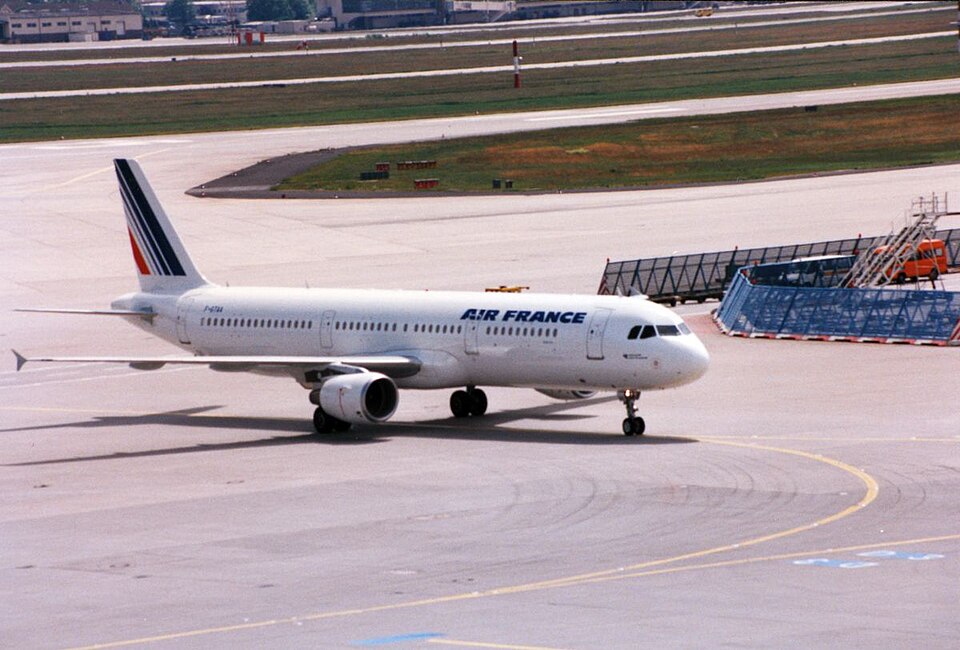
History of the Flight
The aircraft was landing on Runway 09L at London Heathrow Airport after a scheduled flight from Paris Charles de Gaulle. The commander was the handling pilot. The aircraft was configured with Flap Full, manual thrust, and Flight Directors on. The crew received ATIS information V (1350 hrs) with surface wind 010°/13 kt, variable between 340° and 040°, visibility 25 km, cloud few at 1,800 ft, broken at 2,000 ft, overcast at 4,000 ft, temperature +5°C, dew point +2°C, QNH 999 mb. At 1453 hrs, the Tower controller cleared the aircraft to land and passed the surface wind as 020° at 10 kt. No windshear had been reported by landing aircraft. Only light turbulence was experienced during final approach.
As the aircraft descended below 200 ft, there was a sudden loss of airspeed of about 10 to 15 kt. Thrust was increased to maintain VAPP+10 kt. At about 100 ft, the left wing dropped unexpectedly. The commander applied opposite roll sidestick and opposite rudder. Three divergent cycles in roll followed, culminating in the left wing tip striking the runway just before the left main landing gear touched down. The commander then executed a go-around by applying additional thrust. The aircraft became airborne and climbed away.
During the downwind leg, a passenger informed the crew that the left wing tip had suffered damage and the winglet was bent. Handling characteristics were not noticeably affected. The commander elected to land with Flap 3, and the aircraft landed uneventfully at 1510 hrs. There were no injuries.
Flight Recorder Data Analysis
The DFDR showed that during descent from 1,000 ft to 400 ft agl, roll attitude variations were ±3.5° with sidestick inputs up to ±10°. From 360 ft agl, wind speed increased from 20 kt to a peak of 27 kt, and initial rudder pedal movements appeared. Sidestick roll inputs increased to between 13° left and 15° right. From 200 ft to 120 ft agl, a bias of 2.5° right rudder was applied, drift angle reduced, and wind speed reduced to 6 kt near the surface. Engine power increased to 71% N1 for 5 seconds then reduced to 62%. Sidestick inputs ranged from full right to 16° left. Rudder application became oscillatory in phase with sidestick.
From 73 ft, roll oscillations increased rapidly, with peak roll attitudes of 10.5° left, 14.8° right, and 20° left wing down at 2 ft radio altitude, when ground contact occurred. The left main gear compression and a small normal acceleration spike (1.24 g) were recorded. No windshear warnings were recorded. Automatic height calls were heard on the CVR.
Engineering Inspection
Damage was confined to the winglet and wing tip. The lower edge of the winglet was abraded and pushed upward, splitting the upper and lower skins of the wingtip. The winglet could be moved manually. The entire wingtip/winglet assembly was replaced before the aircraft returned to service.
Anemometer Data
The runway 09L threshold anemometer recorded a two-minute average wind of 016° at 8 kt at the incident time, with a ten-minute average of 019° at 10 kt, variable between 345° and 041°, and speeds from 4 kt to 19 kt. Subsequent landing aircraft reported a sudden reduction in wind speed from 20 kt over the threshold to 10 kt at the surface at about 100 ft agl, with steady direction. The terrain north-north-east of the threshold is relatively flat, but several multi-storey buildings near the airfield boundary could generate vertical shear and turbulence. However, the conditions were described as fairly benign.