Incident
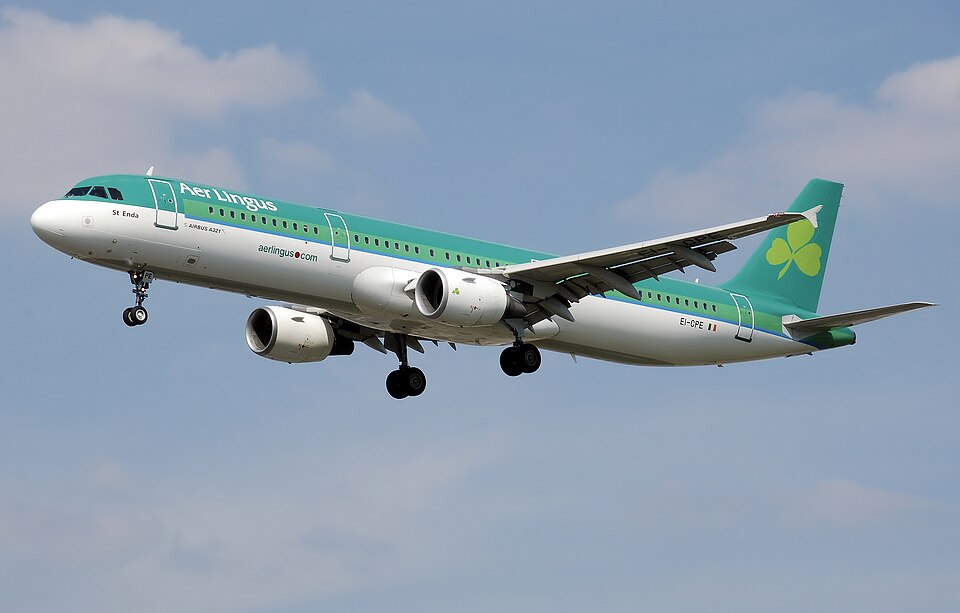
On 21 June 2000 at 1200 hours, an Airbus A321-211, registration EI-CPE, operated a scheduled service from Dublin Airport to London Heathrow Airport. The crew had already flown one round trip earlier that morning; this was their third sector. The ATIS at 1050 reported surface wind 210°/16 kt, visibility 40 km, scattered cloud at 3,000 and 4,500 feet, temperature 17°C, dewpoint 9°C, QNH 1009, and windshear on approach to Runway 27R of ±10 kt at 400 feet agl. The last surface wind before landing was 220°/18 kt.
The aircraft received radar vectors for an ILS approach to Runway 27R, with the first officer as pilot flying. After establishing on the ILS and visual contact, he disconnected the autothrottle and autopilot. The remainder of the approach was flown manually with managed speed and flight director. From 300 feet agl to landing, the aircraft became destabilized in pitch. At around 200 feet agl, the rate of descent reduced significantly and the aircraft deviated above the glideslope. The first officer attempted correction, resulting in a rate of descent of 800–900 ft/min. He applied aft sidestick from 60 feet agl until touchdown, but the rate of descent was not fully arrested, and the aircraft landed firmly.
The main wheels contacted the runway, and the aircraft rebounded, with both wheels lifting off again. Ground spoilers deployed at initial touchdown, and pitch attitude continued to increase. The aft fuselage contacted the runway at the same time as the second mainwheel touchdown. The landing continued uneventfully, and the crew were unaware of the tailstrike until advised by ATC upon vacating the runway. Cabin crew reported an unusual noise at touchdown.
Damage to the Aircraft
The rear fuselage lower skins were heavily abraded between the aft potable water and toilet service panels, over an area extending approximately 2.5 metres longitudinally and 0.4 metres laterally. The lower segment of the aft galley drain mast was bent and partly ground away. A scrape mark about 0.4 metres wide and 8 metres long was found on Runway 27R, slightly left of centre, consistent with the damage on EI-CPE. The lower skin damage was bounded by frames 63 to 67 and stringers 43L to 42R, implying a small right bank at tail contact. Localized penetrations through the full skin thickness occurred where supported by frames and stringers, with minor damage to underlying structure including bent butt-straps and frame flanges. The structural integrity of the fuselage was not compromised.
Flight Data and Simulation
The aircraft landed at 70.7 tonnes (max allowable 75.5 tonnes). A landing wind of 240°/15 kt was entered in the MCDU. The managed speed target had a minimum of 141 kt (VAPP). The normal A321 pitch attitude on stable approach at VREF (136 kt) is 4°. Recorded flight data showed that from 300 feet agl, the aircraft was on the ILS glideslope with 700 ft/min rate of descent. At 200 feet and 142 kt CAS, engine power increased from 53% to 67% N1 for 4 seconds, rate of descent reduced to 450 ft/min, and the aircraft deviated above the glideslope. Forward sidestick input pitched the aircraft down to 0°, airspeed increased to 148 kt, rate of descent increased to 800–900 ft/min. Pitch then increased to 4.5° nose-up. At 90 feet, two brief nose-down inputs caused pitch to reach 0.5° nose-up at 50 feet. At 60 feet, aft sidestick began for flare; pitch reached 2° nose-up and increased, but rate of descent reduced only slightly. Thrust was reduced from 90 feet and levers closed by 20 feet. Touchdown occurred at 130 kt CAS, pitch attitude 7.4° nose-up, normal acceleration 2.0g, with sidestick at 92.5% nose-up demand. Sidestick then reduced to 46.8% nose-up demand. Ground spoilers deployed automatically; FDR showed the main gear oleo switches then 'unmade', indicating rebound. Pitch attitude increased to a maximum of 9.8° nose-up just as mainwheels touched again, where tailstrike occurred. Second touchdown recorded 1.6g, and the commander's sidestick moved forward to 56.3% nose-down demand.
Simulation tests using recorded data required a corrective wind input to match the flight path. Significant vertical turbulence was observed at 300 feet agl. Below 100 feet, a sustained loss of headwind of 10 kt was considered the principle cause of limited flight path change during the flare.
Previous Incidents
Before this event, the manufacturer had details of 9 tailstrikes on the A321, all during landing. Two had been previously reported by the AAIB. In those incidents, after initial touchdown, the aircraft continued to pitch up, resulting in tailstrike after touchdown or during a bounce. After this event, two further instances occurred, one (D-AIRE) also reported in this bulletin. Aft fuselage contact on the A321 occurs at 9.7° pitch attitude with main gear oleos compressed, compared to 11.7° for the A320. The rate of tailstrike incidents per landing for the A321 is four times greater than for the A320.
Pilot Experience
The commander was 51 years old, held an Airline Transport Pilot's Licence, with 13,190 hours total (700 on type). He had been flying the A321 for about one year and had no previous bounced landing experience on type. The first officer had 274 hours total (82 on type) and had recently completed line training.