Synopsis
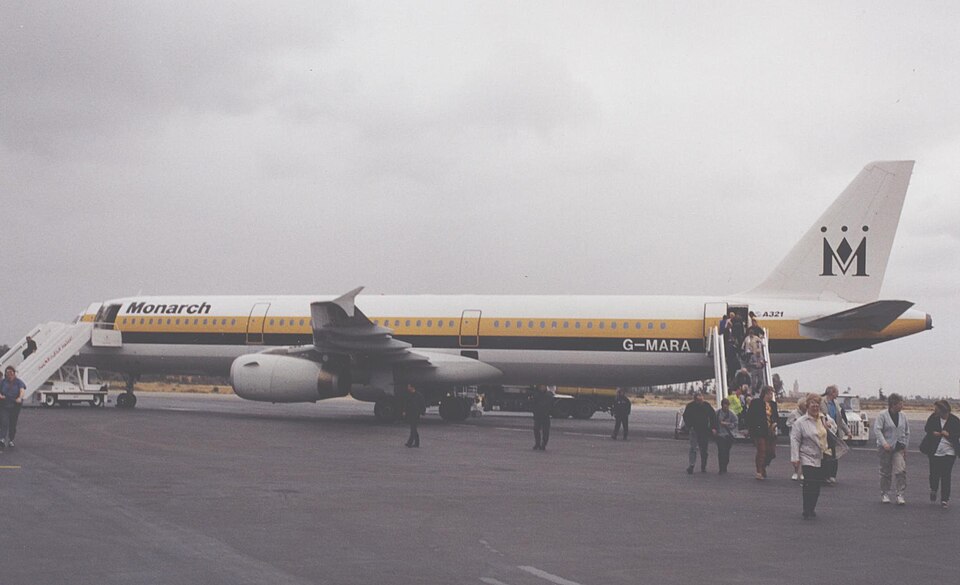
On 28 July 2008, an Airbus A321-231, registration G-MARA, operating a night charter flight from Malaga to Manchester International Airport, experienced a hard landing that caused internal damage to the nose landing gear. The aircraft was substantially repaired following further maintenance actions that discovered severe distortion of the shock absorber assembly.
History of the Flight
The flight was conducted without incident until the landing. The co-pilot, who was the pilot flying, initiated the flare slightly early, causing the aircraft to float at approximately 10 feet above the runway. During the float, the co-pilot's sidestick moved rapidly to the fully forward position and then to the fully aft position. The aircraft responded with a rapid nose-down pitch and touched down in a near flat attitude. A significant bounce occurred, controlled by the co-pilot, followed by a second touchdown and rollout. The commander then taxied the aircraft to the parking stand. Three passenger service unit oxygen masks had dropped from their stowages, but no injuries were reported.
Initial Maintenance Actions
A company ground engineer boarded the aircraft and spoke with the flight crew. The crew reported the heavy landing and expressed certainty that damage must have occurred. The engineer referred to the Aircraft Maintenance Manual (AMM) section for inspection after hard/overweight landings. Because an automatically printed LOAD<15> report was not generated, he accessed the Aircraft Integrated Data System (AIDS) Management Unit (DMU) and found no stored report. Concluding that the landing had not exceeded the parameter limits, he determined that no inspection was required. However, due to the crew's concerns, he performed the visual items of the Phase 1 heavy landing inspection, which revealed no damage. The oxygen masks were re-stowed, the technical log entry was cleared, and the aircraft was released to service.
Further Maintenance Activity
Later that night, G-MARA departed Manchester, but the flight crew was unable to retract the landing gear and received a landing gear shock absorber fault message. The aircraft returned to Manchester and landed without further incident. Fault finding initially focused on the nose leg proximity sensors. When the nose of the aircraft was jacked up to check sensor operation, the nose leg did not extend as expected, and fluid leaked from the assembly. Disassembly revealed that the internal shock absorber assembly was severely distorted, and a link rod connecting the upper arm of the torque link to the moving proximity sensor target mounting was bent. The operator provided the aircraft manufacturer with Flight Data Recorder (FDR) data to determine the extent of additional inspections. The nose leg assembly was replaced, and various inspections identified no other damage.
Flight Recorders and Analysis
The aircraft was equipped with a Flight Data Recorder (FDR) and a Cockpit Voice Recorder (CVR), as well as a Quick Access Recorder (QAR). The FDR provided a complete record of the incident flight. The CVR record for the landing, however, had been overwritten by the time the damage was identified. The QAR data was replayed by the operator. The FDR recorded sidestick positions, pitch attitude, radio altitude, and normal acceleration. Analysis showed that during the flare, the co-pilot's sidestick moved fully forward and then fully aft, causing a rapid de-rotation. The aircraft touched down at about 1° nose down with a peak normal acceleration of 1.99g. Both nose and right main gear oleos compressed within one second, followed by the left main gear. The aircraft bounced, remained airborne for just over a second, then touched down again on the main gear with a 2g normal acceleration. The spoilers deployed automatically, and reverse thrust and manual wheel braking were applied. The commander's sidestick showed no movement throughout the approach and landing. The recorded parameters did not exceed the LOAD<15> report limits (descent rate 9 ft/sec and normal acceleration 2.6g); the initial touchdown recorded 3 ft/sec and 2g.
Co-pilot's Training
The co-pilot had begun flying the Airbus A320 series in February 2008 and had accrued 248 hours on type at the time of the accident. During type conversion training, he found the conventional hand position on the sidestick uncomfortable and adopted a lower grip at the suggestion of a training captain. Following the accident, the operator conducted additional simulator, base, and line training with the co-pilot, which revealed no issues, and he was cleared to resume line flying. A subsequent review of his landings using Operational Flight Data Monitoring (OFDM) data found no problems with his landing ability.