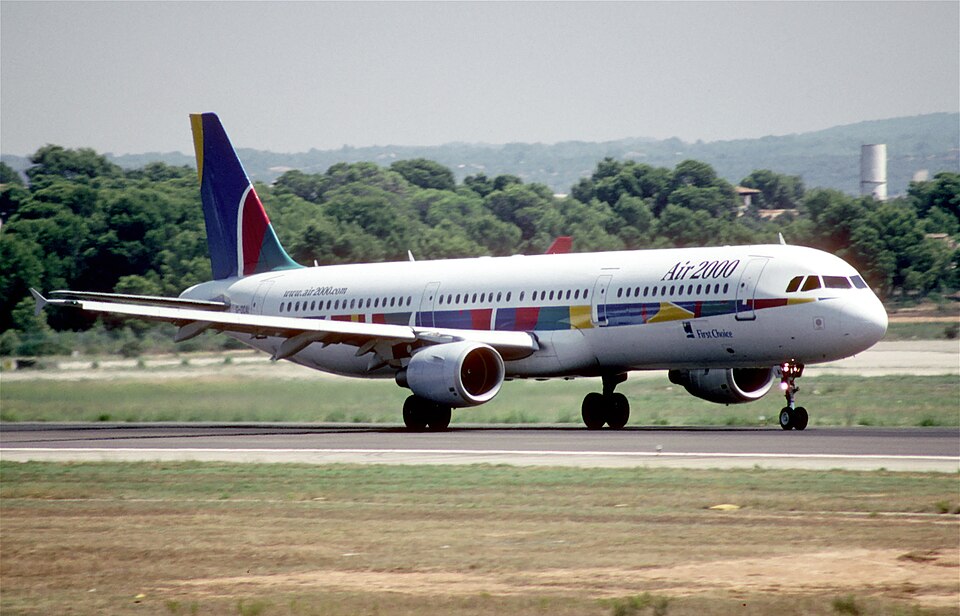
On June 3, 1999, an AIRBUS A321-211 (registration G-OOAI) was involved in an aviation accident near Runway 24R, Manchester International Airport, GB. This summary draws on records from the UK Air Accidents Investigation Branch (AAIB).
An Airbus A321, G-OOAI, made a hard landing at Manchester Airport on 3 June 1999, resulting in a tail strike. The incident occurred during a public transport flight with no injuries reported.
Incident Overview and Aircraft Details On 3 June 1999, an Airbus A321 with registration G-OOAI, manufactured in 1999 and powered by two CMF56 turbofan engines, was involved in an incident at Manchester Airport. The aircraft was operating a public transport flight with seven crew members and 221 passengers on board. No injuries were reported among the crew or passengers. The incident resulted in skin and stringer damage over an area of 137 cm by 46 cm between frames 62 and 65 of the aircraft. ## Flight History and Approach The crew was on the second sector of the day, returning to Manchester Airport. The first officer was designated as the handling pilot for the return flight. The weather at Manchester included a surface wind of 270° at less than 5 kt, visibility of 5,000 metres, scattered cloud at 800 feet above ground level, and a wet runway. The aircraft was vectored by air traffic control to approximately 15 nautical miles east of the airport before being turned inbound for the Instrument Landing System (ILS) approach to Runway 24R. The first officer briefed for a 'CONFIG FULL' landing using automatic spoilers and medium autobrake. He reported being fully established on the ILS by 3,000 feet above mean sea level and the aircraft stabilised by approximately 1,200 feet above ground level. At about 400 feet above ground level, the first officer became visual with the runway and disconnected the autopilot. ## Landing Sequence and Tail Strike During the final approach, the electronic voice called '50 feet' as the first officer applied back pressure to the sidestick. He noticed the rate of descent was higher than normal and moved the sidestick further back. The aircraft contacted the runway hard on the main gear, and the first officer felt his sidestick was fully back. He believed the aircraft bounced and moved the sidestick forward to the neutral position. The commander then called 'I have control' and took over the aircraft. A second touchdown occurred, which was firm but not as hard as the first. The commander recalled that light to moderate rain was falling during the approach. The PAPIs indicated the aircraft was on the correct approach path, and autothrust was maintaining airspeed at about 3 to 5 kt above the lowest speed (VLS) of 135 kt. At the point where the commander expected the flare to be initiated, there was no apparent aircraft attitude change, and he perceived that the nosewheel might contact the ground before the main gear. He urgently called for the nose to be raised, which was done, but the aircraft made a very firm touchdown and seemed to bounce. ## Post-Landing Observations and Damage While taxying to the parking stand, the commander asked air traffic control if there had been any indication of a tail strike on landing and was advised in the negative. He also consulted with the cabin crew and ascertained that there had been an unusual noise at the back end of the aircraft on touchdown. Once on stand, scrape marks were observed on the bottom of the rear fuselage of G-OOAI. ## Flight Recorder Data Recorded information from the Flight Data Recorder (FDR) and Cockpit Voice Recorder (CVR) was available. Both recorders used solid-state recording technology and retained the whole of the accident flight, including the landing. At 400 feet above ground level, the commander briefly operated the windshield wipers. The first officer stated he was visual with the field and required no further calls. He disconnected the autopilot at 320 feet above ground level but left the autothrottle engaged, which maintained a stable, managed airspeed of 140 kt. The final approach was made on the glideslope with an average barometric descent rate of 800 feet per minute and an aircraft pitch attitude of 2.8°. Throughout the approach and landing phase, sidestick movements resulted in corresponding changes in elevator deflection. At 150 feet above ground level, the aircraft began to rise above the glideslope, and the first officer applied a small amount of forward sidestick, lowering the nose to a pitch attitude of 2.1°. The ground closure rate was 900 feet per minute at this time. By 100 feet above ground level, the divergence in glideslope was arrested at a maximum of 0.6 dots, and the first officer neutralised his sidestick. With an unchanged ground closure rate of 900 feet per minute, no further control inputs were made until 60 feet above ground level, when the first officer gradually began to move his sidestick aft. The pitch of the aircraft was unchanged at 2.1° by the time of the automatic 'fifty' feet call. By 45 feet above ground level, the sidestick had reached 2.5° aft of neutral. The commander told the first officer to 'watch the sink rate' as the aircraft descended through 30 feet above ground level, and the first officer continued to move his sidestick to 5° aft of neutral. The pitch of the aircraft was still recorded as 2.1° nose up. Just after the automatic call of 'twenty ... retard', the first officer's sidestick was 10° aft of neutral. The aircraft had started to pitch up and achieved a pitch attitude of 3.1° by 15 feet above ground level, but still with a descent rate of 900 feet per minute. One second later, the aircraft pitch had increased to 5.6°, the first officer had moved his sidestick further aft to 11.1°, and the last airborne radio altitude of 2 feet above ground level was recorded as the rate of descent started to reduce. At touchdown, a normal acceleration of 1.95 g was recorded with the aircraft pitch attitude at 6.0° and wings level. Both left and right main gear 'weight on wheels' switches closed. The first officer's sidestick was recorded as being 12.4° aft of neutral at touchdown. Pitch attitude was still increasing as the aircraft became light on the oleos, opening the left main gear 'weight on wheels' switch but not that of the right main gear. Ground spoilers started to deploy, and the first officer moved his sidestick forward momentarily before pulling it back to 11.2° aft. However, pitch attitude continued to increase through 8.8°, and the commander stated 'I have control'. The first officer's sidestick neutralised as the aircraft sank on the main gear, registering a normal acceleration of 1.64 g at a pitch attitude of 9.5°. The commander applied full forward movement on his sidestick and arrested the pitch up at an attitude of 9.84°. The aircraft began to pitch down rapidly, and at a pitch attitude of 6.7°, the commander applied full aft movement on his sidestick until the nose gear contacted the runway. The maximum rate of pitch down achieved was 7 degrees per second, and the contact of the nose gear with the runway was very distinct on the CVR. ## Comparison with Other Landings The incident landing was compared with previous landings made by G-OOAI that were recorded on the FDR. There were no major differences noted in the centre of gravity positions of any of the flights compared to the incident flight. However, the rate of descent in all the uneventful landings had been reduced earlier by increasing the pitch attitude of the aircraft. Typical of such landings was the start of reduction in descent rate at heights between 60 feet and 100 feet above ground level. This resulted in typical descent rates in the order of 600 feet per minute by 30 feet above ground level and less than 300 feet per minute at touchdown. A different operator, flying the same type of aircraft (G-MIDA), had a very similar event ten months before the date of the incident to G-OOAI. The data from that earlier event showed a descent rate in the order of 900 feet per minute during the final seconds before touchdown and a high pitch attitude of the aircraft during the flare; that event also resulted in a tail strike. ## Engineering and Operational Information Damage to the aircraft was limited to abrasion damage to skin, frames, and stringers over an area of 4.5 feet by 1.5 feet between frames 62 and 65. A post-flight Heavy Landing Inspection found no other damage. Inspection of the runway also revealed no evidence of surface marking resulting from the tail strike. A post-flight readout of the Electronic Centralised Aircraft Monitoring System (ECAMS) showed that there had been no relevant system fault detected during the subject flight. The first officer had recently completed his line training, with his final line check on 29 May. He had then flown two line sectors on 30 May before flying G-OOAI on 3 June. At the time of the incident, he had a total of 5,200 hours, of which 60 hours were on Airbus A320/321. During his line training, he had flown 12 of the 16 sectors on the Airbus A321. His training records indicated a competent pilot who had fully completed his conversion training to a satisfactory standard. The aircraft manuals include the following relevant information about landing the A320/321: 'For the A321, a tail strike occurs if pitch attitude exceeds 11° (9.5° with the landing gear compressed). For the A320, a tail strike occurs if pitch attitude exceeds 13.5° (11.5° with the landing gear compressed). For both models, there is a pitch-up tendency with ground spoiler extension.' Passenger and baggage weights were based on standard European charter flight figures; the centre of gravity and total weight had been calculated accurately on the manual load sheet. Additionally, a manual calculation of VLS and Vapp based on the aircraft weight and surface wind confirmed that the speeds used for the approach and landing of G-OOAI at Manchester were accurate.