Incident
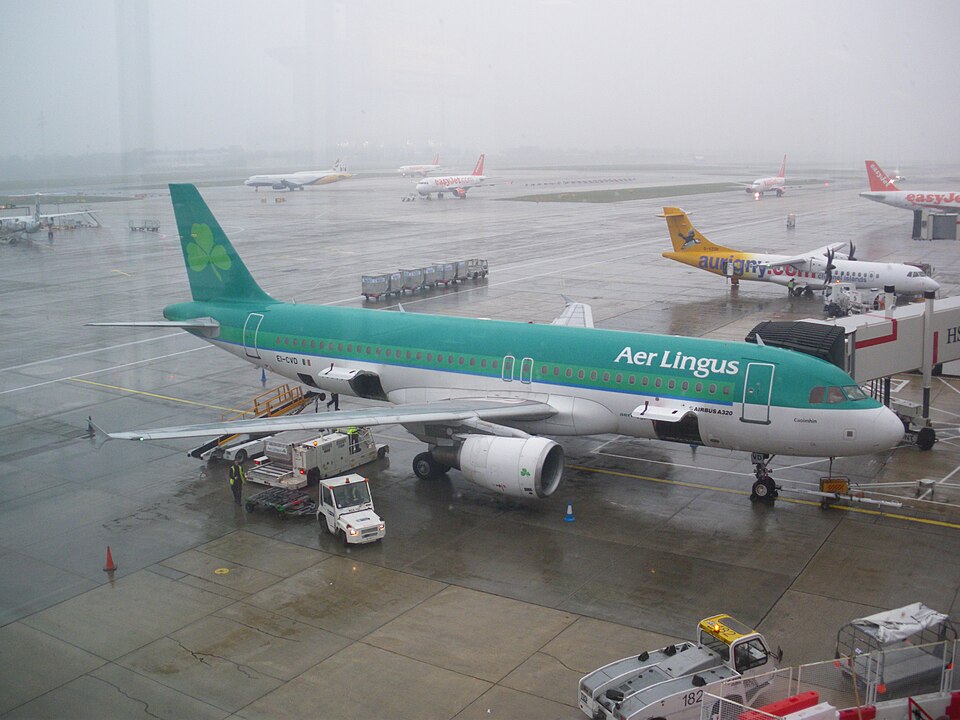
On 4 February 2002 at 2215 UTC, an Airbus A320-211 (registration EI-CVD) operating a scheduled passenger flight approached Stand N84 at London Heathrow Airport's Terminal 1. The aircraft had 7 crew and 151 passengers on board; no injuries were sustained by either crew or passengers. The aircraft turned right to enter the stand from the west. Due to the short taxi distance from the inner taxiway, pilots had limited time to view the stand after aligning with the centreline. The commander observed the stand guidance system was active and appeared operational. He had turned off the aircraft's taxi lights before entering the stand to avoid dazzling ground staff, following standard practice. The commander followed the Azimuth Guidance Nose-In Stands (AGNIS) centreline guidance and stopped at the position indicated by the Parallax Aircraft Parking Aid (PAPA) board. A ground technician then informed him that the outer side of the No. 1 engine nacelle had struck a parked vehicle.
Examination of the Stand
Post-incident examination conducted by airport police, airline, and airport authority personnel confirmed that the aircraft had stopped correctly on the stand centreline at the appropriate distance from the terminal. The collision with a baggage belt loader left a one-metre-long gash in the lower outboard quadrant of the No. 1 engine cowling. Two belt loaders, belonging to a different airline, had been left unattended. They were positioned outside the marked safe vehicle parking zones, in the area beyond where the airbridge was parked. The struck loader projected approximately 4 metres into the stand beyond the designated parking area.
Pre-Arrival Activity
According to the handling agents, it was a dark, wet, and windy night, and flights were operating up to three hours late. The flight dispatcher, responsible for ensuring the stand was clear of obstructions, was busy checking cargo load details and asked a ramp agent to turn on the stand guidance systems on his behalf. The ramp agent complied, believing the stand to be clear. After finishing paperwork, the dispatcher moved to the control position at the end of the airbridge jetty, arriving as the aircraft turned into the stand. He did not see the obstructing belt loaders. As the aircraft neared its stopping point, he noticed a ground handler gesturing to indicate a problem, but by then the aircraft had struck one of the loaders.
Observations
The belt loaders were parked in the area of the stand in front of the airbridge jetty, on the left side from the approaching aircraft's perspective. With the stand lit mainly from the front, the loaders were at least partially in the shadow of the airbridge. Since the aircraft's taxi lights were off, reflective markings on the loaders were not highly visible to the commander, whose attention was focused ahead and to the right on the AGNIS and PAPA indicators. Rain on the windshields partially obstructed both pilots' forward and side views. Once the aircraft was on the centreline, the loaders were obscured from the co-pilot's view by the fuselage. From the dispatcher's position at the end of the jetty, the loaders were outside his field of view. Ground staff at the front of the stand had their view of the loaders partly masked by the airbridge leg and likely partially camouflaged by general stand clutter.
Comments
This incident underscores the importance of ground handling staff exercising proper discipline when parking vehicles near stands. It also highlights the need for staff awaiting an aircraft arrival to conduct a thorough check for obstructions before activating stand guidance systems. While pilots are ultimately responsible for safe manoeuvring, they have a right to expect that an illuminated stand guidance system indicates the stand has been checked for obstructions by a competent person shortly before their arrival.