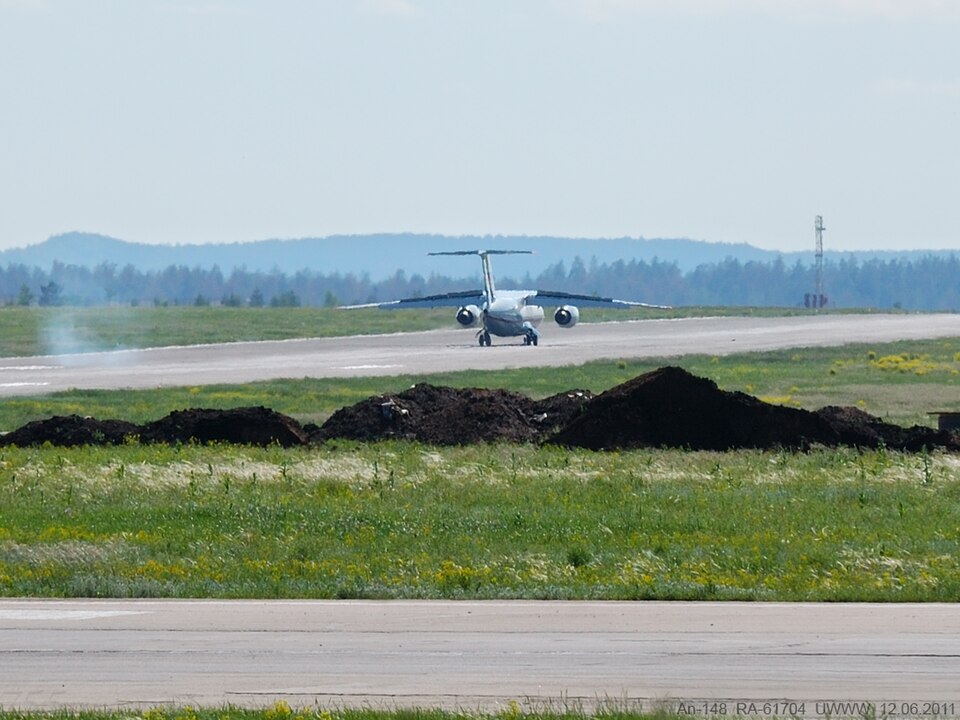
On February 11, 2018, an Antonov AN-148 (registration RA-61704) operated by Saratov Airlines (Saratovskoye Avialinii - Saravia) was involved in an aviation accident near Stepanovskoye, Russia during takeoff. 71 people were killed. Investigators recorded the probable cause as: Erroneous crew actions while climbing in instrument meteorological conditions with unreliable instrument speed readings caused by icing of all three Pitot tubes, leading to loss of control in flight (LOC-I). This summary draws on records from the Bureau of Aircraft Accidents Archives (B3A).
An An-148 disintegrated in a field near Moscow-Domodedovo after takeoff, killing all 71 occupants. The crash was caused by crew error during unreliable airspeed readings from iced Pitot tubes.
Accident Overview and Sequence of Events A twin-engine An-148 aircraft departed runway 14R at Moscow-Domodedovo Airport at 1421 local time. Six minutes after takeoff, while climbing to 6,000 feet in light snow showers, the aircraft descended and disintegrated in a snow-covered field near Argunovo, approximately 37 kilometers southeast of the airport. The aircraft was completely destroyed, with debris scattered over more than one kilometer. All 71 occupants were killed. Both recording systems were recovered. ## Technical Findings Russian authorities confirmed the aircraft was intact until final impact. Preliminary reports indicated speed variations on all three airspeed indicators (ASIs) three minutes after rotation. Fifty seconds after the autopilot was disconnected, the aircraft experienced vertical loads between 0.5 and 1.5 G, then pitched down to 35 degrees. Five seconds before impact, the aircraft banked right to 25 degrees. Investigations determined that incorrect ASI data resulted from icing of the Pitot tubes, as the heating systems were off, apparently because the crew failed to activate them. ## Probable Cause and Contributing Factors The official probable cause was erroneous crew actions while climbing in instrument meteorological conditions with unreliable instrument speed readings caused by icing of all three Pitot tubes. This rendered the aircraft uncontrollable, leading to a dive and ground impact, classified as a loss of control in flight (LOC-I). Contributing factors included: - Crew hurry during flight preparation due to late arrival from a previous flight - Failure to activate Pitot tube heating before takeoff and non-compliance with the “BEFORE TAKE-OFF” checklist - An-148 design features requiring Pitot tube heating checks in a separate checklist section immediately before takeoff, increasing the risk of omission - Systematic crew failure to follow the “dark cockpit” principle, leading to habituation to warning messages on the KISS system - Six warning messages displayed before takeoff, including three about absent Pitot tube heating - Design limitations preventing disabling of certain KISS warning messages during delayed-defect operations - Low safety culture, including failure to record in-flight failures and operating with unresolved defects - Failure to address previous instances of untimely Pitot tube heating activation - Inadequate crew training for the “Speed of Emergency” alarm, including inability to practice this scenario on flight simulators - Absence of federal aviation regulations for flight simulator certification - Approval of simulators without accounting for their ability to reproduce special flight cases - Missing specific flight parameter values in the flight manual for airspeed alarm procedures - Increased crew stress and the captain’s “tunnel effect,” focusing on the left airspeed indicator without comprehensive assessment - Insufficient training in human factors, threat and error management, and crew resource management - Individual psychological factors, including the captain’s reduced flexibility and fixation on their own position, and the second pilot’s disorganized actions - Loss of the captain’s psychological performance, resulting in spatial disorientation and inability to respond to the co-pilot’s prompts or the PULL UP warning - Absence of psychological incapacitation criteria in the airline’s AFM - High annual leave arrears potentially causing captain fatigue - Aircraft control system operating in an undocumented reconfiguration mode with unreliable speed signals, reducing crew recognition time