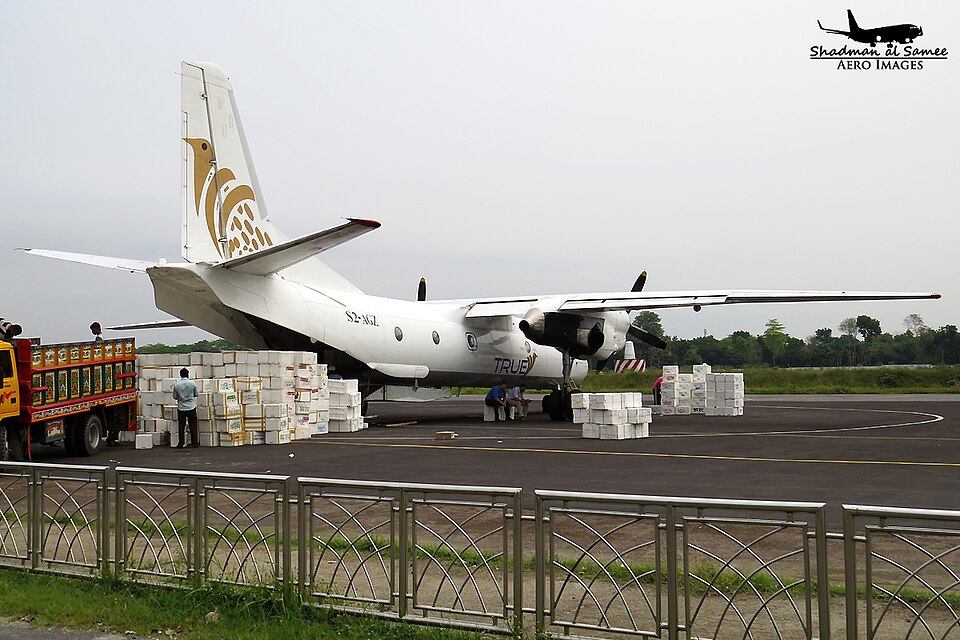
Accident Details
On March 9, 2016, an Antonov AN-26B aircraft operated by True Aviation Ltd was scheduled to transport a cargo of shrimp fries from Cox's Bazar Airport (VGCB) to Jessore Airport (VGJR) in Bangladesh. The cargo consisted of 802 boxes weighing 4,800 kg. A flight plan was filed with the estimated time of departure left blank, routing via CB W4 CTG W5 JSR at flight level 100. All documents except the load sheet were properly signed and retained by the Aircraft Accident Investigation Team.
Flight Sequence
According to air traffic control recordings, the flight crew requested startup clearance at 0258 UTC. The controller provided visibility information for Jessore Airport as 3 km. After starting engines, the aircraft taxied to Runway 35 via taxiway S and was cleared for takeoff at 0305 UTC. Immediately after becoming airborne, the pilot reported an engine failure, initially without specifying which engine, but later confirming the left engine had failed. The pilot requested an immediate return to Cox's Bazar. ATC instructed the crew to join a left-hand downwind leg, but the control tower observed the aircraft making a right-hand downwind at a very low altitude. Emergency services were placed on standby.
The aircraft called final approach and requested landing clearance, but for reasons unknown, executed a low-level go-around. The tower controller saw the aircraft at approximately 400 to 500 feet. The surviving flight navigator confirmed this altitude in a statement. ATC again advised the captain to fly a left-hand downwind, but the crew did not respond. Repeated calls from ATC went unanswered, and communication was lost entirely at 0332 UTC. The airport authority then learned through other means that the aircraft had crashed about 3 km west of the airport.
Probable Cause
The official investigation identified the probable cause as a combination of factors: a) failure to initiate a rejected takeoff during the takeoff roll following the indication of engine failure; b) failure to adhere to company standard operating procedures after detecting the engine failure; c) not diverting to the alternate airfield at Chittagong Airport, located only 50 nautical miles away, which had full ILS approach capability and could have assisted the crew in performing a proper one-engine-out precision approach, especially given the poor visibility at Cox's Bazar; d) the aircraft flew at a speed of 225 km/h in clean configuration, well below the minimum clean configuration speed of 290 km/h; e) according to flight data recorder information, the aircraft stalled while making a turn toward the side of the failed engine at a very low altitude.