Incident Overview
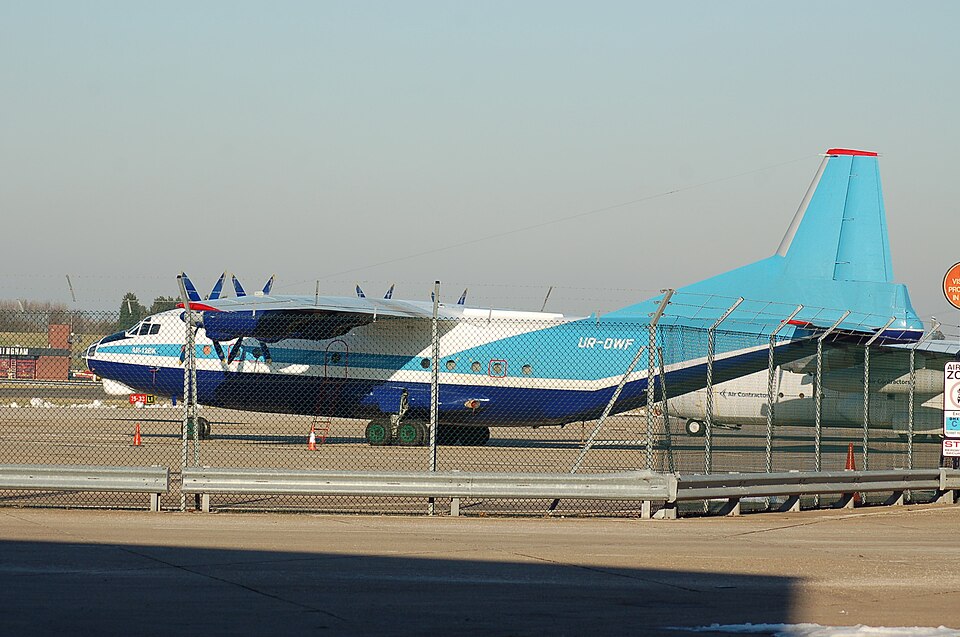
On 9 February 2012 at 1620 UTC, an Antonov An-12BK (registration UR-DWF) operated by an unnamed cargo carrier sustained scratch damage to its right wing after striking the horizontal tailplane of a parked Lockheed L-100-30 Hercules at Birmingham Airport. The aircraft had just landed from Graz, Austria, and was taxiing to its assigned parking position under the guidance of a marshaller and two assistants. There were no passengers on board; the seven crew members were uninjured.
Sequence of Events
After landing, the An-12 arrived on the apron in good time. The marshaller identified a parking position that required the aircraft to taxi through a gap between two parked aircraft: a Piaggio P180 on the left and the L-100-30 Hercules on the right. No ground taxi markings existed on the apron. The marshaller positioned himself between the two aircraft to attract the crew’s attention and indicate the intended stand. Two assistants were placed: one near the Piaggio and one directly under the tail of the Hercules.
As the An-12 taxied straight ahead toward the gap, it began to deviate to the right. The commander later stated his initial concern was clearance from the Piaggio. The assistant by the Piaggio signalled safe wingtip clearance, while the assistant under the Hercules tail made no gestures, which the crew interpreted as safe clearance. Once satisfied with left-side clearance, the commander straightened the aircraft.
The marshaller noticed the An-12’s right wing approaching the Hercules and began signalling to turn left approximately 6 to 10 seconds before the collision. The assistant under the Hercules tail remained passive until immediately before impact. The marshaller gave a ‘stop’ signal but, after a short pause, continued marshalling the aircraft forward toward its parking position. Subsequent inspection revealed scrape marks on the underside of the An-12’s right wing where it had contacted the upper surface of the Hercules’s horizontal tailplane.
Contributing Factors
The gap between the parked aircraft was measured at 42.4 meters. The An-12 had a wingspan of 38 meters, providing only 2.2 meters of clearance on each side. Civil Aviation Publication 168 (Licensing of Aerodromes) suggests a minimum clearance of 20% of wingspan (7.6 meters per side for this aircraft). The marshaller had been confident the aircraft could pass safely.
An Airport Authority report revealed that the assistant under the Hercules tail was not trained for the wingtip guide role, and the An-12 crew could reasonably expect both assistants to be trained. The report noted that while the aircraft could have passed through the gap, the clearance was less than ideal. The aircraft did not precisely follow marshalling signals, and the marshaller and assistants did not stop the aircraft before the collision.
Damage and Aftermath
The Antonov An-12 sustained scratch damage to its right wing. The Lockheed L-100-30 Hercules suffered scratch damage to the upper surface of its left horizontal tailplane. The Hercules was subsequently ferried, with specific approval, to a maintenance facility for repair.