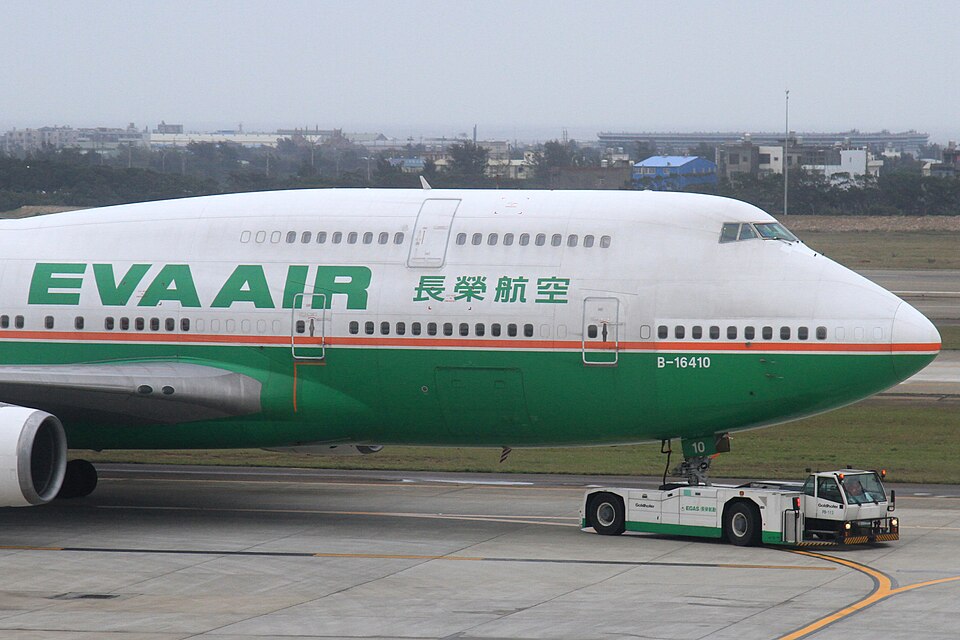
Accident Overview
On September 2, 2010, EVA Air Flight BR701, a Boeing 747-400 (registration B-16410), operated a scheduled passenger service from Shanghai Pudong International Airport to Taoyuan International Airport. The aircraft carried 2 pilots, 14 cabin crew, and 281 passengers. The captain served as pilot monitoring (PM) in the left seat, and the first officer as pilot flying (PF) in the right seat.
Weather and Landing Conditions
At the time of landing, Taoyuan Airport experienced rain showers, and the runway surface was likely wet. During the period 10 seconds before main gear touchdown to 16 seconds after, the automated weather observation system recorded wind direction between 290 and 360 degrees (right crosswind) at 3 to 13 knots.
Accident Sequence
The first officer disengaged the autopilot and autothrottle at 1,000 feet radio altitude and continued a manual landing. The aircraft touched down with a 4.4-degree left bank and a heading approximately 2.6 degrees left of the runway centerline. After touchdown, the left main landing gear departed the paved surface onto the shoulder and grass, then re-entered the pavement. The aircraft eventually stopped on the S2 taxiway, with its tail still within the runway-holding position marking, not fully clear of the runway.
The tower controller cleared the following aircraft, UNI Airways Flight 188 (also a B747-400), to land on the same runway after the crew of BR701 confirmed they had vacated the runway. UNI188 landed at 2140 hours while BR701's tail was still on the runway, resulting in a Category C runway incursion.
Damage
The aircraft sustained damage to the left main landing gear and wheel well (grass found), and the No. 1, 3, and 4 tires were damaged. The left body landing gear, left inboard flap, aileron, flap track fairing, fuselage skin, and horizontal stabilizer leading edge were also damaged. Five runway edge lights were destroyed, and a thousand-foot marker sign fell. No injuries to occupants were reported.
Probable Cause
The investigation identified the following causal factors: The aircraft landed on a wet runway with a right crosswind, with an unstabilized approach showing a left drift and a left-wing-down attitude at touchdown. After landing, the increasing right crosswind and pre-existing left drift continued. During the period from main gear touchdown to nose gear touchdown, reduced tire-to-pavement friction due to the wet runway and incomplete weight on the wheels diminished directional control. Despite right rudder input, the aircraft veered left off the runway before effective control was regained.
Related Findings
The report also listed risk-related findings, including issues with wind shear alert systems, controller communication, runway incursion prevention, airport maintenance, and human factors. These are not considered causal but contributed to the overall safety context.