Incident Overview
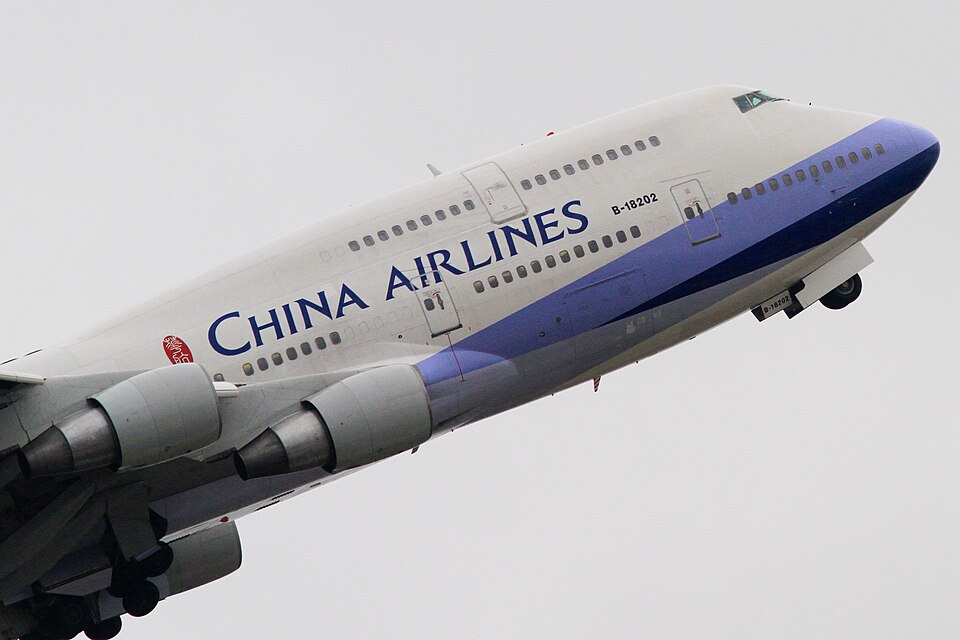
On October 2, 2008, China Airlines Flight 641, a Boeing 747-400 with registration B-18202, was operating a scheduled passenger service from Taoyuan International Airport via Hong Kong International Airport to Bangkok International Airport. The aircraft carried 2 pilots, 16 cabin crew members, and 147 passengers, totaling 165 occupants.
Flight Sequence
The flight departed Hong Kong at approximately 1203 Taipei time, cruising at 40,000 feet with favorable weather conditions. At about 1345:20, while preparing for descent, Thai air traffic control cleared the flight to proceed directly to waypoint CAROS on a heading of approximately 240 degrees, planning to use the CAROS 1B arrival procedure. The flight crew observed a cumulonimbus cloud (CB) ahead and to the left, less than 10 nautical miles in diameter, with red, yellow, and green radar returns and a top exceeding 40,000 feet. The crew assessed that the current heading would safely avoid the cloud, and the captain left the cockpit for the restroom.
At 1355:53, ATC instructed the flight to turn left to a heading of 210 for separation. The first officer, who was at the controls while the captain was away, evaluated that the aircraft was more than 20 nautical miles from the CB and that the turn would pass to its left. The captain returned to the cockpit and observed the aircraft turning toward the CB. He queried the first officer, who explained the ATC instruction. The captain decided to request a further left turn to heading 190, disengaged the autopilot, and hand-flew the aircraft with a steeper bank angle.
During the turn, the ride remained smooth. After reaching approximately 190 degrees, the autopilot was re-engaged. Radar showed no returns, and the CB was to the right. About one minute later, at 1358:16, the aircraft encountered unstable air, with vertical accelerations fluctuating between -0.866g and 1.663g for approximately seven seconds. The aircraft then returned to stable flight.
Injuries and Aftermath
The flight crew was notified by cabin crew that occupants had been injured during the turbulence. At 1408:57, the crew contacted Bangkok ATC, reporting strong turbulence and injuries, and requested ambulances and medical personnel on standby. The aircraft landed at Bangkok International Airport at 1423. Injured individuals were transported to local hospitals. Following inspections, the aircraft was ferried empty back to Taoyuan International Airport.
Investigation Findings
The Aviation Safety Council of Taiwan investigated the incident. The probable cause was identified as the aircraft's failure to maintain adequate separation from the cumulonimbus cloud, leading to an encounter with severe turbulence. Additional findings included that some injuries likely resulted from occupants not having seatbelts fastened, including cabin crew shoulder harnesses. The report also noted deficiencies in communication between flight and cabin crew regarding turbulence warnings, as well as incomplete passenger safety checks and inadequate procedures for injury reporting and handling of bloodborne pathogens.
Safety Recommendations
The council issued recommendations to China Airlines and the Civil Aeronautics Administration to improve pilot training for thunderstorm avoidance, enhance passenger and crew seatbelt discipline, and standardize procedures for turbulence response and injury management.