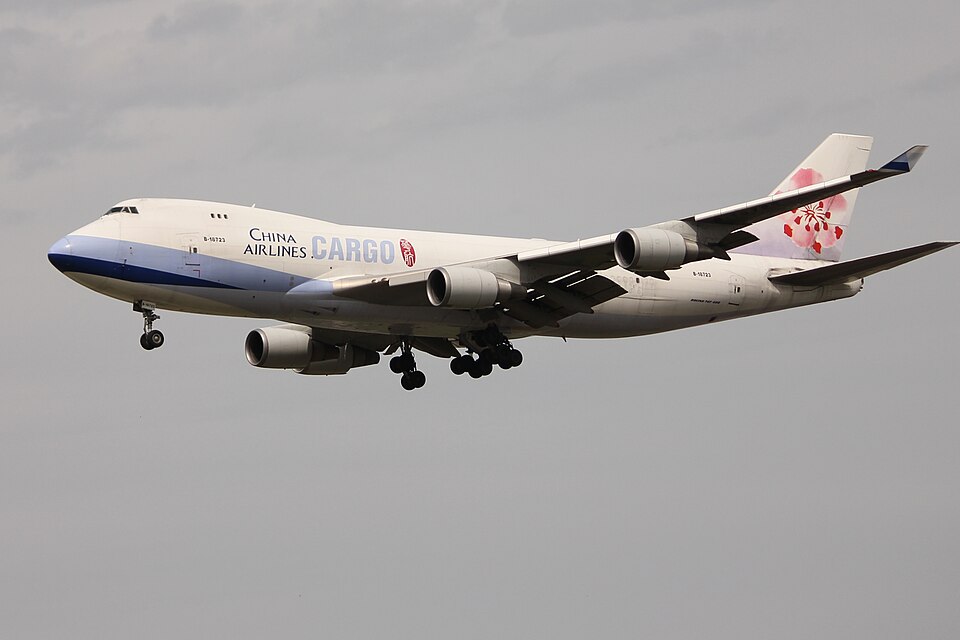
Accident Overview
On March 4, 2010, China Airlines (CAL) Flight CI 5233, a Boeing 747-400F cargo aircraft registered as B-18723, departed Runway 06R at Anchorage International Airport, Alaska, USA, en route to Taiwan Taoyuan International Airport. During the takeoff roll, the aircraft experienced a tail strike, resulting in substantial damage to the aft belly skin. The flight crew continued the flight to Taipei after an in-flight assessment.
Flight Sequence
At 0638 UTC (1338 local time on March 3), the aircraft began its takeoff roll. The flight crew had entered the takeoff data into the Aircraft Communications Addressing and Reporting System (ACARS) Runway Analysis System (RAS). However, the crew mistakenly used the landing weight from the computerized flight plan as the takeoff weight. This led to incorrect takeoff thrust, reference speeds (V1, VR, V2), and takeoff configuration (flaps setting).
During the rotation, the aircraft achieved a pitch attitude of approximately 12 degrees but did not lift off immediately. The stick shaker activated due to a low-speed condition. The pilot flying (CM 1) released the control yoke and manually increased thrust. The aircraft eventually became airborne after a prolonged ground run. The rotation speed (VR) was 149 knots, well below the correct speed of 166 knots, resulting in insufficient lift and an excessive angle of attack, causing the tail to strike the runway.
After takeoff, the crew discussed the possibility of a tail strike but found no specific indications. They decided to continue to Taipei, reducing the planned cruise altitude from FL360 to FL320. Upon landing, maintenance inspection revealed significant abrasion and damage to the aft belly skin, particularly around fuselage station BS2080.
Investigation Findings
The Aviation Safety Council (ASC) of Taiwan conducted the investigation. The following findings are related to the probable cause:
- The first officer (CM 1) entered the landing weight as the takeoff weight into the ACARS RAS, and the captain (CM 2) did not cross-check the input data. The crew also failed to review all output data for consistency.
- The captain entered the erroneous thrust setting into the Flight Management System (FMS), resulting in the FMS displaying "---" for V1, VR, and V2 on the takeoff speed page. The crew did not recognize the significance of the dashes and manually entered the incorrect speeds from the RAS output.
- The relief pilot (CM 3) attempted to verify the RAS calculations using the Runway Analysis Manual but used the same incorrect takeoff weight, thus not detecting the error.
- The aircraft rotated at 149 knots, which was 17 knots below the correct VR, leading to insufficient lift and a tail strike.
The investigation also identified several risk-related findings, including unclear standard operating procedures for RAS data entry, lack of cross-check discipline, fatigue factors among the crew, and deficiencies in crew resource management.
Safety Recommendations
The ASC issued recommendations to China Airlines and the Civil Aeronautics Administration (CAA) of Taiwan. Recommendations included:
- Enhance training and check procedures for takeoff performance calculations.
- Improve the design of the ACARS RAS or use alternative methods to reduce data entry errors.
- Improve readability of weight and balance documents.
- Enhance crew awareness of FMC abnormal displays.
- Strengthen training on tail strike hazards.
- Improve company emergency response and decision-making mechanisms.
- Address fatigue management.
- Enhance CRM training.