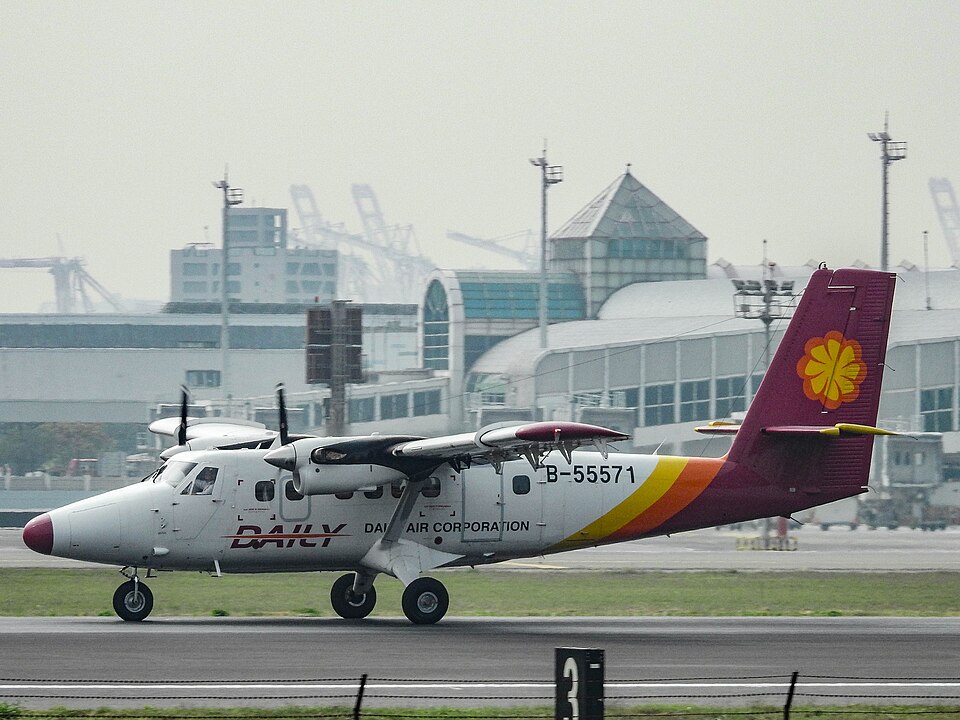
Aircraft and Flight Information
On April 13, 2017, Daily Air flight DA7511, a Viking DHC-6-400 with registration B-55571, departed Taitung Fengnian Airport at 1610 local time for a scheduled passenger flight to Lanyu Airport. The aircraft carried a captain, a first officer, a maintenance technician, and 16 passengers—19 persons in total.
Accident Sequence
At 1632, the aircraft landed on runway 13 at Lanyu Airport. During the landing roll, the aircraft veered left off the runway and struck the airport perimeter fence, sustaining substantial damage. All occupants were uninjured.
Investigation Findings
The investigation, conducted by the Aviation Safety Council (ASC) with participation from the Transportation Safety Board of Canada, Transport Canada, Viking Air, and others, identified the following findings related to probable cause:
- The aircraft approached and landed in left crosswind conditions. At touchdown, the nose was oriented to the left. After landing, a clockwise wind shear and flight maneuvers created a left-turning tendency.
- During the left deviation, the captain applied right rudder and pulled both power levers into reverse. When the captain intended to use right differential thrust to correct the left deviation, based on recorded engine torque and reverse thrust output, the captain inadvertently pulled the left power lever further, increasing left reverse thrust, which aggravated the left turn.
- Despite increasing right rudder and right brake application, the captain continued to increase left reverse thrust to maximum, causing the aircraft to veer off the runway and strike the fence.
Other findings included:
- The flight crew held valid licenses and medical certificates; no evidence of impairment due to drugs, alcohol, or fatigue.
- Moderate wind shear and near-moderate turbulence were encountered during final approach and landing, but crosswind and tailwind remained within limits.
- Aircraft weight and balance were within limits, and no pre-existing mechanical failures were found in engines, systems, or structure. Post-accident tests of engine controls and wheel brakes revealed no anomalies.
- Two previous incidents of power lever asymmetry and left veering had been corrected on March 24, 2017, and were unrelated to this accident.
Safety Recommendations
The ASC issued 12 safety recommendations, including calls for Daily Air to evaluate and document procedures for differential thrust use during landing roll, enhance safety management system training, improve self-audit programs, and establish flight data recorder readout capability. Recommendations to the Civil Aeronautics Administration included strengthening oversight of Daily Air’s safety management, reviewing airport risk assessments, and improving airport rescue and firefighting vehicle reliability.