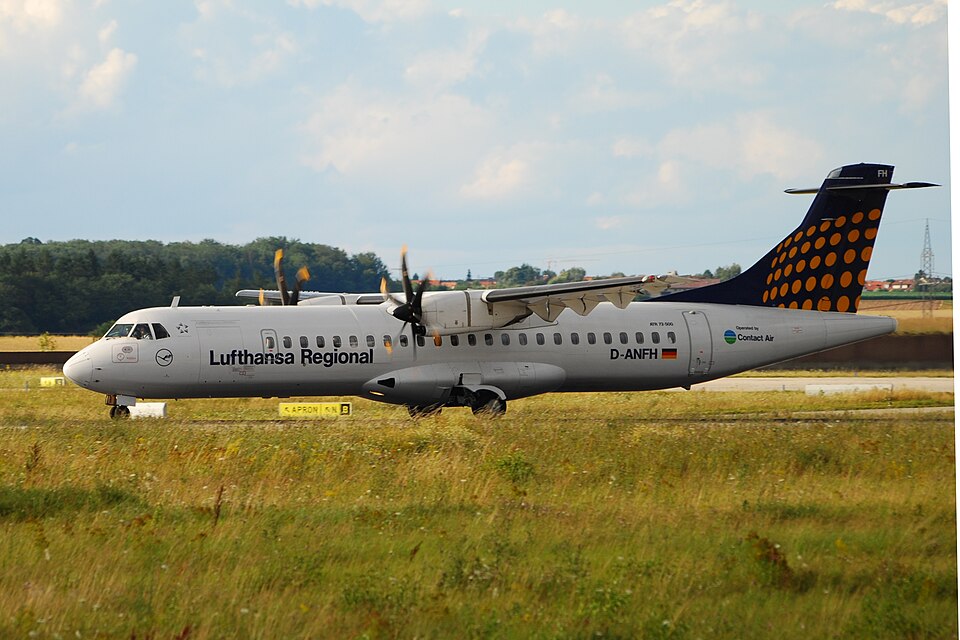
Accident
On 17 September 2005 at 1202 hours UTC, an ATR 72-212A aircraft, registration D-ANFH, sustained damage to its lower rear fuselage during landing at Guernsey Airport. The aircraft was operated on a non-scheduled public transport (passenger) flight from Düsseldorf. There were 4 crew and 63 passengers on board; no injuries were reported.
Flight History
Prior to the descent, the crew obtained the ATIS broadcast indicating Runway 27 in use, surface wind 020°/11 kt, visibility exceeding 10 km, and few clouds at 3,800 ft. They briefed for an ILS approach to Runway 27. The landing weight was 20.7 tonnes, and the approach speed (VAPP) was 107 kt (VREF plus 5 kt).
Guernsey ATC vectored the aircraft to the final approach track at 2,000 ft and offered a visual approach, which the crew declined. The aircraft intercepted the glideslope with landing gear extended and flaps set to 30°. At approximately 500 ft above the runway, the co-pilot (Pilot Flying) stated his intention to maneuver slightly below the glideslope. The co-pilot later explained that this decision reflected his relative lack of experience landing on shorter runways, as Guernsey was one of the shorter runways he operated to. The aircraft descended below the glideslope. Throughout the approach, airspeed varied between 110 kt and 127 kt, reducing to 100 kt at touchdown. The aircraft landed hard and bounced, during which the lower rear fuselage struck the runway. The commander recalled there was 'no flare' and that he had been 'guarding' the controls but did not have time to intervene. The crew completed the landing and taxied to parking. Ground staff later informed the commander of the damage.
Personnel Information
The commander, aged 54, held an Airline Transport Pilot's Licence with 10,000 total flying hours, including 517 hours on type. He had previous experience on the Shorts SD3-60 and Fokker 50. The co-pilot had 4,000 total hours and 500 hours on the ATR, with previous experience on the Fokker 50. The co-pilot had returned from two weeks holiday two days before the accident and reported he was well rested and fit to fly.
Operating Manual Requirements
The company's Operations Manual required a stabilised approach by 1,000 ft above threshold elevation, including being on the correct flight path and using appropriate power. It also specified a height over the landing threshold of no lower than 50 ft and a touchdown point 300 m beyond the threshold.
Landing Performance
Given the conditions (tailwind component of 5 kt, landing weight 20.7 tonnes), the Landing Distance Required was 949 m. The Landing Distance Available was 1,453 m.
Meteorological Information
The Guernsey TAF forecast wind 030°/12 kt, visibility >10 km, and scattered clouds at 3,000 ft. The 1150 hrs METAR (ATIS Information Bravo) reported wind 020°/11 kt, varying between 340° and 050°, visibility >10 km, few clouds at 3,800 ft, temperature 14°C, dew point 4°C, and QNH 1027 mb.
Aircraft Examination
Fuselage skin beneath the rear cabin door showed abrasion over 0.9 m length and 0.5 m width, affecting Frames 36 to 38. The skin was worn through, exposing flanges. Damage was symmetrical, indicating a wings-level attitude at initial touchdown. The tail skid, designed to prevent fuselage contact at pitch angles of 8° or greater, showed severe abrasion; its steel shoe had lost all red paint, and the shock damper was fully compressed. The limit strike detectors on the fuselage were worn away.
Runway Examination
A scrape mark 75–80 mm wide was found on the runway, approximately 35 m after the Runway 27 designator numerals (about 95–100 m from the start of paved area) and 60 m before the touchdown zone markings. The mark was adjacent to the centerline and contained red paint, consistent with the tail skid. The scrape was about 9 m long, with a wider portion up to 0.4 m where the fuselage underside also contacted the runway.
Flight Data Recorder Analysis
The FDR and CVR recorded the approach and landing. The CVR recorded crew conversation in German. FDR data showed the aircraft was initially above the glideslope, then regained it at about 1,500 ft. Airspeed varied, reaching 135 kt then decreasing. At approximately 500 ft, the aircraft was maneuvered below the glideslope, with pitch decreasing to -4°, then increased to 0° as torque reduced. During the flare, starting two seconds before touchdown, pitch increased to +6.5°. Touchdown occurred at 100 kt with vertical acceleration of 2.7g.