History of the Flight
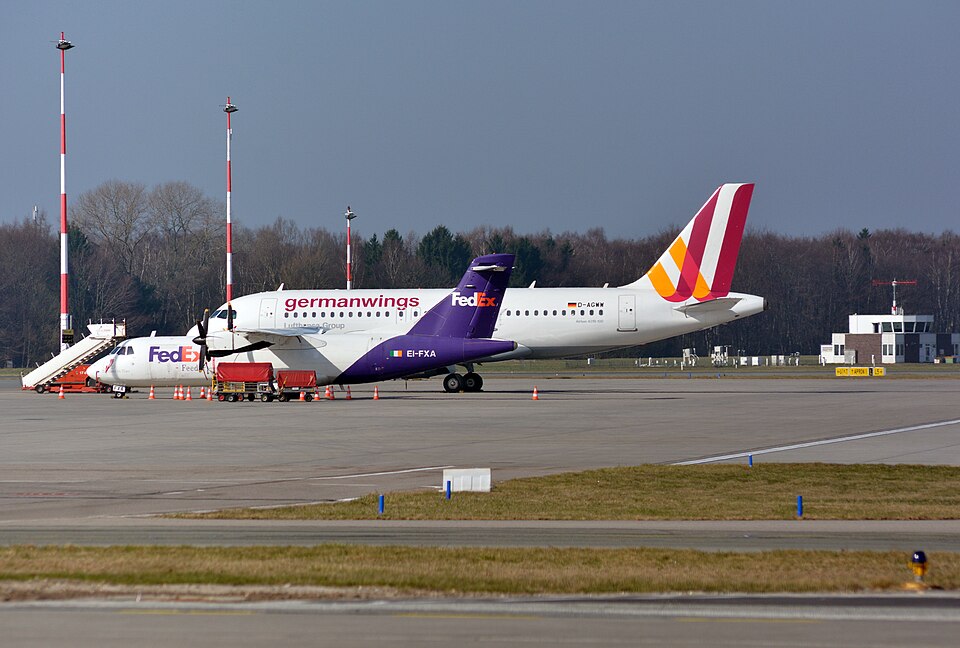
The crew reported for duty at Manchester at 2130 hrs on 21 February 2012, operating three cargo flights. After an ATR-72 flight to Paris, they took over ATR42-300 EI-FXA for the remaining two sectors. The co-pilot flew the first sector to Newcastle, then the commander assumed pilot flying for the departure to Glasgow at 0607 hrs.
During the cruise, the commander initiated conversation on various topics, speaking at length, while the co-pilot responded politely but briefly. The commander yawned periodically. Both crew members missed or misheard ATC communications. Some standard operating procedures were not followed.
Approach to Glasgow
The co-pilot obtained the ATIS for Runway 23: wet runway, wind 220°/21 kt, visibility 8 km in moderate rain, cloud layers at 1,300 ft, 2,000 ft, and 3,800 ft, temperature 11°C, dewpoint 10°C, QNH 1007 mb. The calculated approach speeds were 99 KIAS (non-icing) and 114 KIAS (icing). The commander did not specify which speeds would be used and omitted other briefing topics.
Events During the ILS
The approach controller provided radar vectors and descent instructions. At 0648 hrs, the aircraft was vectored onto the localiser. The commander commented on a "nice short final" and reduced engine torque. During the descent, the autopilot captured the localiser, and the commander instructed the co-pilot to arm approach mode. Engine torques were reduced to near zero, and the aircraft descended at 185 KIAS from 2,500 ft.
At about 2,100 ft, flap 15 was deployed. The autopilot then levelled at 2,000 ft with low torque, causing airspeed to decay. Neither pilot commented on the decreasing speed. The co-pilot noted they were 6.5 nm from the runway, but the glideslope had not been captured. When the controller asked if they were established on the ILS, the co-pilot keyed to respond, and at that moment the stall alert sounded and stick shaker activated; the autopilot disconnected at 111 KIAS, 1,700 ft agl.
The commander immediately pitched nose-down to -10° and advanced power to full, saying "I've got it." Airspeed dropped to 104 KIAS before increasing. The co-pilot called for nose-up, but the commander refused. At 125 KIAS, the commander began to pitch up, having descended to about 1,600 ft agl. The aircraft was then levelled at 1,900 ft with high torque, causing an overspeed beyond the flap 15 limit of 170 KIAS, peaking at 174 KIAS for about 5 seconds.
The commander reduced power, and the co-pilot suggested engaging the autopilot, but the commander declined. The flight director captured the glideslope at 4.8 nm. During the descent, airspeed reduced again to 111 KIAS, with angle of attack reaching 10.5° (just below the stall threshold). Crew attempts to re-engage the autopilot failed initially; torque was increased and airspeed rose. The controller was informed of problems, which were then resolved. At 115 KIAS and 3.4 nm, the autopilot was engaged, and the aircraft was fully configured for landing.
Aftermath
The landing was normal until touchdown, when a nacelle overheat warning activated; the crew did not follow the associated procedure. The commander briefed the engineer that there had been an autopilot problem, but the co-pilot stated the autopilot was not faulty and requested preservation of the flight recorder. No formal report was made of the stall alert, overspeed, or overheat warnings.
Later, the co-pilot contacted the company's flight safety department, leading to an internal investigation. The company notified the Irish Air Accidents Investigation Unit on 23 February, and the AAIB was informed on 24 February. An inspection revealed no damage or abnormalities.
Crew Information
The two pilots had not previously flown together. The commander, 58, held an ATPL and had 6,389 total hours (3,900 on type). In the three weeks prior, he had been on a training course and leave. The co-pilot reported sleeping well during the weekend but having disrupted sleep on 20 February, with about four to five hours of quality sleep, which he considered insufficient, though he stated he was not tired during the approach. Guidance on avoiding fatigue (CAP 371) did not directly apply as the operation was regulated by the Irish Aviation Authority.
Previous Sector Observations
CVR recordings from the Paris-Newcastle sector showed the commander (then pilot monitoring) using non-standard phraseology, yawning, and engaging in non-operational conversation. The co-pilot corrected an engine shutdown error upon arrival.