History of Flight
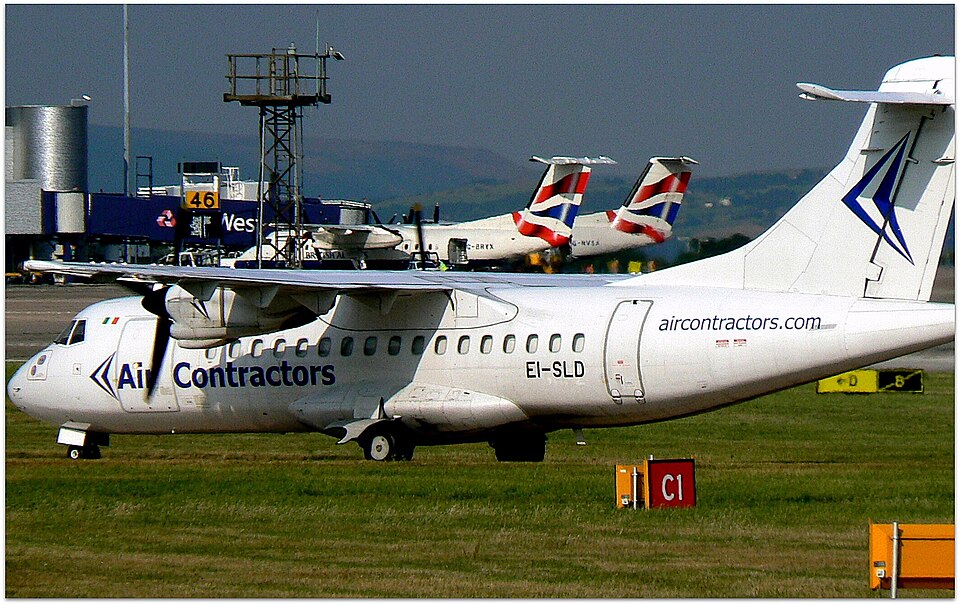
The aircraft, an ATR42-300 (registration EI-SLD), was operating a series of freight flights originating and ending at Glasgow Airport on the evening of 18 January 2007. The flight crew of two had been operating the aircraft continuously for several days and arrived at Glasgow at 0145 hrs the previous night. Both pilots reported for duty at 1600 hrs adequately rested. Glasgow had experienced snow and strong winds during the day, so the crew arranged for de-icing prior to departure. No ice was detected, and the surface temperature was 3°C. The first flight to Stansted was uneventful except for an intermittent, brief illumination of an amber caution light on the Central Crew Alerting System (CCAS), which had persisted for a few weeks without identification. The aircraft landed at Stansted at 2055 hrs.
Forecast strong crosswinds led the crew to load fuel for a diversion back to Glasgow. The aircraft departed from stand at 2211 hrs with two pilots, 2,800 kg of freight, and 300 kg of ballast. The calculated takeoff mass was 15,459 kg (maximum 16,700 kg), and the centre of gravity was 28% mean aerodynamic chord. The aircraft took off from Runway 23 with a reported wind of 240° at 14 kt. Almost immediately after becoming airborne, the crew experienced a yawing motion that developed into a motion described as similar to a Dutch roll. The co-pilot attempted to engage the yaw damper but it would not engage. The commander reported difficulty controlling the aircraft. The aircraft climbed to 3,000 ft and maintained approximately the runway heading. Air Traffic Control observed deviation from the cleared SID and instructed a right turn; the co-pilot informed the controller of control difficulties and requested radar vectors for an immediate return.
Flight Crew Reports
The commander had been flying the ATR42 and ATR72 for six years and had 2,144 hours on type, with 525 hours in command. The co-pilot had also flown the ATR42 and ATR72 for six years, with 800 hours on the ATR42. The initial motion was a gentle yaw producing heading changes of a few degrees. The commander attributed the motion to the yaw damper not engaging. When attempting to turn right, she achieved only a shallow angle of bank with full control wheel deflection. The motion remained predominantly yaw, increasing during turns. The co-pilot described the rudder displacing across its full travel within one to one and a half seconds. Neither pilot handled the flying controls throughout the flight. The motion varied in severity and, at its worst, was extremely uncomfortable. The crew also reported turbulence associated with strong low-level winds. Both pilots reported that right turns were difficult. The commander perceived limited roll control authority to the left and very restricted authority to the right. She stated reluctance to use the rudder pedals, though her feet remained on them. Neither pilot recalled significant pedal movement.
The crew elected not to declare an emergency initially but did so after reviewing the situation. The aircraft was vectored for an ILS approach to Runway 23. The commander experienced difficulty turning right onto final approach, and the aircraft flew through the runway centreline. After further vectoring, the aircraft established on the localiser but descended below the glidepath. Late in the approach, configuration warnings related to landing gear and flaps (not correctly set) were received. The aircraft continued and landed from a reduced-flap approach at 2241 hrs, after a flight of 15 minutes 24 seconds. No control difficulties occurred during rollout. The motion improved somewhat with flap 15 extended, which was deliberately selected late on approach. The commander instructed the co-pilot to handle engine and propeller controls for landing, and the final touchdown was controlled and smooth.
Examination of the Aircraft
Following the incident, the aircraft was examined. The tail cone was removed, exposing the base of the rudder and tab, the rudder input lever, and the Releasable Centring Unit (RCU). All components were secure and undamaged. The desiccant cartridge on the RCU was blue, indicating no moisture ingress. The gust damper showed no evidence of hydraulic fluid loss. No mechanical fault was found that would have caused the motion. However, an undetected and intermittent fault affecting components within the rudder control system could have degraded the aircraft's handling characteristics with the yaw damper not engaged, as could a takeoff with the rudder control system incorrectly configured. The nature of the motion and observed control deflections were such that an inadvertent and inappropriate rudder input by a pilot would have been required for the oscillations to persist.
Rudder System Description
The ATR42 is equipped with a manually operated primary flight control system augmented by hydraulically operated spoilers in the roll axis. Rudder pedals connect via cables to a spring-loaded servo tab on the rudder trailing edge. The rudder is connected to a Releasable Centring Unit (RCU), which provides a centring force toward the trimmed position to improve directional stability and dampen Dutch roll. An electrically operated trim actuator acts on the same linkage. The rudder trim switch also releases the RCU clutch. The yaw damper, part of the Automatic Flight Control System (AFCS), normally engages after takeoff to provide yaw damping and turn coordination. A gust damper (hydraulic dash-pot) is fitted between the rudder and fin. A force detector rod disconnects the autopilot/yaw damper if a load exceeding approximately 30 kg is applied to either rudder pedal. Prior to takeoff, the RCU must be centred on the trimmed rudder position by centring the pedals and momentarily moving the trim switch.