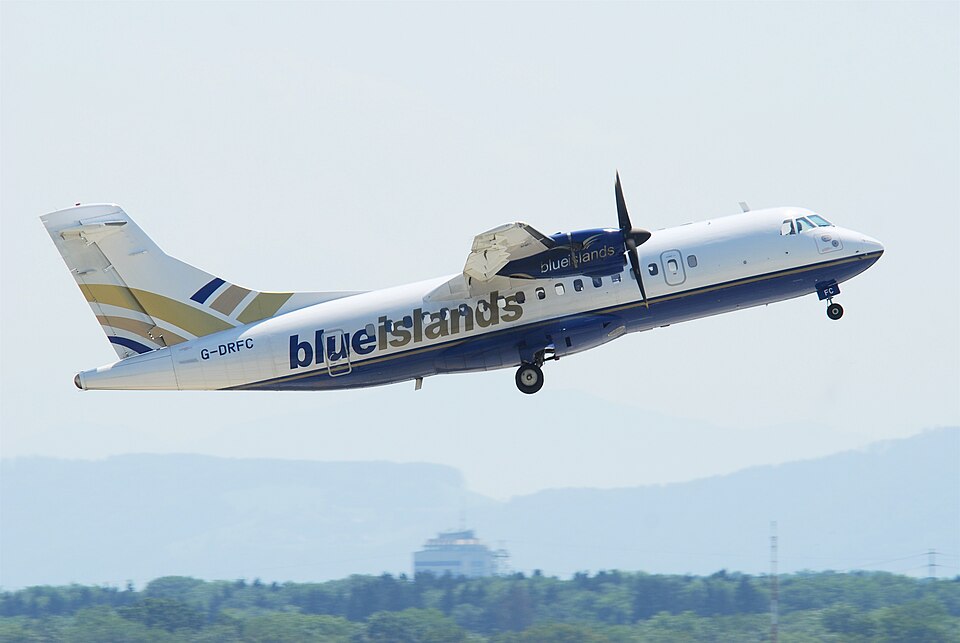
Flight Details
The crew reported for duty at Guernsey Airport at 0620 hours. The commander was conducting line training of a recently joined first officer. The first sector was from Guernsey to Jersey. Pre-flight preparation identified no issues, and the aircraft departed on time at 0705 with the commander as handling pilot. The short flight was uneventful. Weather at Jersey was reported as good with wind from 210° at 16 knots, few clouds at 2,000 feet, and visibility exceeding 10 km.
Approach and Touchdown
The commander elected a visual approach to Runway 27 at Jersey using a planned approach speed of 107 knots with flap 30. The landing gear was selected down, and the crew confirmed three green indications that the gear was locked down. The approach and touchdown appeared normal, with crosswind from the left causing the left main gear to touch first. Immediately after touchdown, both pilots and the cabin crew member heard a noise, and the commander felt the aircraft settle differently, suspecting a tyre burst.
Post-Landing Events
The commander selected ground idle and partial reverse pitch. As the aircraft decelerated through 70 knots, the co-pilot took over aileron control per procedures while the commander handled the steering tiller. The co-pilot reported that despite corrective inputs, the aircraft continued rolling left. A ground operations staff at Holding Point E observed that the left landing gear leg did not appear properly down. The aircraft rolled left until the left wingtip and propeller contacted the runway. The aircraft halted left of the centerline, approximately abeam Holding Point D. Both propellers continued rotating; the commander selected fuel shutoff and pulled fire handles to stop the engines. The tower controller activated the crash alarm, and emergency services arrived quickly.
Investigation Findings
The recorded data showed that the rate of descent during final approach was not excessive and remained low through touchdown. Although vertical acceleration at ground contact was high, it is believed to have resulted from the accelerometer's proximity to the fractured side brace rather than a hard landing. The collapse of the left main landing gear was precipitated by a fatigue crack that propagated through most of the cross-section of an attachment lug on the side brace upper arm. This crack continued as a region of ductile cracking until complete failure. The increased loading on other elements of the twin lugs caused rapid onset of fatigue damage and ductile overload failure of both lugs, rendering the side brace ineffective and allowing the main trunnion to translate outboard. The aluminum material met specifications. The initial fatigue crack emanated from a feature that was inter-granular and high in titanium content, likely a TiB2 particle introduced during grain refining. Surrounding the particle was an area consistent with static loading before fatigue crack propagation. It is concluded that at some time during the component's life, it probably suffered a single loading event sufficient to exploit the presence of the origin, initiating a crack that remained undetectable until failure.