Incident Summary
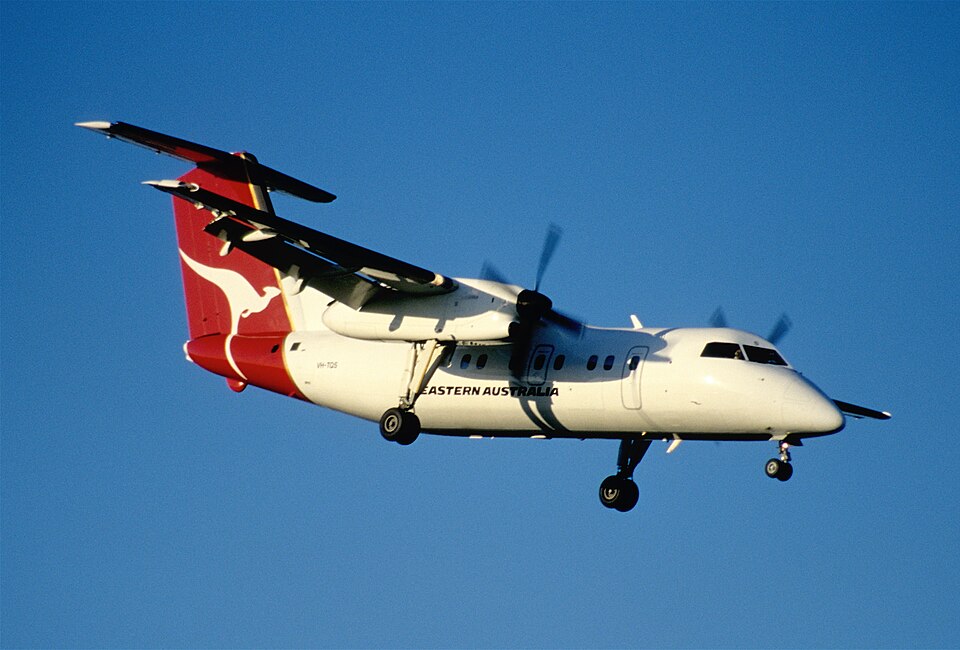
On 8 November 2022, a De Havilland Canada DHC-8-202, registered VH-TQS and operated by QantasLink, was conducting a passenger flight from Lord Howe Island to Sydney, New South Wales. During the descent, the flight crew observed failures of the traffic alert and collision avoidance system (TCAS), the ground proximity warning system (GPWS), and the radio altimeter. During landing, the beta lockout system horn activated, followed by engine manual warnings on both engines. The captain advanced the power levers to maintain propeller speed above the restricted range. After taxiing to a holding point, braking performance degraded, eventually failing and igniting. The captain initiated an evacuation; no one was injured.
ATSB Findings
The Australian Transport Safety Bureau (ATSB) identified that the radio altimeter failure led to the subsequent failures of TCAS and GPWS, as these systems rely on radio altimeter data. The radio altimeter failure also caused the beta lockout system to rely solely on weight-on-wheels (WoW) sensors. During landing, a momentary in-air indication from the WoW sensors triggered the beta lockout, resulting in a dual engine manual condition. With engines in manual mode, the captain had to manually advance the power levers to avoid the ground operating restricted range of the propellers. This increased braking demand, and combined with a taxi of over 5 km, caused the brakes to overheat, fail, and ignite.
The ATSB also noted that operational guidance in the Quick Reference Handbook (QRH) did not adequately inform the flight crew of the flow-on effects of the radio altimeter failure on the beta lockout system, nor did it provide sufficient guidance for responding to a dual engine manual condition. Although not contributory to the accident, the use of a Bromo Chloro di-Fluoromethane (BCF) fire extinguisher on the high-temperature brake fire potentially increased the risk of exposure to hazardous by-products.
Operator Actions
In response, QantasLink revised the DHC-8-200 QRH and Flight Crew Operating Manual to include further information about the beta lockout system and new checklists for radio altimeter failure and dual engine manual condition scenarios. The operator also published a technical advisory bulletin to DHC-8-200/300 flight crew outlining the event and associated learnings.
Technical Details
Flight data showed that when the power levers were retarded to beta range, the WoW sensors recorded a momentary in-air condition, activating the beta lockout. This reverted the engine control units to manual mode, disabling reverse thrust. To avoid the restricted propeller speed range (below 780 RPM), the flight crew increased thrust, placing additional load on the brakes. Braking performance deteriorated after about 3.3 km of taxi, with eventual brake failure and fire.
The absence of specific QRH guidance for a dual engine manual warning meant the flight crew followed procedures for a single engine manual warning, which did not address the need to minimize taxi distance. Had guidance existed, the crew could have stopped earlier, likely avoiding the brake failure and fire.