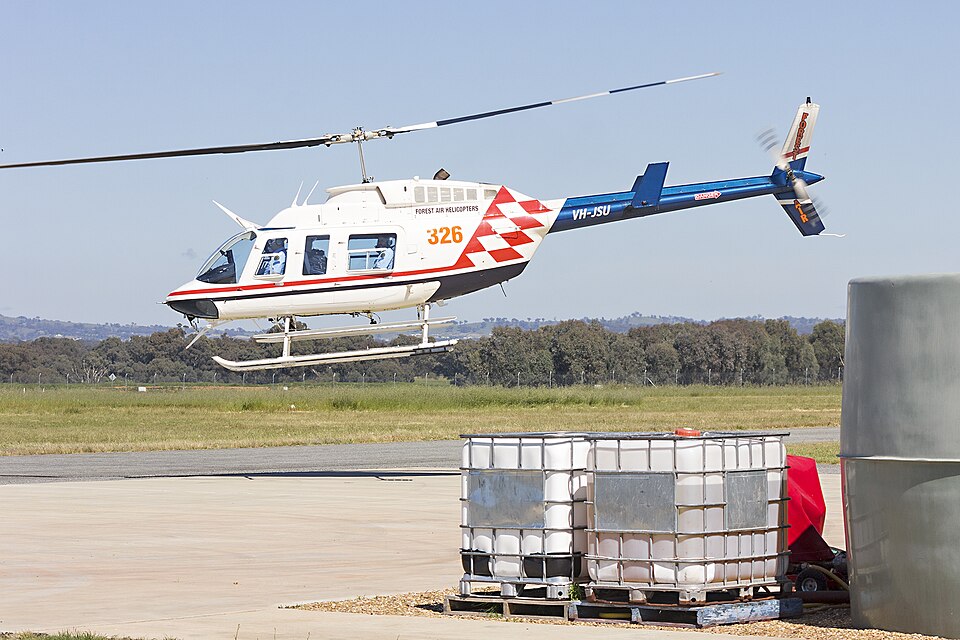
Incident Summary
On 9 December 2022, a Bell 206L-3 Longranger helicopter, registered VH-JSU and operated by Forest Air Helicopters, was conducting a low-level wildlife survey out of Deniliquin, New South Wales. While surveying above forest, the pilot heard a loud bang, after which the helicopter pitched nose up, rolled to the left, and began vibrating severely. With no immediate landing site, the pilot applied cyclic control inputs to counter the pitch and roll and flew straight for about 10 seconds, at which point the vibration effectively stopped. The pilot then flew the helicopter approximately 2 kilometres to farmland at the edge of the forest, where a precautionary landing was performed.
Investigation Findings
The Australian Transport Safety Bureau (ATSB) found that the right forward pylon support link assembly had fractured. This link assembly is part of the nodal beam transmission suspension system, designed to isolate and support the main rotor transmission and rotor, and to reduce cabin noise and vibration. The link assembly failed due to fatigue cracking that initiated as a result of unidentified degradation of the lower elastomeric bearing. The helicopter manufacturer advised the ATSB of two similar occurrences involving the same component, which led to partial control loss and resulted in a hard landing and a ditching, respectively.
Maintenance Issues
The investigation determined that degradation of the lower elastomeric bearing was likely present at the time of the most recent periodic maintenance inspection, which occurred 12 flight hours before the incident. However, the helicopter maintainer had not removed the link assemblies in accordance with the helicopter manufacturer’s maintenance manual inspection requirements, reducing the likelihood of detecting the degraded bearing. The progressive wear resulted in abnormal loading and eventual fatigue cracking.
Safety Actions
The helicopter maintainer updated its maintenance scheduling to include the requirement to remove the link assemblies for detailed examination in accordance with the maintenance manual. The ATSB also reminded maintenance personnel to ensure that all required maintenance procedures are appropriately reflected in their scheduling and to consider the potential influence of protective coatings when inspecting for elastomeric degradation.