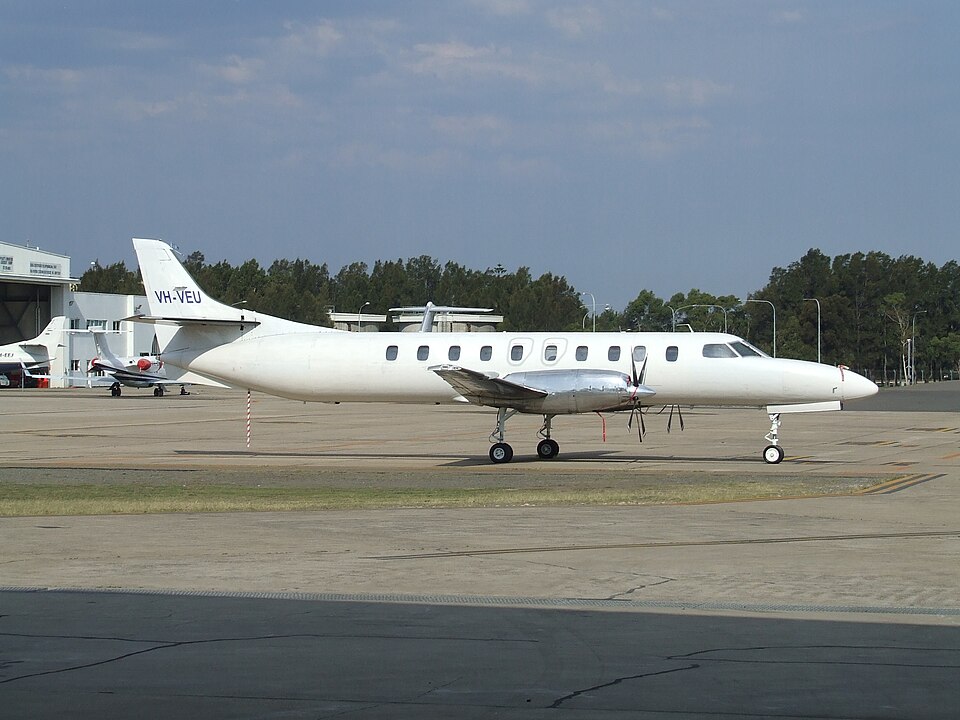
Incident
On 2 July 2024, a Fairchild Industries SA227-DC, registered VH-VEU and operated by Corporate Air, departed Cobar Regional Airport, New South Wales, for a passenger charter flight to Brisbane Airport, Queensland. During the instrument landing system (ILS) approach into Brisbane, the aircraft descended below the glideslope. Approximately 8 NM (14.8 km) from the runway, the descent triggered an air traffic control (ATC) minimum safe altitude warning (MSAW). ATC advised the crew that they were below the glideslope, but the aircraft continued descending until 3 NM (5.6 km) from the runway, when the descent rate was reduced. The aircraft then passed above the glideslope before increasing its descent rate again and re-intercepting the glideslope from above at 1 NM (1.8 km) from the runway at 500 ft. The aircraft subsequently followed a stabilised flight path to landing.
ATSB Findings
The Australian Transport Safety Bureau (ATSB) found that the pilot flying (PF) descended the aircraft below the 3° glideslope after briefing and receiving clearance for an ILS approach. The descent rate and altitude triggered the MSAW. Additionally, the pilot monitoring (PM) was not monitoring the glideslope and did not challenge the PF to correct the deviation or reduce the descent rate. The ATSB also found that the operator's standard operating procedures (SOPs) contained areas of inconsistency regarding procedures when an aircraft entered visual conditions during an instrument approach. Furthermore, the Aeronautical Information Package (AIP) was unclear whether pilots were required to comply with precision approach flight tolerances.
Actions Taken
Following the incident, Corporate Air made several changes to its SOPs. The instrument approach procedure was updated to require discussion of expectations if visual conditions arise during the approach brief. The statement that 'during a visual approach using the ILS, the glideslope calls do not need to be given' was removed. A requirement to make callouts referencing visual slope indications was added. A note was added to visual approach procedures stating that crew require a clearance to discontinue an instrument approach in controlled airspace. The operator also increased focus on pilot monitoring skills during proficiency checks, which now include standard instrument departure and arrival routes, and during line training for new flight crew. An additional pilot monitoring sector was added to the annual line check. The Civil Aviation Safety Authority advised that it will amend the AIP regarding precision approach flight tolerances to include clearer links to existing legislative requirements and the use of defined terms.
Safety Message
The ATSB safety message emphasised that effective monitoring in a multi-crew environment is paramount to aircraft safety. Bringing deviations to the attention of the PF, whether in instrument or visual conditions, ensures the aircraft remains on a safe flight path. Receiving confirmation from the PF can assist in early detection of incapacitation. When an approach has been briefed, flight crew share the same mental model of the expected flight path, and deviations can be readily identified, advised, and corrected. If the approach type changes without further briefing, both crew members are unlikely to have the same expectations, making it difficult for the PM to identify and advise the PF of deviations.