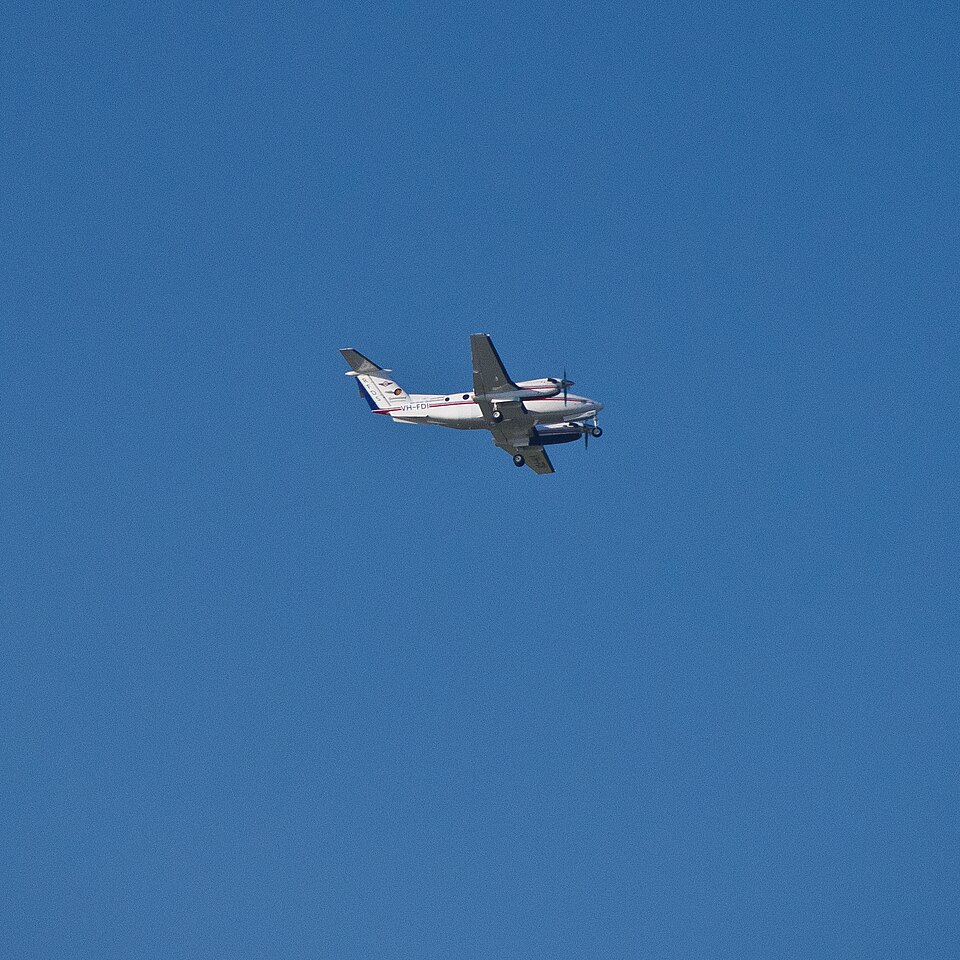
2026-02-24: Hawker Beechcraft Corporation B200C (VH-FDI) — Royal Flying Doctor Service of Australia (Queensland Section) Limited — Brisbane West Wellcamp Airport, Queensland
On February 24, 2026, a Hawker Beechcraft Corporation B200C (registration VH-FDI) operated by Royal Flying Doctor Service of Australia (Queensland Section) Limited was involved in an aviation accident near Brisbane West Wellcamp Airport, Queensland. No fatalities were reported. Investigators recorded the probable cause as: The pilot diverged from the turn pad taxi centreline guidance which positioned the aircraft in the centre of the large turn pad which aligned with the right runway edge. This summary draws on records from the Australian Transport Safety Bureau (ATSB).
Probable cause
The pilot diverged from the turn pad taxi centreline guidance which positioned the aircraft in the centre of the large turn pad which aligned with the right runway edge. While lining up on the runway at night, the pilot misidentified the runway edge lighting as the centreline and collided with an edge light during take-off.
— NTSB Determination
Accident narrative
Turn pad alignment While taxiing on the turn pad at the end of runway 12, the pilot initiated a tighter right turn than the guidance line to line up for take-off. The pilot reported that this tight turn was an accepted operational practice as no specified operational procedure was provided for turn pads. The pilot also reported that they could not recall seeing the threshold markings, or the guidance line in the dark conditions, and stated that they were not intentionally using these features to guide the turn. As they progressed through the turn, they noticed the right runway edge lights and aligned the aircraft with these.Following the turn, the aircraft was positioned in the centre of the 90 m wide turn pad with concrete visible to the right of the aircraft within the limits of the aircraft’s forward lights, which likely reinforced the pilot’s perception that they were lined up in the centre of the runway. While turn pads are both useful and necessary, they can increase the risk of misalignment at night where a wider paved area leads onto a narrower runway, as demonstrated via previous occurrences. Centreline misidentification When pilots taxi and take off during daylight conditions, they are normally presented with a wide range of visual cues by which they can navigate and verify their location. At night, however, the amount of visual information available is markedly reduced. Pilots rely more on the taxiway and runway lighting patterns presented to them and what can be seen in the field of the aircraft’s taxi and landing lights. For instance, the painted lines and markings were reportedly less prominent to the pilot, while the right edge lights were highly noticeable and the pilot anchored their orientation towards these lights, mistakenly identifying them as the runway centreline.The pilot then missed several conflicting cues to alert them of the aircraft’s misalignment. Before completing the turn, the threshold markings were not identified by the pilot. Furthermore, the pilot did not identify the left runway edge lights 45 m away from the aircraft position on the turn pad. This would have contradicted their perception that the right edge lights were centreline lights, because only 2, rather than 3, parallel lines of lights were present. Other available cues included the blue turn pad node lights spaced in a diagonal direction along the start of the right diagonal turn node edge. If perceived, the angle of the lights had the potential to alert the pilot to their alignment with the turn pad edge. Lastly, the pilot was unaware of the red precision approach path indicator (PAPI) lights visible to the right of the runway edge lights which indicated the area to the right of the aircraft was outside the runway surface.None of the above cues sufficiently alerted the pilot to their misalignment with the right runway edge, and the pilot misperceived the right runway edge lights as the centreline lighting. The pilot then started the take-off roll from the turn pad, resulting in the aircraft accelerating faster than taxi speed by the time the edge of the runway was reached.