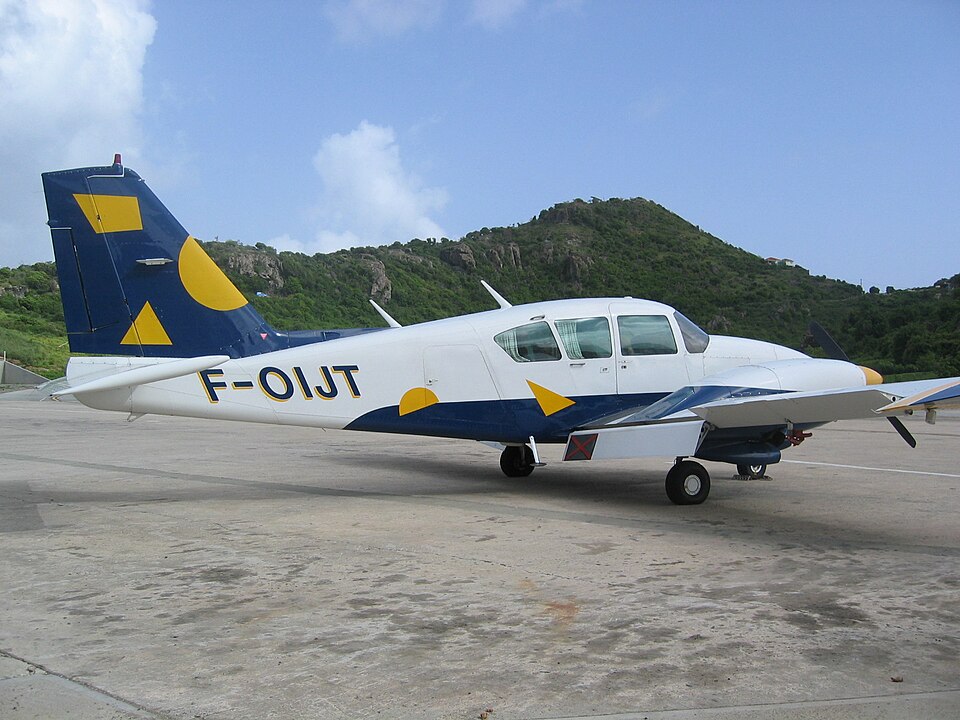
Incident Overview
On 26 June 2013, at 18:30 local time, a Piper PA-23-250 Aztec registered as F-OIJT was conducting a training flight from Pointe-à-Pitre/Le Raizet Airport in Guadeloupe. The aircraft carried an instructor, a pilot under instruction, and a passenger. The purpose of the flight was to renew a multi-engine qualification.
Sequence of Events
After performing several maneuvering exercises in the local area, the pilot conducted a touch-and-go on runway 12. During the downwind leg for the final landing, the pilot extended the landing gear and set the flaps to the approach position. The amber gear indicator light remained illuminated, and the flaps did not deploy. With the instructor's assistance, the pilot followed the emergency gear extension procedure using the manual pump lever, but it was unsuccessful. The flaps, which share the same hydraulic system, also failed to extend. The pilot then activated the emergency gear extension gas cartridge. The right main gear extended and locked, but the left main gear and nose gear extended without locking.
The instructor took control and attempted various maneuvers to lock the left main and nose gear, without success. A low pass was performed, and the air traffic controller confirmed that the gear was partially extended. During the landing on runway 12, the right main gear touched down first. The left main gear subsequently locked, indicated by a green light. The instructor held the nose high and shut down both engines by adjusting the mixture controls. During deceleration, the nose contacted the runway and slid for approximately 200 meters before the aircraft came to a stop.
Aircraft Examination
A hydraulic fluid leak was discovered in the nose gear bay, originating from a perforated aluminum line in the hydraulic circuit that feeds the nose gear actuator. The perforation was located near a clamp securing the line to the airframe. The hydraulic fluid reservoir was found empty. After refilling the reservoir, a test of the emergency manual pump revealed a leak from the perforated line. Metallurgical examination of the perforation showed the presence of iron and manganese foreign to the tube's base material, and evidence of heating to at least 600 °C. The damage was consistent with a rapid, localized heating event, such as an electrical arc during a short circuit. No anomalies were found in nearby electrical equipment (connectors, cables, or boxes).
Testimonies
The pilot and instructor reported that the gear had been cycled multiple times during the maneuvering exercises without any issues. After the failure of the manual pump and the inability to deploy the flaps, they concluded there was a hydraulic leak and that the reservoir was likely empty. The aircraft had flown earlier that day; the afternoon flight was delayed due to a mechanical issue with the left engine starter, which was resolved by maintenance. No work was performed in the battery compartment, and no recent hydraulic fluid traces were detected during that maintenance.
Conclusion
Due to the leak, the hydraulic reservoir emptied during the gear cycles performed during flight. Once empty, it was impossible to extend the flaps or landing gear, including via the emergency manual pump. The emergency gas cartridge system was only partially effective, as gas could also escape through the perforation. The investigation determined that the perforation allowed only a limited number of gear cycles. It is likely that the perforation occurred during the day's flights, given the number of gear cycles performed. The origin of the electrical arc that caused the perforation was not identified.