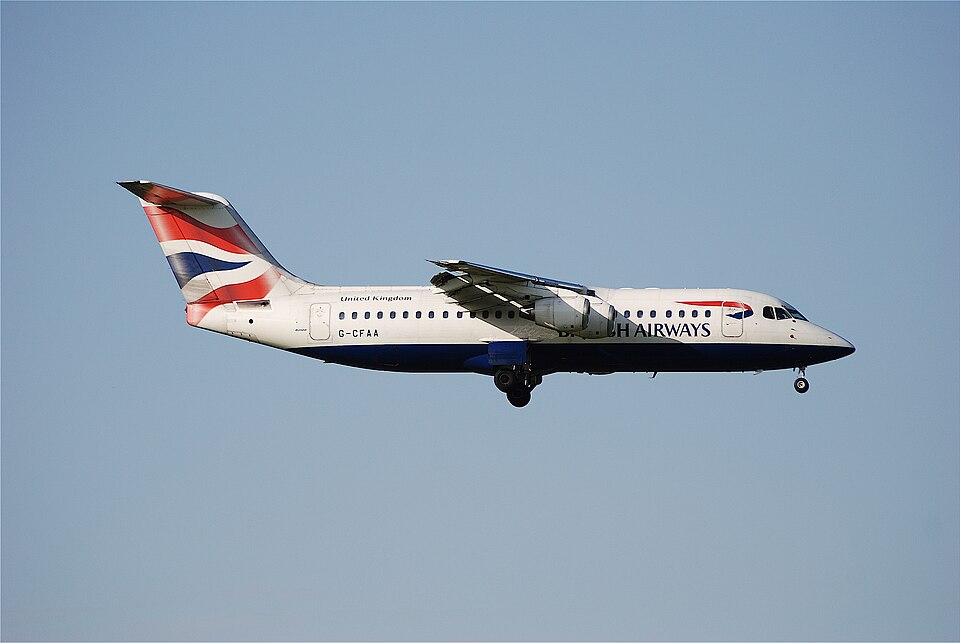
Aircraft Information
- Aircraft Type and Registration: Avro 146-RJ100, G-CFAA
- Engines: 4 Lycoming LF507-1F turbofan engines
- Year of Manufacture: 2000
- Operator: Public Transport (Passenger)
History of Flight
On 7 January 2005 at 1335 UTC, the aircraft was returning from Geneva to London City Airport. The crew obtained the Terminal Aerodrome Forecast predicting wind from 220° at 20 kt gusting 30 kt, with a 30% probability of stronger winds up to 40 kt. In light of the blustery conditions, they elected to load additional fuel. The flight progressed normally until crossing the English coast, where they received ATIS information indicating Runway 28 in use with wind from 230° at 21 kt gusting 32 kt.
The crew briefed that the co-pilot would fly the approach and the commander would take control for landing. The commander decided not to add a speed increment for gusts, citing positive windshear experienced in similar conditions on previous days. The landing weight was 35.3 tonnes, with a reference speed (Vref) of 116 kt. The co-pilot set the speed bug at 121 kt, and the aircraft was established on the glideslope from 3,000 ft in landing configuration.
At about 1,300 ft, the commander took control, disconnecting the autopilot and autothrottle. The controller reported wind from 240° at 25 kt gusting 33 kt, and a previous landing aircraft reported strong crosswinds with no negative windshear. At 500 ft, the wind was reported as 240° at 23 kt. The co-pilot noted the approach was "STABLE AS IT'S GOING TO BE TODAY." The commander began the flare at 100 ft, as per company procedures. At about 50 ft, he felt the aircraft sink slightly but decided not to apply additional thrust, citing engine acceleration time. The landing was described as firm, in the right place and at the right speed. After taxiing and shutdown, a routine walk-around inspection revealed damage to the Ground Strike Indicator (GSI), which the crew had not noticed.
Damage
The damage was confined to the GSI, a 2.3 m long aluminium strip on the tail underside. The forward 1 m section had scraping and crushing damage, but no penetration of the aircraft structure occurred. The aircraft was not equipped with a tail strike indicator in the flight deck.
Flight Recorder Analysis
Flight Data Recorder and Cockpit Voice Recorder were successfully replayed. The final descent from 3,000 ft began 3 minutes 40 seconds before touchdown. Speed during descent was 120 kt (Vref+4 kt) ±10 kt. Autothrottle was engaged until about 1,100 ft. In the last 16 seconds, at 245 ft, the aircraft was at 125 kt (Vref+9 kt) with a descent rate of 750 ft/min. Two thrust increases were recorded: one at about 150 ft from 57% to 63% N1, and another at about 85 ft from 60% to 69% N1. At about 85 ft, the airspeed decreased by 16 kt to Vref-10 kt over 3 seconds, with ground speed increasing only slightly. At 35 ft, airspeed remained at Vref-10 kt until touchdown. At touchdown, pitch attitude peaked at 6.6° and descent rate was 600 ft/min.
Ground Marks
A line of paint deposits and scrape marks, approximately 4 m long, was found about 50 cm to the right of the runway centreline, starting about 80 m from the beginning of Runway 28. The paint colour matched that of the aircraft's underside near the GSI.
Airport and Operator Information
London City Airport is built on a narrow strip between two docks, with a runway 1,199 m long and 30 m wide, and a steep 5.5° glideslope. The operator's Operations Manual described the airport as having significant obstacles and emphasized accurate speed control. Monitored approaches were required, with captains performing all landings after specific training.
Analysis
The analysis noted that the flight proceeded normally until the final approach in gusty conditions. The commander considered previous positive windshear and a report from the preceding aircraft in deciding not to add a speed increment. At about 85 ft, a thrust increase was applied, but airspeed dropped significantly, making a normal touchdown difficult.