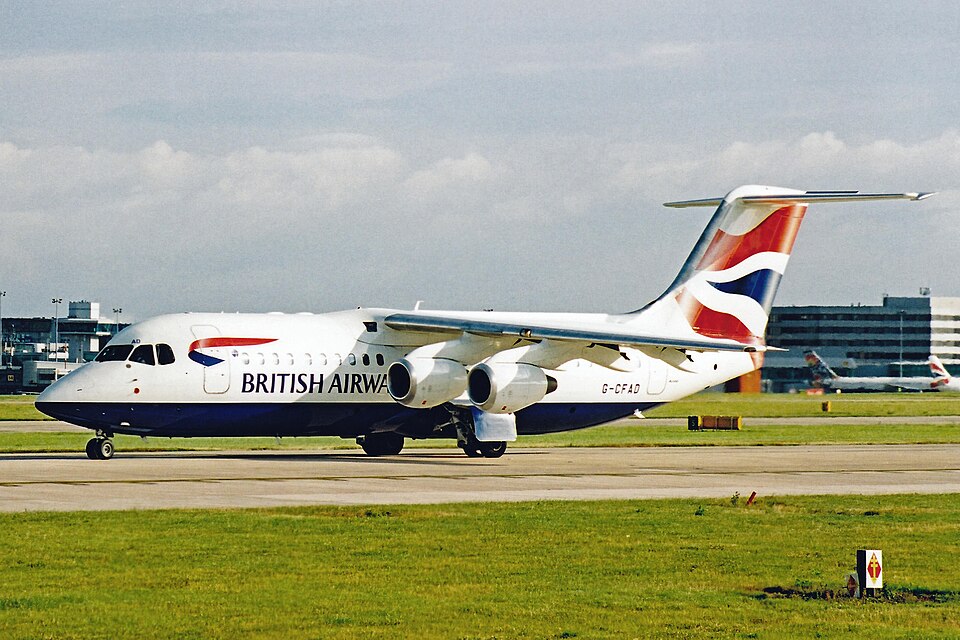
Flight History
The aircraft operated a passenger flight from Glasgow Airport to London City Airport on 26 August 2003. The co-pilot handled the approach to Runway 10, which has a 5.5° glideslope. The commander took control at approximately 800 feet above ground level and disengaged the autopilot and autothrust. At between 100 and 200 feet, the commander increased pitch as the PAPI indicated three red lights. At 100 feet, the thrust levers were moved to idle. Both pilots noted a sink, and the commander increased pitch again. The aircraft touched down, but the co-pilot observed a slightly higher than normal pitch attitude. After landing, air traffic control requested a runway inspection, which confirmed a tail strike.
Weather Conditions
The weather at the time included a light wind from 030° at 6 knots, visibility of 10 kilometres, and a broken cloud base at 4,500 feet. No turbulence or windshear was reported.
Flight Recorder Data
Flight data recorder information showed the autopilot and autothrust were disconnected at 800 feet, with an airspeed of 125 knots indicated. The aircraft remained on the glideslope until about 280 feet, when it began descending below the glidepath. The maximum deviation was 0.92 dots below the glideslope at 128 feet. At 75 feet radio altitude, the aircraft temporarily regained the glideslope at 119 knots indicated airspeed and 1.75° nose-down pitch. The flare transition lasted 5 seconds, with an average descent rate of 636 feet per minute. Half a second before touchdown, the descent rate was 480 feet per minute. Touchdown occurred at 107 knots indicated airspeed with a pitch attitude of 7.82° and normal acceleration of 1.775g.
Aircraft Damage and Runway Evidence
The rear fuselage sustained damage from frame 36 to frame 36Y, spanning 1.7 metres. The tail bumper was largely ground away, and fuselage skins showed abrasion up to 27 centimetres wide. Internal frames were locally buckled, but overall structural integrity was not immediately threatened. A scrape mark on the runway, located approximately one metre right of the centre line and 200 metres beyond the threshold, matched the damage. The mark began as a single contact and broadened to 20 centimetres over 5.3 metres, crossing a runway light, then extended a further 1.7 metres to a maximum width of 27 centimetres before fading. The strike occurred at or near initial wheel touchdown within the normal landing area.
Company Standard Operating Procedures
The operator's procedures for a steep ILS approach specified maintaining VREF33 + 5 knots plus gust factor during the glideslope descent, with landing gear, 33° flap, and airbrake extended. Speed was to be reduced to cross the threshold at VREF33 plus gust factor. A Flight Operations Bulletin on tail strikes noted that one likely cause is a flare too early or prolonged during a steep approach, leading to sink and potential over-rotation. The bulletin advised that more than 4° pitch up in a correctly executed flare is unusual.