Synopsis
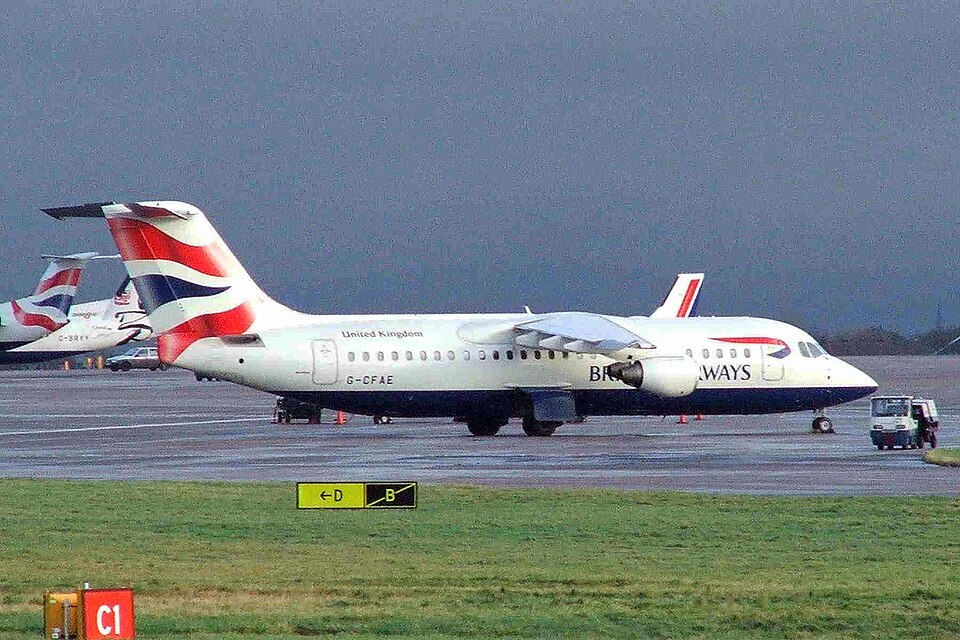
The incident occurred on 11 January 2006 at Edinburgh Airport involving Avro 146-RJ100, registration G-CFAE. The aircraft was operated on a scheduled public transport passenger flight. The Auxiliary Power Unit (APU) was unserviceable prior to departure. The incident was initiated when the procedure for engine start with the APU not available was not followed. A subsequent engine fire led to an emergency evacuation. The investigation revealed a lack of knowledge of the communications system under degraded electrical power, and the locked cockpit door contributed to a lack of effective liaison between the flight and cabin crew.
Sequence of Events
The crew, consisting of two pilots and three cabin attendants, prepared the aircraft for departure. The commander noted from the Technical Log that the APU was unserviceable and briefed the purser accordingly. With an external power unit connected and communications established with the ground handler, the crew obtained clearance to start No 4 engine and then pushback. The start was uneventful, and after selecting No 4 generator 'ON', the external power was disconnected. The pushback was normal, and the aircraft stopped abeam Stand 23. After the tug disconnected, the commander was cleared to start engines Nos 3, 2, and 1 in turn.
The commander initiated the start sequence for No 3 engine but realized he had not increased the N2 of No 4 engine to 65% as required. Almost immediately, the cockpit lights dimmed, and the ground handler reported a fire on No 4 engine. The commander could not see the engine from the cockpit and later could not recall if he had selected the No 3 fuel lever to 'ON' but was certain it was now 'OFF'. He also switched the starter master switch to 'OFF'. With another urgent call from the ground handler, the commander selected the No 4 fuel selector to 'OFF' and reached for the No 4 fire handle. The first officer already had his hand on it, and the commander instructed him to pull the handle and fire both extinguishers. The commander then transmitted a 'Mayday' call to ATC, which was acknowledged. There had been no cockpit indications of an engine fire.
Meanwhile, in the cabin, the cabin attendants were positioned for the emergency equipment demonstration. At about the time the briefing covered life jacket donning, electrical power went off, and emergency lights illuminated. After about five seconds, power returned briefly but went off again. The purser attempted to contact the commander via interphone but found no power. He tried to open the cockpit door but could not. He then saw CA No 3 approaching with passengers, saying there was a fire and they needed to evacuate.
CA No 3 had noticed a flashing light to his left and saw a passenger with a horrified look. He looked out of the right side and saw a flame stretching about 6 ft from the rear of an engine. He watched for about 1½ seconds before moving forward, hearing passengers releasing seat belts. He reported the fire to the purser, who again tried the interphone but failed. The purser then decided to evacuate. After checking the left front cabin door exterior appeared clear, he opened it; the slide deployed normally. He was reminded by CA No 3 that there was a fire on the right side, so they evacuated passengers via the left front slide only. The purser attempted to contact the rear cabin via interphone but again no power. He considered using a loudhailer but deemed it unnecessary as evacuation was proceeding efficiently.
At the rear, CA No 2 moved to her station to use the communication system, but neither interphone nor PA showed power. She then followed passengers forward, checking rows. Initially, she thought it was a precautionary rapid disembarkation but later realized it was an emergency evacuation. Many passengers were unaware of the evacuation until reaching the front. Once on the ground, passengers moved away but had no direction. The cabin attendants left immediately after the last passenger, and buses arrived to direct passengers.
In the cockpit, the commander confirmed that the Airfield Fire and Rescue Service was en route. He and the first officer confirmed the aircraft was empty before leaving. By the time they reached the ground, the AFRS was in attendance.
Operational Information
Flight crew procedures: Engine start procedures with no APU available were detailed in the company Operations Manual. They required starting all engines on stand using external AC power or starting No 4 engine on stand and then the others after pushback. If the latter method, the start master switch should be selected 'OFF' after No 4 engine start to allow the generator to come online before reselecting start master to 'ON'. Prior to starting other engines, the APU generator should be selected 'OFF' and No 4 engine N2 selected to 65% until the other engines have started.
Locked cockpit door policy: JAR-OPS 1.1255(c)(1) requires the cockpit door to be closed before engine start for take-off and locked when required by security procedures or the commander until after engine shutdown after landing, except for authorized access. The company Operations Manual required the flight crew to confirm the door was secured per security regulations.
Cabin crew procedures: The Cabin Crew SEP Operations Manual included information on evacuation initiation. It stated that unusual or abnormal occurrences must be reported to the captain. Unless there is immediate danger, cabin crew should wait 15 seconds before investigating. Emergency conditions requiring cabin crew to initiate evacuation include a self-sustaining aircraft fire, dense smoke, extreme and unusual aircraft attitude, any time passengers are in immediate danger, or unusual sounds prior to stopping. At the time of the incident, there was no information in the manual regarding the aircraft internal communications system under degraded electrical conditions. Furthermore, many personnel, including the crew of G-CFAE and some of the company's cabin crew instructors, were unaware of the system's behavior under such conditions.