Background
The Air Accidents Investigation Branch (AAIB) received reports of numerous flight control restriction events during the winter of 2004/2005 on aircraft with non-powered flying controls. A bulletin published in April 2006 documented these occurrences and made safety recommendations to the Joint Aviation Authorities (JAA) and European Aviation Safety Agency (EASA). The events were believed to have been caused by the freezing of rehydrated residues of thickened de/anti-icing fluids that had accumulated in aerodynamically quiet areas of elevator and aileron controls.
During the winter of 2005/2006, additional control restriction events were reported to the AAIB by UK operators. These involved Avro 146/RJ and Embraer 145 aircraft.
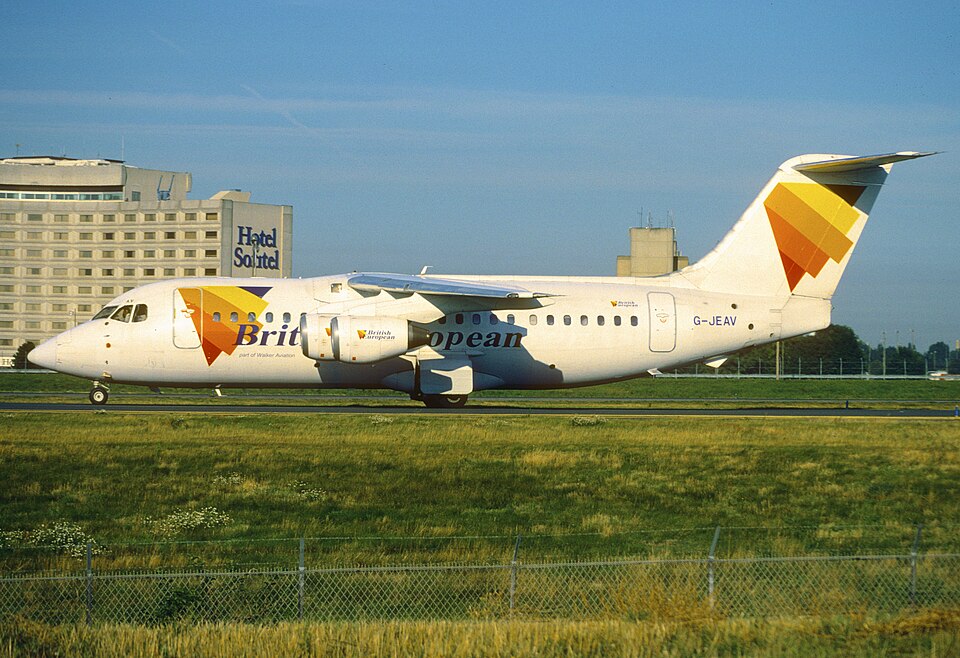
Incident Description (G-JEAV, 17 January 2006)
On 17 January 2006 at 1600 UTC, an Avro 146-RJ100 (registration G-JEAV) was operating a public transport passenger flight between Southampton and Manchester. The aircraft had five crew and 37 passengers on board; no injuries were reported and no damage occurred.
During cruise at Flight Level 270 (FL270), the aircraft was sluggish during an autopilot-controlled turn and failed to roll level out of the turn. The 'AIL' warning caption appeared. Upon disconnecting the autopilot, the aileron controls were very stiff and resistant to movement, but the aircraft remained controllable. The flight continued to its destination, and aileron controls became normal as conditions warmed. The takeoff and climb to FL150 had been in wet conditions.
Findings from Inspections
Following the incident, G-JEAV was removed from service for investigation. When elevator trim rod fairings were removed, significant accumulations of residues of thickened de/anti-icing fluid were found. In response, the aircraft manufacturer issued All Operator Message 06/001V. The operator of G-JEAV instigated a fleet-wide check to remove trim tab fairings and inspect for and remove accumulations of fluid residues.
Similar findings were reported for other Avro 146/RJ aircraft in the fleet. For example, on G-JEAJ after a flight on 8 January 2006, significant quantities of de/anti-icing fluid residues were found under elevator trim tab control rod fairings. On G-JEAV itself, following an earlier event on 8 January 2006, 'significant' quantities of residues were found during an inspection at Southampton, with elevator trim tab control rods coated with fluid residues.
Other Control Restriction Events
The AAIB bulletin also detailed several other incidents during winter 2005/2006. For instance, on 20 January 2006, G-JEAV experienced stiff aileron controls during cruise at FL270; aileron stiffness disappeared when descending through FL100. On 15 February 2006, G-JEAV reported an elevator trim oscillation and 'ELEV TRIM' caption; strong resistance was felt when attempting to move the trim wheel, with controls returning to normal at around FL130. Similar events involved G-JEAJ, G-JEAY, G-MANS, G-CFAA, and G-OZRH, as well as Embraer 145 aircraft G-EMBF and G-EMBK.
Embraer 145 events included a pitch oscillation shortly after establishing cruise at FL200, where the control column became immovable fore and aft, requiring use of pitch trim for control during a PAN descent. Inspections on Embraer 145 aircraft found re-hydrated anti-icing fluid in gaps between the stabiliser and elevator control surfaces, leading to increased inspection frequency.
AAIB Concerns
The AAIB repeatedly expressed concerns to the UK Civil Aviation Authority (CAA), JAA, and EASA that effective measures to address the airworthiness concerns posed by residues of thickened de/anti-icing fluid had yet to be implemented.