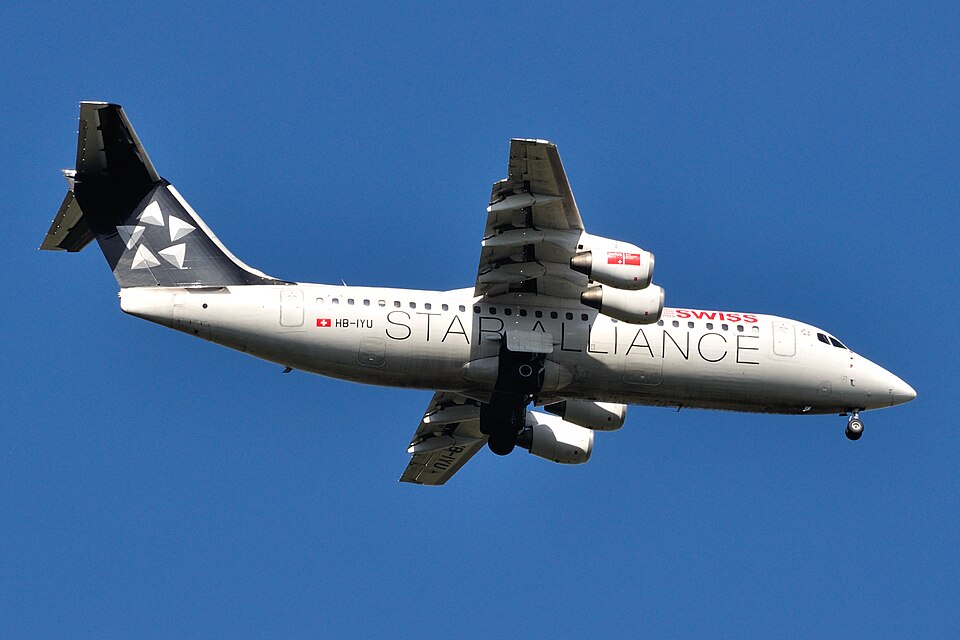
Accident Overview
On 18 August 2007 at 0940 UTC, an Avro RJ100, registration HB-IYU, sustained significant structural damage to its lower rear fuselage after the aft fuselage contacted Runway 28 at London City Airport during landing. The aircraft was operating a scheduled commercial passenger flight from Zurich to London City. On board were 5 crew and 88 passengers; none were injured. The commander, aged 47, held an Airline Transport Pilot’s Licence and had over 9,000 flying hours, including 1,340 hours on type.
Approach and Landing
The commander was the pilot flying, as required by the operator for landings at London City. The approach was an ILS procedure with a 5.5° glidepath. The aircraft was fully configured with landing gear down, 33° of flap, and the airbrake deployed. The autopilot was disconnected at 1,300 ft. The last reported surface wind from the tower was 190° at 10 kt.
During the final descent, the crew observed that the PAPIs indicated a slightly high position, which they corrected. The EGPWS issued "minimums" and "fifty" callouts. As the radio altitude passed between 50 and 30 ft, the pilots sensed a sudden drop. The commander pulled the control column back, and the aircraft’s pitch attitude increased to a maximum of 9.3° nose-up. The lower aft fuselage briefly contacted the runway, producing scrape marks approximately 11 m long. The aircraft then landed on the main wheels. Neither the flight crew nor the cabin crew were initially aware that a tailstrike had occurred, although the rear cabin attendant reported a loud noise on touchdown.
Aircraft and Aerodrome Information
The Avro RJ100 (BAE 146 variant) was first certified for operations at London City Airport in 1995. For the 5.5° glidepath, the pitch-limiting attitude is 7°, and the body angle clearance at landing is approximately 7°. The aircraft’s calculated landing mass was 37.8 tonnes, with a VREF of 119 kt for flap 33°. The required landing distance from a steep approach was 640 m, and the runway length available from Runway 28 was 1,319 m.
The airport has a single concrete runway (10/28) 1,508 m long. The ILS glidepath is 5.5°, and PAPIs are set to the same angle. Two white high-intensity lights mark the end of the touchdown zone at 336 m from the threshold. Due to the built-up area, building-induced turbulence is possible in unstable meteorological conditions; no windshear detection system is installed.
Meteorological Conditions
A meteorological aftercast indicated a low pressure area over Northern Ireland producing a fresh to strong south-westerly flow across southern England. The airmass was unstable with convective cloud layers between 1,800 and 2,500 ft. An AMDAR-equipped aircraft departing Heathrow at 0939 recorded a wind profile showing a reduction of wind strength from 11 kt at the surface to 5 kt at 300 ft, then increasing again at 600 ft, indicating possible mechanical and convective turbulence. The ATIS at 0936 reported surface wind from 190° at 11 kt. No landings occurred at London City for 50 minutes before the accident. A landing 20 minutes later reported a more turbulent approach than expected.
Flight Data and Cockpit Voice Recorder Analysis
The FDR and CVR captured the event. The aircraft took off from Zurich at 0822 hrs and cruised at FL280. During descent, a senior cabin crew member joined the cockpit. The final descent from 3,000 ft was initiated at glideslope capture. Airspeed varied between 117 and 128 KCAS. At 1,300 ft, the autopilot was switched off, and the non-handling pilot called out airspeed relative to VREF: +7, +3, +1, +3, and +4 kt.
Between 50 and 30 ft radio height, the power levers were retarded. The descent rate was approximately 900 ft/min and reducing. The FDR did not show a sudden altitude drop, though sample rate may limit detection of short events. The aircraft’s nose-down pitch was being levelled, then large elevator inputs produced a nose-up pitch rate of 4.5°/sec. A left roll to 5° was recorded before the left main gear weight-on-wheels sensor activated, and the roll direction reversed. At touchdown, normal acceleration reached 2.3g. The pitch then reversed to 10°/sec nose-down, and the nose gear contacted the runway 1 second later.
Damage Assessment
Inspection by the manufacturer and the AAIB revealed significant structural damage to the lower fuselage in the aft cargo hold area between frames 35 to 43 and stringers 27 port to 27 starboard. Scrape marks ran along the lower fuselage for approximately 3.9 m, aligned 4° left of the aircraft centreline. The composite fairing around the rear galley drain pipe was damaged, the pipe distorted, the tailscrape indicator mostly worn away, and skin panels abraded and distorted. A fore-aft crack existed outboard of stringer 34 port. Runway scrape marks indicated first contact by the drain pipe (5 m) followed by lower fuselage (11 m).