History of the Flight
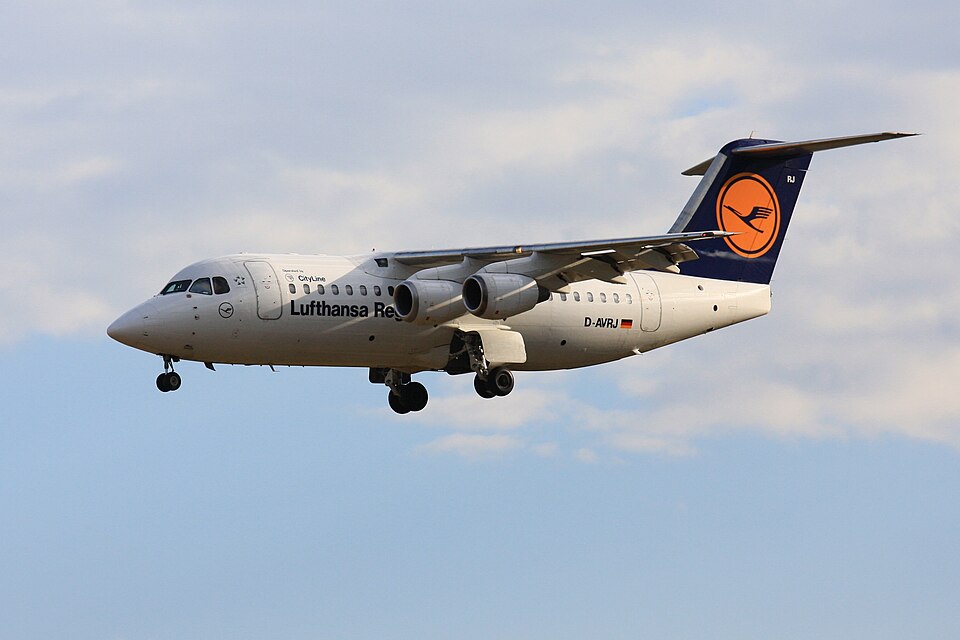
On 21 April 2008 at 0650 UTC, an Avro RJ85 (registration D-AVRJ) was parked on Stand 10 at London City Airport, with an Avro RJ100 (registration G-BZAT) parked on the adjacent Stand 11 to its left. Both aircraft are derivatives of the BAe 146 series, with a wingspan of 26 m. D-AVRJ had arrived from Munich and parked under marshaller guidance. During turnaround, passengers boarded and engines started. The commander noted to his co-pilot that the RJ100 appeared closer than normal and asked the marshaller to monitor wingtip clearance during taxi.
The aircraft initially had a heading of 338°(M). The commander intended to turn right then left towards Holding Point Alpha. He taxied forward slowly, but shortly after beginning a right turn, the marshaller gave a stop signal. The aircraft stopped on a heading of 013°(M). The marshaller connected his headset and advised that left wingtip clearance to the RJ100 was insufficient.
It was decided to push back D-AVRJ using a tug to gain wingtip clearance. After pushback, the heading became 018°(M). The commander then taxied forward again, turning right under marshaller guidance. Another staff member monitored the left wingtip. Shortly after, the marshaller gave another stop signal. During the right turn, the left horizontal stabiliser of D-AVRJ had moved left, passed under, and contacted the right horizontal stabiliser of the RJ100, scoring the RJ100's right elevator. The final heading was 039°(M).
The commander shut down the engines and kept passengers on board to maintain weight and prevent further damage from oleo extension. Additional ballast was placed, and the RJ100's nosewheel tyres were deflated to provide vertical clearance for separation. The passengers then disembarked.
Analysis
Both aircraft were parked on adjacent stands. The RJ100 on Stand 11 was 1 m to the right of its stand centreline, parallel to it, reducing clearance from D-AVRJ on Stand 10 by that amount. D-AVRJ was initially on its stand centreline. The initial taxi stop at 013°(M) and subsequent pushback to 018°(M) increased wingtip clearance but reduced tail clearance, unnoticed.
As D-AVRJ taxied forward and turned right, its tail moved left, further reducing tail clearance until contact occurred. CAA guidance in CAP 168 recommends minimum clearance of 20% of wingspan between manoeuvring aircraft and obstructions; for 26 m wingspan, that is about 5 m. With an aircraft on Stand 11, clearance between similar-sized aircraft was reduced below this. The airport operator had required a person to monitor wingtip clearance but not tail clearance; thus the tail hazard was unidentified.
Conclusion
The collision occurred due to a combination of the RJ100 on Stand 11 being parked 1 m to the right of its stand centreline, D-AVRJ on Stand 10 being pushed back onto a heading which further reduced the tail clearance, and the limited clearance between aircraft of this size when using these stands. The absence of a person monitoring the tail area meant that the inadequate tail clearance was not identified prior to the collision.
Safety Actions
Following the incident, the airport operator introduced three safety actions to address tail-to-tail contact: (1) When a 146/135 aircraft is on Stand 11, ground staff must provide wingtip and tail fin monitoring during taxi off Stand 10; if the aircraft on Stand 10 is misaligned, towing off is considered. (2) If towing, the marshaller must re-establish headset communication with the cockpit, and all ground staff observing wingtips/tail fin should wear headsets for direct communication. (3) Operations will consider which aircraft types are parked on Stand 10.