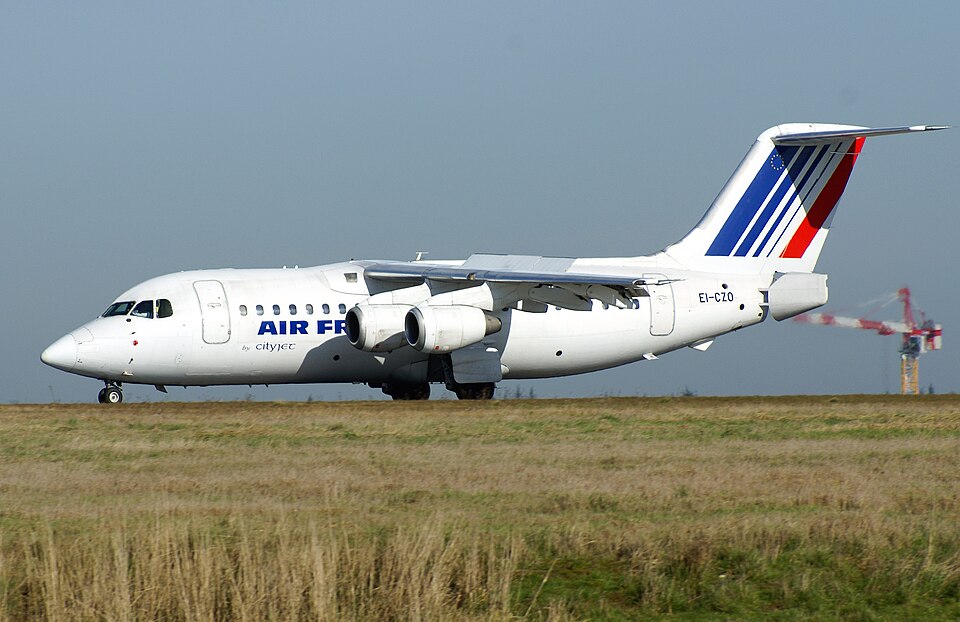
Incident Overview
On 20 February 2007, at 0833 UTC, a BAe 146-200, registration EI-CZO, operated a commercial passenger flight from Paris Orly Airport to London City Airport (LCY). The aircraft came to rest in the paved undershoot area of Runway 28 after landing on Runway 10, having burst all four main landing gear tyres. There were no injuries to the 5 crew or 55 passengers.
Flight Details
The aircraft, manufactured in 1984, was powered by four Lycoming ALF502R-5 turbofan engines. The commander, aged 33, held an Airline Transport Pilot's Licence and had 4,750 flying hours, including 470 on type. The weather at LCY was benign: surface wind from 170° at 5 kt, visibility 10 km or more, and a damp runway. The landing weight was approximately 32.0 tonnes, with a Vref of 110 kt considered appropriate; however, the landing data card prepared prior to the approach showed a Vref of 119 kt.
Landing and Spoiler Non-Deployment
During the ILS approach to Runway 10 (5.5° glide slope), the latter part was flown at approximately 124 kt. Touchdown occurred immediately before the end of the touchdown zone, some 330 metres beyond the Runway 10 threshold, at 119 ± 2 kt in a level pitch attitude. Flight data recorder analysis showed that the lift spoilers did not deploy after touchdown. The aircraft was likely close to 'wheel-barrowing' during the early landing roll due to the lack of spoilers, with the main landing gear compressed just enough to activate the weight-on-wheels switches.
Brake System Selection and Outcome
The commander, who was pilot flying, selected engines to ground idle and recalled moving the airbrake/lift spoiler lever to LIFT SPOILERS. He pressed the brake pedals fully but perceived no deceleration, calling "brakes, brakes". Believing the Green hydraulic system brakes had failed, he selected the Yellow hydraulic brake system, then the Emergency Yellow system, which provides no anti-skid protection. The aircraft decelerated slowly and came to rest in the undershoot area of Runway 28, 161 metres short of the dock edge. Skid marks from the four main wheel tyres extended 473 metres. The aerodrome fire service arrived; there was no fire, and passengers disembarked normally.
Engineering Examination
An exhaustive investigation found no malfunction in any relevant system. The aircraft was returned to service after replacing the wheels and tyres. A friction test of the airbrake/lift spoiler lever showed that moving the lever through the detent to lift-spoiler required 14 lb force, while moving it back required zero force; both within maintenance manual limits. A service bulletin (SB 27-73-00889) issued in March 1988 amended the lever's force characteristics to require 12 lb to move from lift-spoiler to airbrake, but this bulletin was not mandatory and EI-CZO had not been modified.
Safety Action
In light of several similar overrun events involving BAe146 aircraft since its introduction, the Chief Inspector of Air Accidents ordered an Inspectors Investigation into this incident.