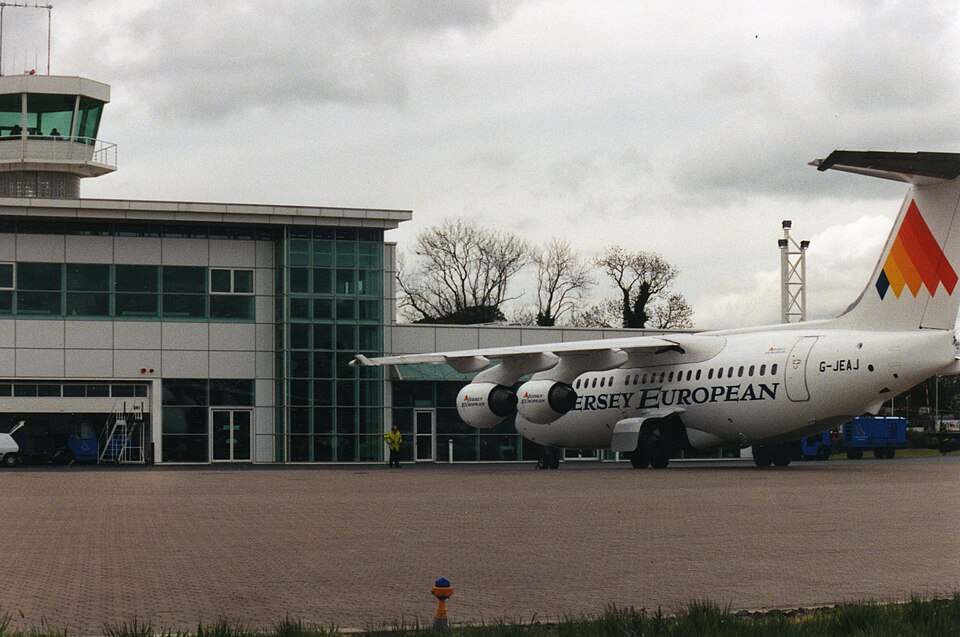
History of the Flight
The aircraft was conducting a public transport flight from Edinburgh to London City Airport. Radar vectors were provided for an approach to Runway 10. Per company policy, the commander, who held an Airline Transport Pilot's Licence and had 3,217 hours total experience with 2,011 on type, was the handling pilot. The reported weather included surface wind from 140° at 8 knots, variable between 100° and 180°, CAVOK, temperature 22°C, dew point 9°C, and QNH 1013 mb.
The approach was flown with the autopilot coupled, stabilized at 119 knots (Vref plus 5 knots) with speed brakes deployed. The autopilot was disengaged at 1,700 feet radio altimeter. The commander used the runway's Visual Approach Slope Indicators for visual guidance, cross-checking with the ILS presentation, and the first officer monitored. After completing approach checks, the aircraft flared at approximately 100 feet. At this point, an abnormally high sink rate developed that could not be arrested, and the aircraft made a heavy landing on the runway numbers, short of the usual touchdown zone.
The aircraft bounced, and the first officer called for a go-around. However, the commander determined that the aircraft would land before the end of the touchdown zone and elected to continue. The second touchdown was also heavy, and the lift spoilers were selected, but only the green hydraulic system spoilers deployed. The first officer informed the commander and called for maximum braking, which was initially applied and then reduced when a normal rollout was assured. The aircraft stopped within the available landing distance.
Neither air traffic control nor the crew were aware of any damage, and the aircraft taxied to its parking stand. Following the heavy landing, the commander and an engineer inspected the tail area and found damage to the underside.
Examination of Aircraft
An inspection of the runway 24 hours later did not reveal any scrape marks, but rainfall had occurred in the interim. The aircraft's rear fuselage underside showed a light scrape measuring 1.57 meters long and approximately 0.27 meters wide. The damage extended from just ahead of Frame 37 to the forward face of Frame 39. Frame 37 is near the aft edge of the left baggage door, and the rear pressure bulkhead joins the fuselage skin at Frame 45. Additionally, a light strike was found on the tail bumper, which is attached to the air conditioning equipment bay door aft of the rear pressure bulkhead.
The skin suffered light abrasion and loss of paint but was not penetrated. Some dimpling occurred in areas between stringers and frames in the center of the panel. After removing floor panels in the baggage area, the dimpled skin was inspected; no cracking was found, and frames and stringers were undamaged. A subsequent inspection at the operator's maintenance base confirmed no additional damage. The aircraft returned to service after replacement of the affected skin panel.
Conclusion
The commander's assessment was that he may have retarded the throttles slightly early during the flare, and that the high sink rate probably resulted from a downdraft from nearby buildings or variable wind direction. He recalled applying some power, but it was insufficient to stop the sink rate. This led to an early touchdown in a nose-high attitude, causing the fuselage to scrape the ground.