History of the Flight
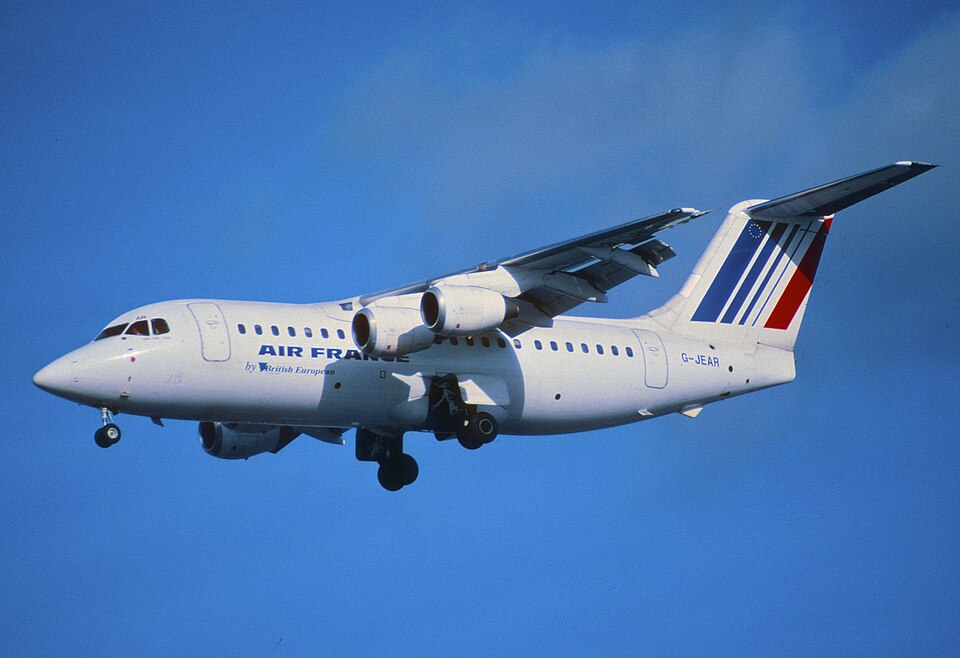
The aircraft, operating a scheduled service from Lyon to London Heathrow, began its takeoff run with all engine indications normal. During rotation, a loud noise was heard and the No 3 engine failed. The flight crew took appropriate actions and returned to land at Lyon without further incident.
Initial Inspection
Initial inspection of the No 3 engine showed all stage 4 turbine blades had separated at or near their root ends. Fragments had penetrated the jet pipe and fan-stream duct, and there was slight damage to the pylon rear underside cover. With permission from the French BEA, the fan was locked and the aircraft ferried to the UK operator's maintenance base for investigation.
Detailed Examination
At the operator's base, further examination confirmed the stage 4 turbine blade failures and revealed severe distortion of the jet pipe and its attachment flange shield. The engine was removed and examined at the operator's facility, then at the manufacturer's overhaul facilities in the UK and USA.
During strip inspection, all stage 4 turbine blades had failed near their roots. Stage 4 nozzle guide vanes (NGVs) were badly damaged by debris impact. Stage 3 turbine blades were also damaged; four consecutive blades had failed close to their roots. The LP shaft showed rubbing abrasion marks near the stage 3 turbine disc. The HP shaft had failed at a position coincident with the LP shaft abrasion area, with evidence of severe overheating from rotational contact.
Metallurgical Examination
Metallurgical examination of the failed stage 3 turbine blades revealed that the longest root end exhibited a fatigue fracture initiated just behind the leading edge on the concave face. The crack propagated until overload failure. Examination of tip platforms (shrouds) of unbroken stage 3 blades showed wear on contact faces and absence of a hard face coating recommended by Service Bulletin ALF502R 72-279.
Service Bulletin ALF502R 72-279
Service experience had shown that excessive wear of stage 3 turbine tip platform contact faces could allow blades to vibrate and develop fatigue cracking. The manufacturer introduced a hard surface coating via SB ALF502R 72-279 in October 1991, recommending compliance when blades or turbine assemblies were returned to service centres. However, it was permissible to continue using unmodified blades if tip platform wear was within limits at overhaul. The bulletin stated the reason as 'To provide greater wear resistance and longer service life' but did not mention the potential for fatigue cracking or serious secondary damage.
Summary
The fatigue failure of one stage 3 LP turbine blade caused secondary failure of three adjacent stage 3 blades, then all stage 4 LP turbine blades. The resulting LP turbine imbalance caused the LP shaft to bow and contact the HP shaft, leading to HP shaft separation. The most probable reason for fatigue initiation was larger than permitted clearances between stage 3 turbine tip platforms, allowing excessive vibration. The platform wear was a consequence of the engine returning to service in September 1997 after overhaul without embodying SB ALF502R 72-279. No record of clearance measurements was found, but the platforms appear to have worn excessively within less than half the overhaul period.