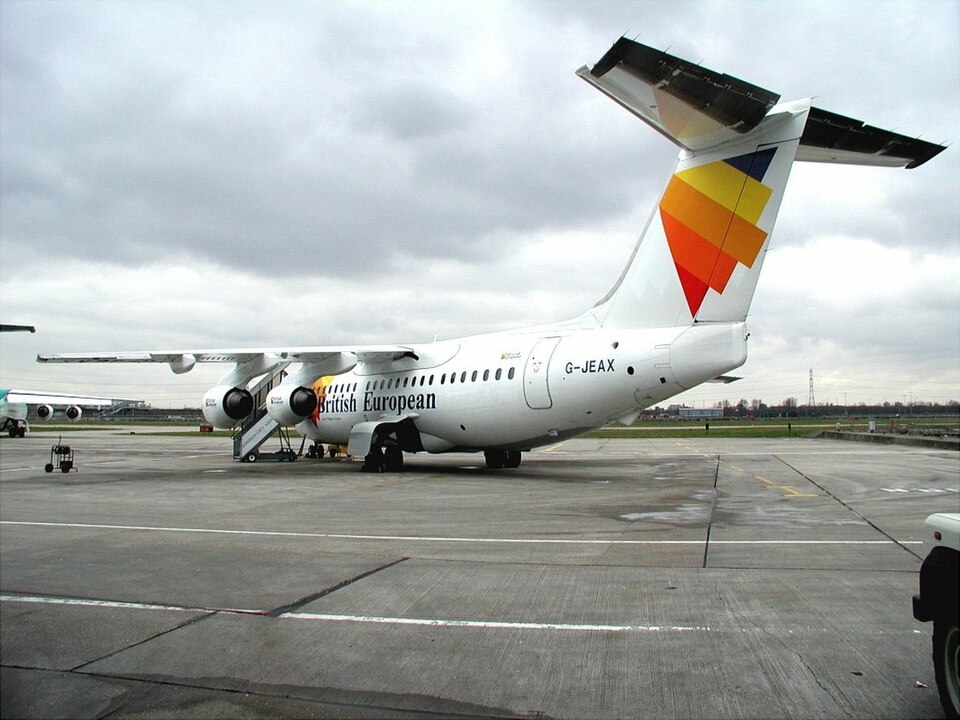
Synopsis
On 12 December 2002, a BAe 146-200, registration G-JEAX, was operating a scheduled passenger flight from Birmingham to Belfast City. During the climb, the aircraft exhibited unusual pitch hunting with the autopilot engaged. After disengaging the autopilot, the aircraft pitched up and required heavy forward control forces. Application of nose-down trim caused a rapid pitch-down. Both pilots then pulled back with considerable force, and the controls suddenly freed, resulting in a rapid pitch-up and a large vertical acceleration excursion. This injured two cabin crew seriously and one cabin crew and one passenger minor.
History of the Flight
The aircraft had been parked overnight at Belfast City and was treated with anti-icing fluid at 0200 hrs. The first three sectors of the day were uneventful. At Birmingham, the aircraft remained on stand for 55 minutes while rain, sleet, and snow fell. The crew decided against de-icing as precipitation was not settling. Before takeoff, the control column was held fully back for about 25 seconds per company procedure to drain water from the elevator. The aircraft departed at 1252 hrs. The commander flew manually to 3,000 ft then engaged the autopilot. Anti-icing systems were used as clouds were encountered. The crew noted pitch oscillations more pronounced than usual. The autopilot was disengaged and re-engaged several times. Approaching FL240, the aircraft did not level off; it pitched nose-up. The commander disengaged the autopilot and felt a strong pitch-up tendency. He applied forward pressure and electric trim. The aircraft then pitched down markedly. Both pilots pulled back with considerable force; the controls suddenly moved aft, causing a violent shudder. After this, control forces returned to normal and the aircraft was leveled at FL240. A PAN call was made, and the aircraft landed at Belfast City without further incident.
Pitch Control System
The BAe 146-200 has manually operated elevators with mechanical controls. Control column inputs move servo tabs that provide aerodynamic force to move the elevators. Torsion bars limit tab forces; if enough force is applied, the columns move the elevators directly with higher forces. A mechanical feel system prevents excessive deflection. The control columns are interconnected and can be disconnected in case of a jam. Elevators, servo tabs, and trim tabs have drain holes. Gaps between surfaces are small (approximately 5 mm).
Meteorological Conditions
At 1200 hrs, high pressure over Norway with light south-easterly flow over the route. Frontal systems over southern UK produced rain and snow over the Midlands, falling from multiple cloud layers. The UK Low Level Forecast warned of severe icing in freezing rain and moderate icing in cloud. METARs for Birmingham between 1150Z and 1250Z indicated light rain and snow, reduced visibility, and temperatures around 0°C.
Investigation and Probable Cause
The investigation determined that the accident was probably caused by icing of the elevator servo tabs, coupled with the crew's response to the situation for which they had not been trained. The report also noted previous occurrences of suspected servo tab icing on the BAe 146/RJ series and made safety recommendations for maintenance and emergency procedures.